error
Subscriptions are not available for this site while you are logged into your current account.
close
Skip to main content

      On 27 March 2024, the Financial Reporting Council (FRC) issued Amendments to FRS 102 The Financial Reporting Standard Applicable in the UK and Republic of Ireland and other FRSs – Periodic Review 2024, as part of its second periodic review of the financial reporting standards.

      The majority of these amendments will take effect for accounting periods beginning on or after 1 January 2026*, with early adoption permitted.

      These amendments aim to enhance consistency and alignment with International Financial Reporting Standards (“IFRS”) including:

      • Introduction of a new revenue recognition model, aligned with IFRS 15: Revenue from Contracts with Customers, incorporating certain simplifications;
      • Implementation of on-balance sheet lease accounting for lessees, aligned to IFRS 16: Leases, but allowing specified practical exemptions; and
      • Various other revisions affecting fair value measurement, uncertain tax positions, business combinations, and an updated Section 2, aligned with the IASB’s Conceptual Framework.

      *Amendments to supplier finance arrangements were effective for periods beginning on or after 1 January 2025.



      Download our report

      Upcoming changes to FRS 102

      (PDF, 1.6MB)
      These are arguably the most significant changes to take effect since FRS 102 was introduced more than 10 years ago. These amendments aim to enhance the consistency and alignment of FRS 102 with IFRS, with revenue and lease accounting most notably impacted.
      Eamon Dillon
      Eamon Dillon

      Partner

      Accounting Advisory


      Key focus areas

      • Revenue recognition
        • Based on IFRS 15 Revenue from Contracts with Customers: Five-step revenue recognition model.
        • Entities will need to review revenue contracts and apply the five-step model potentially impacting the timing of revenue recognition. 
        • In particular, entities will need to consider the treatment for contracts that have bundles of goods/services, variable consideration, warranties, customer options, or significant financing components.
        • Key simplifications from IFRS 15:
          • Accounting policy choice in respect of the capitalisation of costs to obtain a contract.
          • Significant financing components: adjusting for the time value of money on payments received in advance is optional.
          • May apply the five-step model to a portfolio of similar contracts.
      • Transition
        • Choice of Retrospective; or
        • Modified retrospective; where there is no restatement of comparatives, with the required adjustments recognised directly in equity on the date of initial application
      • Leases
        • Based on IFRS 16 Leases: on-balance sheet lease accounting for lessees; as a right of use (ROU) asset and lease liability.
        • Lease expenses now presented as depreciation and interest; impacting EBITDA and key metrics.
        • Exemptions available for short-term leases and leases of low-value assets.
        • While not an exhaustive list, the key simplifications from IFRS 16 include:
          • Low value assets: provides guidance on what may be a low value asset and examples of which assets cannot be a low value asset.
          • Discount rates: additional option available of using an obtainable borrowing rate.
          • Sale and lease back arrangements: Under FRS 102 (where it’s a sale) accounting policy choice available in measuring the ROU asset.
          • Lease modifications: Under FRS 102 (where not a separate lease), in certain circumstances, can use original discount rate.
      • Transition
        • No restatement of comparatives required.
        • Permitted to use carrying amounts for group reporting under IFRS 16 as opening balances.
        • If not applying the group exemption, asset recognised is equal to liability on transition. Any cumulative effect of initially applying the standard is recorded as an adjustment to opening retained earnings.


      Other areas of focus

      While not an exhaustive list, other changes to FRS102 include:

      • Financial instruments

        Entities not already applying IAS 39 recognition and measurement principles for financial instruments can no longer adopt such policies under Section 11 and 12 of FRS 102, subject to paragraph B11.5A.

      • Supplier financing

        Section 7 of FRS 102 will now require additional disclosures about supplier finance arrangements and their impact on the balance sheet and cash flows.

      • Fair value measurements

        A new Section 2A (Fair Value Measurement) replaces the Appendix to Section 2 of FRS 102, incorporating the principles of IFRS 13 Fair value measurement.

      • Going concern disclosures

        Section 3 of FRS 102 has new requirements for management to affirm consideration of future information and to disclose significant judgments on going concern.

      • Business combinations

        Section 19 of FRS 102 has been updated to include guidance on the identification of an acquirer in a business combination similar to the principles of IFRS 3 Business combinations.

      • Share based payments

        Section 26 of FRS 102 includes enhanced guidance on accounting for vesting conditions, fair value determination and share based payments with cash alternatives.

      • Uncertain tax treatments

        Section 29 of FRS 102 includes guidance for uncertain tax treatments, which aligns with the principles of IFRIC 23 Uncertainty over Income Tax Treatments.

      The above does not cover all amendments, such as concepts and pervasive principles, accounting policies and estimates, investment property, employee benefits and a host of incremental improvements


      While the key areas of focus for most entities to date have been on the impact to revenue recognition and lease accounting, there are a number of other amendments which should not be overlooked and should be factored into your impact assessments.
      Kelly Campbell

      Kelly Campbell

      Director

      Accounting Advisory


      Think about the broader impact of these changes

      These changes aren’t just limited to statutory accounts preparation. Finance teams should consider the broader financial impacts:


      Entities will need to consider the impact of these accounting changes on any of their existing financial covenant arrangements. For example, bringing operating leases onto the balance sheet could increase reported liabilities, potentially affecting debt-to-equity ratios and risking breaches of loan covenants under metrics agreed under the previous accounting standards. Understanding how these changes will impact on your business and communicating these impacts to your lenders in a clear and timely manner is key.

      Entities will need to consider the impact of these accounting changes on any of their existing remuneration arrangements with senior management. For example, changes to revenue recognition timing could impact performance-based bonuses or share-based payments tied to revenue or profit targets. Additionally, changes to lease accounting could result in a boost in reported EBITDA, which could impact on performance-based bonuses or share-based payments tied to EBITDA targets. Understanding how these changes will impact on your business and communicating these impacts to your senior management team in a clear and timely manner is key.

      Profit margins, EBITDA, and asset turnover ratios may be distorted by revised lease expenses and revenue timing, affecting performance analysis and comparisons over time. For example EBITDA in the past would have included an operating lease expense. This expense will now be replaced by interest and depreciation. As a result EBITDA will be boosted, since, by definition, EBITDA does not include depreciation and interest. In terms of ratios, gearing increases, while interest cover, asset turnover and current ratios may decrease.

      The inclusion of lease liabilities and right-of-use assets may push companies over statutory thresholds for audit requirements or reporting exemptions. Understanding early in the process whether these changes will result in your company moving into a new band, is important to manage any revised expectations with respect to audit and reporting requirements.

      Fluctuations in financial metrics due to accounting changes may affect investor confidence or stakeholder decisions, especially in periods of transition. Clear and timely communication on the impact of these changes are key.


      These changes aren’t just limited to statutory accounts preparation. Finance teams need to consider the broader commercial implications. You should be considering the wider impacts of these changes on your financial covenants, remuneration arrangements, KPIs, systems and processes and company size thresholds to name a few. Communication needs to be clear, accurate and timely to your key stakeholders of the impacts of these changes on your business.
      Robert-Molloy

      Robert Molloy

      Director

      Accounting Advisory


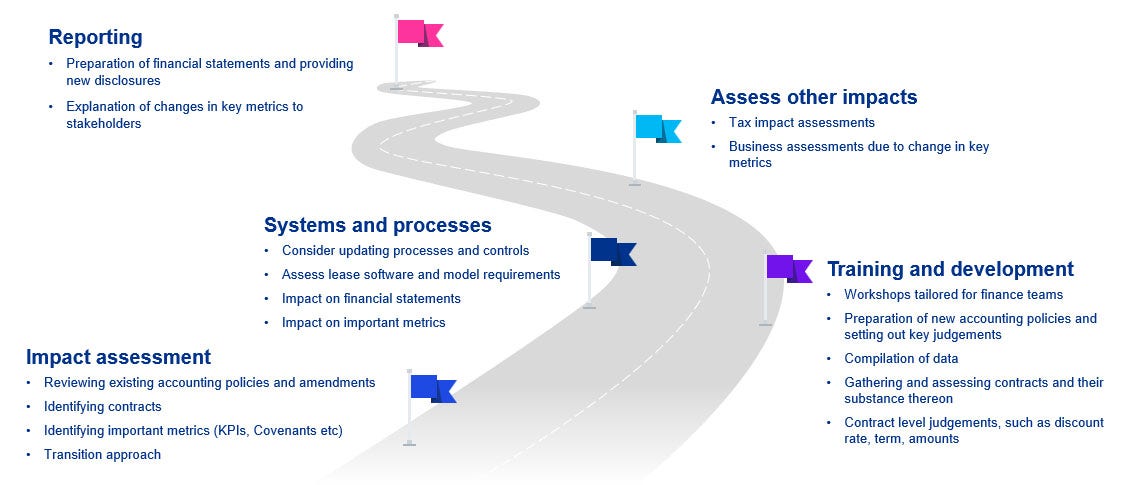
      Next steps for implementation


      How we can help 

      • Review your existing accounting policies and changes under the FRS 102 amendments.
      • Identify customer contracts and lease portfolios.
      • Identify impacted metrics (e.g., KPIs, covenants).
      • Determine a transition approach appropriate for your business.

      • Prepare accounting policy papers setting out application of the standards to your arrangements.
      • Set out key judgements under the new standards.

      • Review revenue and lease contracts and extract data.
      • Make contract level judgements, such as:
        • Leases – discount rate, lease term, lease payments, practical expedients.
        • Revenue – unbundle promises, measure variable consideration, standalone selling prices.
      • Model lease and revenue contracts.

      • Advise on updated processes and controls.
      • Assess lease software and model requirements.
      • Charts of account mapping.
      • Identify any financial statement and consolidation impact going forward.
      • Training across the business.

      • Tax impact assessment – transition and beyond.

      • Prepare financial statement disclosures under the new FRS 102 amendments.
      • Explain changes to key metrics to stakeholders.
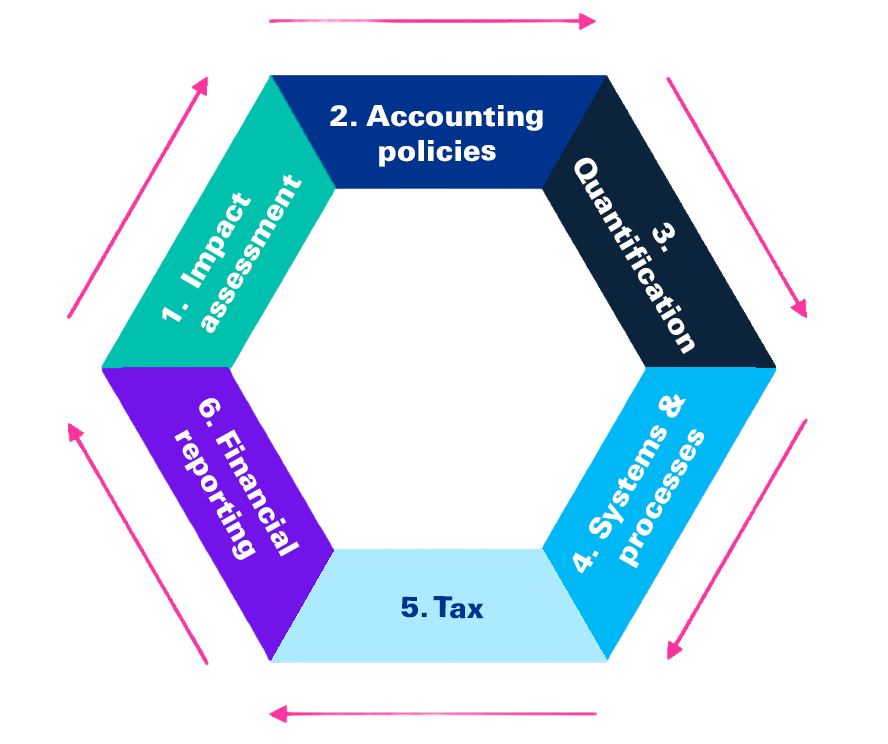
      Transition plan


      Get in touch

      Are you navigating the complexities of FRS 102 and finding yourself in need of expert advice? Our team of professionals is here to guide you through the intricacies of FRS 102, ensuring compliance and empowering your financial decisions.

      Contact our team below to discuss your specific needs, answer your questions, and provide comprehensive insights to optimise your financial practices.

      Eamon Dillon

      Partner, Board Leadership Centre Lead

      KPMG in Ireland

      Terence Coveney

      Partner

      KPMG in Ireland

      Robert Molloy

      Director

      KPMG in Ireland

      Kelly Campbell

      Director

      KPMG in Ireland


      Discover more in Accounting Advisory

      Something went wrong

      Oops!! Something went wrong, please try again

      Accounting Advisory

      Supporting you to reach the right accounting solution

      2101929538