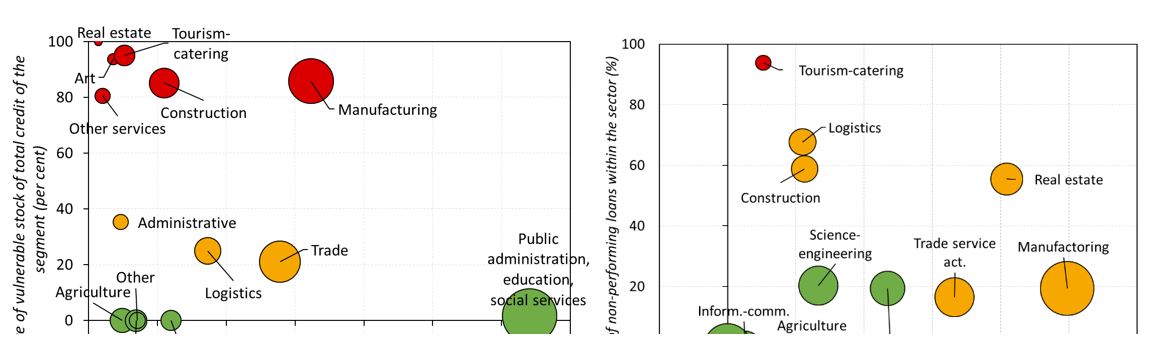
Risk indicators for corporate lending also improved fundamentally by the end of 2019, the share of project loans in the sector-level portfolio decreased compared to the previous crisis, but companies are also experiencing significant difficulties with the coronavirus epidemic and negative supply and demand shocks. Debt service can be a problem for companies that lose a significant portion of their revenue. In the figure above, vulnerable loans are the loans taken out by debtors with vulnerable activities (Hungarian NACE Rev. 2), the size of the circle bubble is proportional to the value added of the sector as a whole. In addition to the above, based on the MNB's data, it can be seen that 16% of the current bank corporate loan portfolios have a medium or worse liquidity situation and at the same time, a medium or high level of indebtedness.
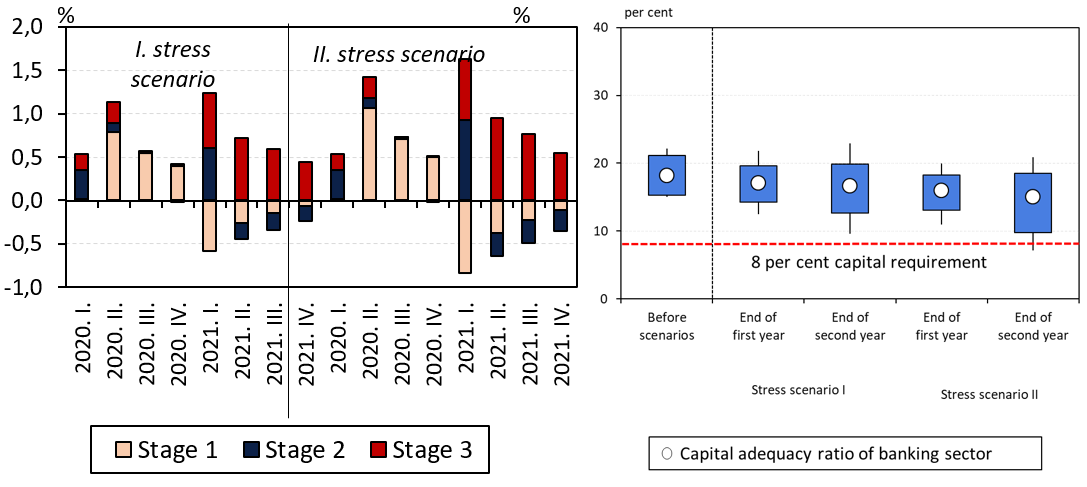
Unfortunately, no public, sector-level data are available on loan loss provisions for the first quarter of 2020, but the MNB's scenario analysis can provide a good basis for analyzing these. On stress scenario I, a change of GDP of -3.8% was expected for this year, while for next year -0.1%, and on stress scenario II, -7.1% and -2.9%, respectively. In addition to the two stress scenarios MNB examined, among other things, the loan loss provisions and the distribution of the number of capital adequacy ratios. The chart on the left shows net generated loan loss provisions, grouped by end-of-quarter stages, in proportion to the gross book value of the household portfolio. It is clear that significant increases in Stage 2 and Stage 3 loan loss provisions are expected after the end of the payment moratorium. For the corporate portfolio, only annual data is available, which shows that net generated loan loss provisions, cumulated from the start of the stress test in proportion to the gross book value of the corporate portfolio is 2.22% in Scenario I and 2.99% in Scenario II by the end of 2021.
The other figure shows what the impact would be on capital adequacy for a given stress situation. Based on the MNB's results calculated on the basis of current information, it can be seen that although the epidemic will have a significant impact on the profitability of the banking system, most domestic banks do not need capital replenishment even in the event of a more severe stress trajectory.