

Scalable, efficient, service-oriented: these were our client’s requirements for a Centre of Excellence (CoE) for their ServiceNow platform, on which standardised service and workflow processes are mapped digitally, transparently and with end-to-end automation.
Need for structural and organisational optimisation
Even at the outset, the ServiceNow platform delivered tangible added value to the organisation and generated considerable interest in the expansion of further features and functionalities. However, structural and organisational weaknesses prevented this potential from being realised consistently, efficiently and at scale: central ownership and overarching governance had not been clearly established. Team and accountability structures had evolved over time and were, in some cases, fragmented, whilst standards were interpreted and implemented differently from one application to another. The heavy reliance on external service providers led to increased costs whilst simultaneously reducing transparency regarding responsibilities and deliverables.
Furthermore, the lack of consistent quality mechanisms hampered the structured and sustainable further development of the platform. Cumbersome and inflexible testing and approval processes increased the likelihood of errors and had a noticeable impact on user acceptance. Last but not least, the lack of transparency regarding performance and quality metrics limited targeted management and the data-driven further development of the ServiceNow platform.
Reduction
in administrative workload
Centralised
consolidated testing processes
530,000 EUR
Potential annual savings
Sector
Financial services companies
Project objective
Reorientation and optimisation
Technology
Platform for service and workflow automation
The path to customer transformation
- The task
- Our approach
- The added value
Identifying weaknesses and developing a target operating model
The financial services company commissioned us to carry out an organisational and structural reorganisation of the platform. The key factors behind this decision were our extensive expertise in the ServiceNow environment and our structured, analytical approach to evaluating and further developing the existing Centre of Excellence (CoE) model.
Through a thorough analysis – including interviews, data analysis, benchmarking and KPI definitions – we identified the weaknesses, conducted a robust assessment of potential efficiency gains and, based on this, derived a target operating model that strengthens governance, accelerates operational implementation, reduces errors and ensures the platform’s long-term scalability.
The ServiceNow teams involved demonstrated a high level of motivation and strong technical expertise, thereby laying a solid foundation for the platform’s further development.
Analysis and benchmarking as the basis for a target operating model
To tackle these challenges systematically, we carried out a comprehensive analysis. This was based, amongst other things, on the responses to more than 230 interview questions, over 40 structured checklist validations and the evaluation of more than 2,300 data points. We also compared our client’s platform performance with that of similar ServiceNow projects in order to assess its performance realistically.
The benchmark analysis shows that the relative monthly overhead decreases significantly as project volume increases and stabilises at a level well below external maintenance rates thanks to a centralised CoE model.
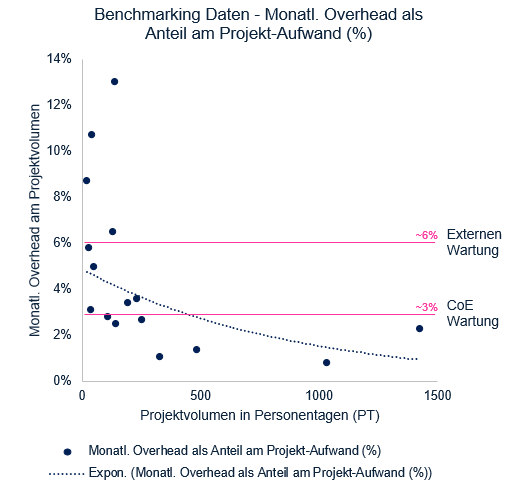
Building on this, the project team developed a KPI scorecard and a target operating model with clearly defined roles and responsibilities. In addition, more than 30 structural measures and eleven quick wins with immediate impact were identified to bring about a noticeable improvement in transparency, quality and efficiency.
Efficient resource planning and scalable development
The reorganisation of governance and the greater centralisation of testing processes have enabled the identification of potential annual savings of up to 530,000 EUR. These savings stem from a reduction in administrative overheads of up to three per cent and in testing costs of up to ten per cent compared with decentralised set-ups. A clearly defined CoE governance structure now lays the foundation for more efficient resource planning and the scalable further development of the platform with a view to 2030. In addition, a transparent service portfolio, a cost-based operating model and standardised go-live checklists have been developed. Furthermore, structured health scans of the ServiceNow platform and its applications, as well as the establishment of a community platform to promote company-wide knowledge transfer, were recommended.


Your contacts

Björgvin Magnússon
Partner, Technology Transformation and ServiceNow Practice Lead Germany; GRC Technology Lead Germany
KPMG AG Wirtschaftsprüfungsgesellschaft

- Item 1
- Item 2

KPMG’s people can make all the difference on your transformation journey, because when technology is placed in the right hands, great things can happen.
Discover how KPMG can help your organisation boost agility and resilience – and thereby lay the foundations for holistic growth – through the personal insights, success stories and technology solutions shared by our advisers.
KPMG. Make the Difference.