

Sustainability strategies and reporting are now high on the agendas of German company boards, which is driving the increasing focus on sustainable finance. The following article provides an overview of the benefits and current developments.
1. overview: Classification of sustainable finance
Sustainability has become a megatrend in recent years, driven by social, economic and regulatory factors. Growing public awareness of climate change and social issues has increased the pressure on companies to strengthen their commitment to sustainable practices. Consumers, investors and employees increasingly expect companies to act responsibly and sustainably. Investors are increasingly recognizing that companies with robust ESG strategies not only have a lower risk profile and are more resilient during economic downturns, but can also generate higher returns over the long term.
This trend is further reinforced by regulatory initiatives. Governments and supervisory authorities around the world are implementing stricter regulations to promote sustainability. The European Union's Sustainable Finance Disclosure Regulation (SFDR) requires financial institutions to disclose their sustainability criteria in decision-making processes. The Corporate Sustainability Reporting Directive (CSRD), which was passed by the EU Parliament, significantly expands the existing rules on non-financial reporting and is estimated to affect around 15,000 companies in Germany. These regulations promote transparency and accountability and motivate companies to adopt more sustainable business practices.
Sustainability also encompasses the transformation of the economy and the financing of this transformation through specially developed sustainable financial instruments. Sustainable finance is therefore particularly important for companies to actively support the transition to a more sustainable economy. Financing is also part of a comprehensive sustainability strategy. This is why more and more companies are turning to sustainable finance. But what is sustainable finance? ESG aspects, i.e. environmental, social and governance aspects, are taken into account.
In recent years, the sustainable finance market has seen lively participation from German companies, making it clear that sustainable finance is not a marginal phenomenon. The study "Sustainability and Green Finance. How companies are mastering the flood of data" by LBBW (LBBW. (2024). Sustainability and green finance. Wie Unternehmen die Datenflut beherrschen) shows that by 2024, more than half of the German CFOs and treasurers surveyed see sustainable finance as the new standard and 17% of those surveyed have already taken out loans with sustainability components.
2. advantages of sustainable finance
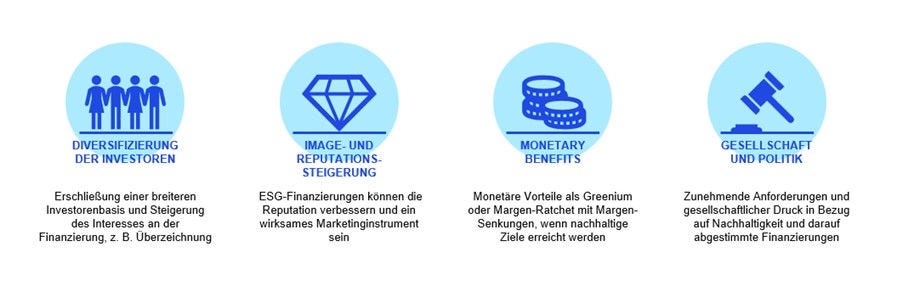
There are many good reasons for sustainable corporate financing. The obvious one is to make a positive contribution to the environment, because the investment promotes sustainable projects that are good for our environment and our climate. Providing sustainable financing can have a positive image/PR effect on a company's reputation. If companies can show their stakeholders that they are serious about sustainability, this often results in an improved external perception. This positive external perception enables companies to build a broader customer base and also helps to increase their attractiveness as an employer - in some cases this even applies to the finance department within the company.
Investors and lenders are increasingly paying attention to how sustainable their portfolios are. This makes it increasingly difficult for companies without a clear sustainability strategy to obtain financing, but gives sustainable companies access to a broader and more diversified investor base.
Last but not least, the potential reduction in financing costs is another argument for more sustainability in financing.
Fig. 1: Advantages of sustainable finance
Source: KPMG AG
3. important financing instruments in the area of sustainable finance
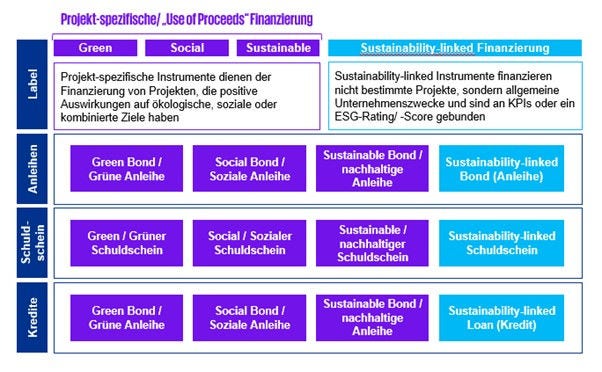
Companies have a wide range of options at their disposal to take advantage of the aforementioned benefits of sustainable finance. The most popular financing instruments, namely loans, bonds and promissory note loans, are also all available in "sustainable" form. With sustainable financing instruments, a basic distinction is made between ESG-linked/sustainability-linked and project-specific or "use of proceeds" financing instruments.
Fig. 2: Overview
Source: KPMG AG
ESG-linked or sustainability-linked financing
Sustainability-linked financing instruments include sustainability-linked loans, sustainability-linked bonds and sustainability-linked promissory note loans. These financing instruments can be used for the financing or refinancing of general corporate purposes. These financing instruments differ from their non-sustainable counterparts in that the conditions include certain clauses that provide for a change in the margin if predefined sustainability indicators of the company change. The "Sustainability-linked Loan Principles", the "Sustainability-linked Bond Principles" of the ICMA (The International Capital Market Association) and the EU Taxonomy are available as standards and guidelines for such financing instruments.
A change in the margin can usually occur in both directions, so it is not only possible to reduce the financing margin, but also to increase it. The sustainability-linked instruments are either linked to an external ESG rating / score of the company or to previously defined KPIs / SPTs (sustainable performance targets). The selected link determines the change in the margin. In recent years, a preference for the KPI/SPT-based approach has emerged on the market.
If the KPI approach is chosen, it is becoming increasingly uncommon to link financing to just one KPI and 2-5 KPIs are often preferred. Companies often ask themselves which KPIs are relevant for them. The advantage of the KPI approach is that each company can identify relevant KPIs with the financing parties and thus receive a customized solution. Care should be taken to ensure that the targets set are ambitious.
If a company wishes to use an external ESG rating or score for financing, the sustainability-linked instrument is linked to one or more ratings/scores. If the rating improves, this results in an improvement in margins. If the ESG rating deteriorates, the financing margin increases.
Companies often have no experience with sustainable KPIs and do not have an ESG rating, but would still like to issue a sustainability-linked financing instrument. In this case, it is possible to issue an "ESG-ready" loan.
ESG-ready loans combine the current financing requirements of a company with the intention to incorporate sustainability into corporate financing in the future. For this purpose, a clause is included in the loan agreement that allows the company to make the necessary decisions and submit the documentation within 12 months. The inclusion of this "rendezvous clause" in the loan agreement does not create any pressure to act or any obligation: the financing agreement merely stipulates that the interest rate will be linked to ESG criteria in future by means of an addendum.
Project-specific or "use of proceeds" financing
The project-specific financing instruments include "green" loans, bonds and promissory bills, social loans, bonds and promissory bills and sustainable loans, bonds and promissory bills. The instruments themselves have the same structure and differ only in terms of the label. So-called use-of-proceeds financing focuses on financing green, social or sustainable projects or a combination of these projects for the sustainable label. Compared to the previously mentioned sustainability-linked instruments, this type of financing has the restriction that only projects that are demonstrably green, social or sustainable can be financed. Various standards and guidelines have been established for this form of financing. These include the Green / Social Loan Principles, Green / Social Bond Principles, Sustainability Bond Guidelines, EU Taxonomy and the EU Green Bond Standard. The company must also publish a suitable framework for issuing these instruments, e.g. a green bond framework for a green bond.
4. Current developments in the sustainable finance market
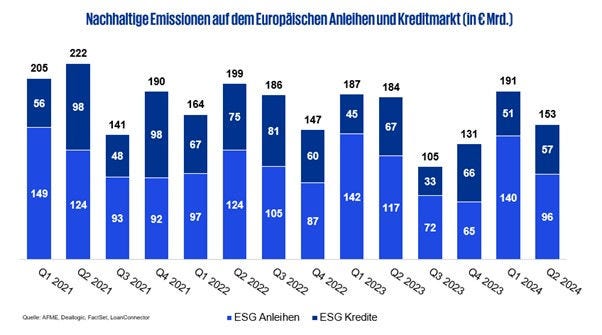
Measured by issue volume, the European sustainable finance market grew strongly until 2021, reached its absolute peak in 2021 and has since weakened in various areas, similar to the general economic sentiment in the last two years. The market made a strong start to 2024 with an issue volume of around € 140 billion in sustainable bonds and € 51 billion in sustainable loans in Q1 2024. With a total quarterly volume of € 191 billion, the market not only made a strong start to 2024, but also showed a strong quarterly volume, which is similar to 2021. The second quarter of the year was weaker than Q1 with € 57 billion in sustainable loans and € 96 billion in sustainable bonds.
The "green" label has always been by far the most strongly represented on the sustainable bond market. In Q1 2024, approx. 68% of all sustainable bonds were green, approx. 17% social, 9% sustainable and only 5% sustainability-linked bonds. (AFME. (2024). ESG Finance Report Q1 2024) In the European bond market as a whole, the sustainable labels together accounted for a share of approx. 12% in Q1 2024. (AFME. (2024). ESG Finance Report Q1 2024) It is interesting to note that the share of investment-grade companies clearly predominates across all labels, with the gap narrowing only in the case of sustainability-linked bonds. In the case of sustainability-linked bonds, almost twice the volume of investment grade companies is issued as companies without an investment grade rating.
The market for sustainable loans can be divided into "green loans" and "sustainability-linked loans", as the other labels have negligible volumes. In the first quarter of 2024, around 19% of all loans on the syndicated loan market in Europe are sustainable.2 The share of sustainability-linked loans in the total amount of sustainable loans has been increasing for years and is now always over 90%. In Q1 2024, 86% of sustainable loans were taken out by investment grade companies and 14% by non-investment grade companies. 2
With the increasing stabilization of interest margins and the expectation of a stagnating or falling key interest rate for the second half of 2024, market sentiment remains positive for sustainable financing.
Fig 3: Sustainable issues on the European bond and loan market
Quelle: KPMG AG
5. The monetary advantage of sustainable corporate financing
For sustainability-linked instruments, the financing advantage is negotiated in the margin grid. Often 1-5 KPIs are selected and the clauses are structured in such a way that the margin is reduced by 1-2.5 basis points in each case if the individual targets are met. Alternatively, the margin grid can also be structured in such a way that a margin reduction only comes into effect collectively if all targets are met. With both types of design, the interest margin can also be increased (often by the same amount) if the company's performance in the selected KPIs deteriorates. The design is transferable to the structure with ratings/scores instead of KPIs - even if the link to ratings/scores has become increasingly unpopular in recent years and a link to KPIs is becoming the standard.
While the financing benefits of sustainability-linked financing are directly apparent, assuming that the defined targets are also achieved, the benefits in the interest margin are more difficult to identify in the case of "use of proceeds" financing. A margin advantage in this type of financing is often referred to as ESG premium or "greenium". In order to determine a greenium, the margins for financing with the "green", "social" or "sustainable" label must be compared with their non-ESG counterparts. Data providers that present this margin advantage show deviating information and a strongly fluctuating ESG premium over the last few years. AFME (The Association for Financial Markets in Europe) recently showed a decreasing ESG premium since 2021 in the "ESG Finance Report - Q1 2024". In the first quarter of 2024, issuers saved an average of around 1.4 basis points on Use of Proceeds corporate financing.2 This premium is only an average and for investment grade companies the greenium is also in the low single-digit basis point range in most cases. The margin savings for non-investment grade issuers, on the other hand, are usually significantly higher.
6. conclusion/conclusion
Sustainability strategies and reporting are now high on the agendas of German company boards, which is driving the increasing focus on sustainable financing and its benefits. It is essential that financing strategies follow the corporate strategy. The first step in issuing sustainable financing instruments is therefore for companies to clearly define their sustainability focus.
It is also crucial that companies disclose credible targets, relevant KPIs and long-term plans to enhance their positive or mitigate negative impacts on ESG factors. CSRD plays an important role in closing information gaps and thereby integrating the implementation of sustainable finance into the existing financing mix at companies.
The inclusion of relevant ESG metrics in financial contracts can strengthen relationships with stakeholders, increase the interest of financing parties and reduce financing costs. With growing demands for clear sustainability targets, commitments and reporting, these practices are expected to become standard in the future. Companies that fail to meet these requirements may find access to the financing market increasingly restricted.
Source: KPMG Corporate Treasury News, Issue 146, August 2024
Authors:
Till Karrer, Partner, Deal Advisory, KPMG AG
Börries Többens, Partner, Finance and Treasury Management, Corporate Treasury Advisory, KPMG AG
More KPMG insights for you

Your contact

Börries Többens
Partner, Financial Services, Finance & Treasury Management
KPMG AG Wirtschaftsprüfungsgesellschaft