

With a population of just over 84 million, Germany accounts for only around one per cent of the world's population of around 8 billion people, but generates almost five per cent of the world's gross domestic product. This makes Germany the third largest economic power in the world. This has been possible because the German economy has become massively internationalised and globally networked in recent decades: Germany is now the second most globally active and internationally invested country after the USA. The German economy's business model is based on global supply chains and sales markets as well as the availability of favourable international resources and production locations. China and the USA are by far the largest suppliers, production locations and sales markets for the German economy.
The German economy: globally networked and successful
Threat to the existing business model
This business model is increasingly being threatened by decoupling or derisking - the decoupling of the global economy, particularly of the two major economic blocs, the USA and China - and by geopolitical disruptions.
Decoupling or derisking is not a short-term phenomenon, but a long-term trend that has been fuelled by "America First" and China's "dual circulation" strategy in recent years. Decoupling is multifaceted and is on the rise:
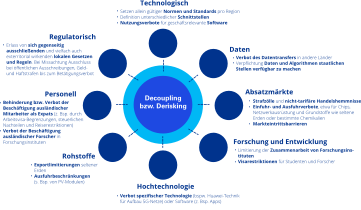
At the same time, geopolitical disruptions and shocks - often referred to as "black swans" - have increased massively in recent years. These include pandemics, wars, human rights violations, environmental disasters and cyber attacks, as well as the introduction of protectionist measures such as sanctions and trade restrictions. Current examples include Russia's war in Ukraine, the Covid pandemic, the lockdowns in China, global warming, Brexit including the UK's imminent cancellation of the EU-UK trade agreement, the blockade of the Suez Canal, the "WannaCry" cyber attacks and many more.
The coming decade will be characterised by great uncertainty due to the accumulation of disruptive events and shocks, the protectionism of many countries and the withdrawal of the United States as a global power.
Realignment required
Decoupling or derisking and the regular occurrence of geopolitical incidents are forcing a continuous adjustment of business strategies, which in turn leads to a variety of adjustments to all corporate processes, the corporate structure, supply chains, sales markets and global value creation. Validate here the extent to which your organisation is affected by progressive decoupling or derisking:

Recommendations for action
Today, companies of all sizes should systematically and continuously take geopolitical risks into account in their corporate strategies and react to changes in these risks in terms of business policy.
A distinction must be made between the following tasks:
Our services
With these services and the expertise of our specialists, we can provide companies with comprehensive advice and support on all issues and challenges relating to geopolitics and decoupling or derisking.
With an interdisciplinary team of specialists, KPMG offers cross-thematic solutions:
The continuous early recognition of "red flags" of changing framework conditions, laws and regulations with the help of technical screening solutions forms the basis of every strategic corporate decision.
Contacts: Tobias Naujoks, Jan-Hendrik Gnändiger
The result of the strategy analysis is an adjusted geopolitical target operating model of the most resilient structure possible for all areas of the company along the entire value chain.
Contact: Tobias Naujoks
Based on the geopolitical strategy and the defined target operating model, implementation will generally require new market entries through start-ups, investments or acquisitions, but also carve-outs and divestments of business units or exits from regions.
Contact: Alexander Bischoff, Ralf Pfennig, Daniel Kaut
The realignment of the global group structure must be optimised in operational (including IT), tax and legal terms. Localisations/regionalisations, separations and integrations raise a variety of operational issues.
Companies must also constantly adapt their business model in each country in which they operate so that local country-specific laws, such as tax laws and data protection laws, import and export control laws, investment control laws and reporting laws as well as national sanction regulations are complied with.
Contact: Gernot Gutjahr, Lars Christian Mahler, Boris Schilmar, Julia Ruf
In order to comply with the regionally applicable and dynamically developing laws and to avoid sanctions, but also to recognise opportunities, it is necessary to set up a global, country-specific compliance/opportunity management system (CCMS).
Contact: Jan-Hendrik Gnändiger, Johann Schnabel, Carsten Wember
Resilienz in Zeiten des Decoupling bzw. Derisking und geopolitischer Krisen
Unsere Lösungen zum Decoupling bzw. Derisking im Überblick
More KPMG insights for you


Your contact
