Skills shortages, business succession and competition for qualified staff present challenges for many small and medium-sized enterprises and family-run businesses. Employee share schemes can help to retain talent in the long term, strengthen employees’ sense of identification with the company and allow them to share in the company’s success.

      At the same time, many companies are faced with the question of how to implement an employee share scheme without giving up shares or altering existing shareholder structures. This is precisely where profit-sharing rights can offer an attractive solution.

      Profit-sharing rights: involving employees without giving up shares

      With profit-sharing rights, you allow your employees to share in your company’s financial success without granting them voting or decision-making rights. The structure is flexible, existing shareholder structures remain unaffected and notarisation is not usually required.

      pdf

      The balancing act between cost-cutting and retaining talent (in German only)

      Employee share ownership in small and medium-sized enterprises

      Attractive tax and social security benefits

      When structured correctly, profit-sharing rights can offer significant advantages over traditional bonus and remuneration models. Up to 2,000 euros per year per employee can be granted in addition to the regular salary, free of income tax and social security contributions (Section 3(39) of the German Income Tax Act (EStG)).

      This benefits both sides: employees receive a higher net benefit, whilst companies reduce non-wage labour costs and, at the same time, increase the effectiveness of their incentive schemes. The prerequisite is that the opportunity to participate must, in principle, be open to all employees. 


      Ready to talk?

      do_disturb_on

      A simplified example:

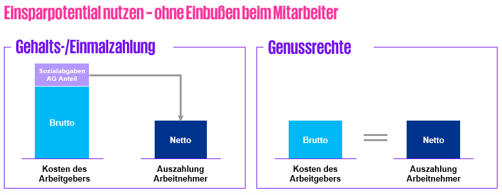
      A Christmas bonus of 2,000 euros costs the company around 2,400 euros, including social security contributions – in the worst-case scenario, the employee receives only around 1,000 euros.

      check_circle

      Alternatively, with a profit-sharing right

      • the same net benefit can be achieved with as little as 1,000 euros (savings of up to 1,400 euros per employee) or
      • the full amount of 2,000 euros can be granted – resulting in a cost saving of 400 euros per employee whilst simultaneously enhancing perceived appreciation.

      Greater loyalty. Greater motivation. Greater flexibility.

      Profit-sharing rights are usually issued at the start of a financial year and are only paid out after a defined period (typically one year) and upon fulfilment of specified conditions. This creates a long-term financial commitment between employees and the company.

      The return on profit-sharing rights can be structured on an individual basis and specifically aligned with the company’s objectives. In practice, this is often achieved by linking them to key performance indicators such as net profit for the year or EBIT.

      Another advantage: Depending on the structure, income from profit-sharing rights is taxed at 25 per cent capital gains tax (plus solidarity surcharge and, where applicable, church tax) rather than at up to 45 per cent income tax (plus solidarity surcharge and, where applicable, church tax) – an often-overlooked net benefit resulting in lower overall costs.


      Schaubild

      How we support you

      From the initial idea through to day-to-day administration, we support you in theimplementation or further development of share ownership schemes:


      • Analysis and design
        • Analysis of your company’s specific challenges and objectives
        • Simulation calculations to illustrate the tax implications 
      • Tax and legal structuring
        • Tax advice on optimal structuring and support in obtaining a potential advance ruling on payroll tax
        • Drafting of contractual documents (KPMG Law)
        • Valuation of the selected equity instrument, as well as business and accounting classification
      • Communication & Administration
        • Communicating your scheme to staff
        • Ongoing administration of your share scheme

      Further interesting content for you

      Your contact

      Carmen Egermann

      Director, Tax, Global Mobility Services

      KPMG AG Wirtschaftsprüfungsgesellschaft