Big tech companies such as Amazon, Google, Facebook and Apple are often cited as leading practices due to the success and flexibility of their business models. On the one hand, they owe their rapid growth to their enormous innovative spirit; on the other hand, they have a clear focus on the global scaling of digital sales channels. Payment services play an important role in this scaling in order to monetise offers efficiently. This is generally done via so-called "corporate fintech", independent Group companies that bundle expertise and solutions for payment processing.

      The following article provides answers to the questions of what advantages corporate fintech brings for established companies, for whom it is suitable, how it can be implemented and what value contribution corporate treasury can make.

      Independent fintech units in corporate groups

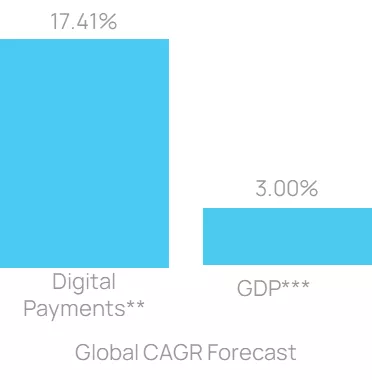
      While the economy as a whole will have to contend with a recession in the coming years, the market for digital payments is expected to grow by 20.8%1 annually. This will make the market more relevant, if not highly relevant, for all companies.

      In line with this, investor Angela Strange, who works as a partner at Silicon Valley investor Andreesen Horowitz2 , has put forward the thesis that "every company can be a fintech in the future" and generate a significant proportion of revenue from financial services. This is made possible in particular by new web services, such as BaaS (Banking as a Service) offerings, which also allow companies without a banking licence to offer financial services.

      Conversely, a lack of expertise in the area of digital payments could become a stumbling block for business development in the future. Customers are already turning away in annoyance today if a payment process is too complicated, is cancelled or popular payment methods are not offered. In the future, there will be further challenges to overcome in order to be successful in competition. These include the automatic processing of payments on marketplaces or between systems in the background (M2M payments).

      Unfortunately, established banks, payment service providers or the internal payment factory often do not offer suitable solutions for the complex organisational, process-related and international requirements of companies. Against this backdrop, companies and digital groups from various industries have bundled all activities in specialised departments or subsidiaries in recent years. These units take care of all digital payment topics and offerings across the group.

      Digital payment will play a major role in almost all companies

      Figure 1: Comparison between the development of digital payment and global GDP

      Quelle: ** Growth Forecast Global Digital Payment Growth: https://www.prnewswire.com/news-releases/digital-payment-market-size-to-grow-by-usd-85-12-bn--driven-by-rising-number-of-online-transactions--technavio-301451318.html *** Growth Forecast Global GDP: https://www.imf.org/en/Publications/WEO/Issues/2023/07/10/world-economic-outlook-update-july-2023

      Corporate Fintech: advantages and characteristics

      Companies that bundle digital payments in an independent subsidiary, a so-called corporate fintech, gain the greatest advantage. The exact structure of the financial services offered varies from company to company, but all corporate fintechs have one thing in common: they are made up of experts with specialist, technical and legal backgrounds, enabling them to develop innovative financial services faster and more efficiently and establish them throughout the Group thanks to a bundled interdisciplinary team.

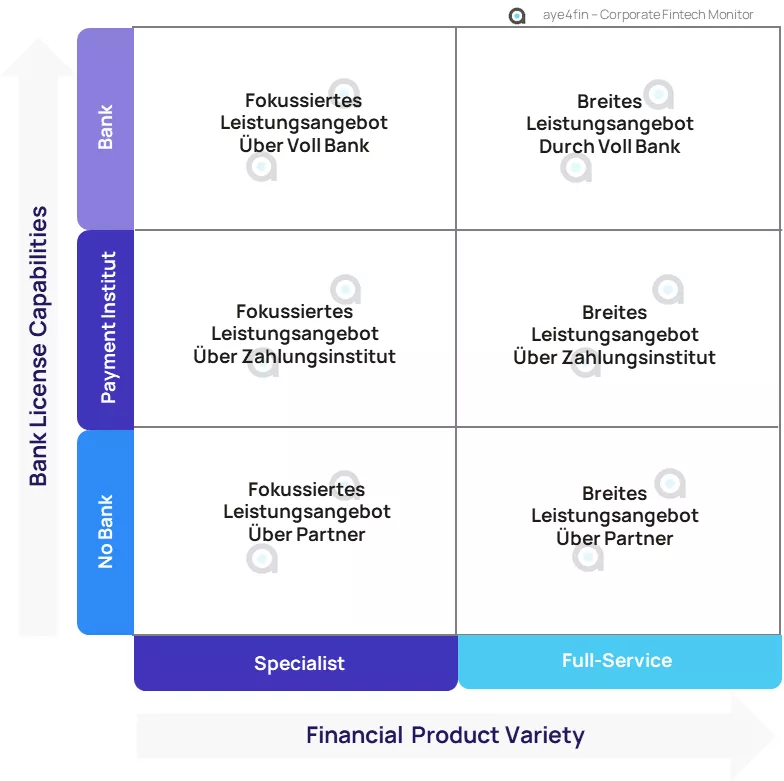
      For companies with significant turnover via digital payments, it is usually worthwhile setting up a small banking licence, usually with a permit in accordance with the Payment Service Provider Supervision Act (ZAG). Although this licence does not allow you to grant loans, you can define payment processing and the associated customer processes independently. Optimised cooperation with other banking partners is also possible. For very large companies in particular, it should be noted that these small banking licences are operated in parallel with existing house banks. This allows digital payment services to be offered in a more focussed manner.

      The ZAG licence is used to offer more customer-friendly processes, to process certain forms of payment such as purchase on account independently or to reduce dependency on service providers. This is also a further step towards expanding internal value creation.

      For which corporate groups is a corporate fintech worthwhile?

      Corporate fintech therefore serves in particular to bundle digital payment activities and implement them in a structured and efficient manner, as well as to reduce dependencies on third parties.

      The question now is: Shouldn't every company set up its own corporate fintech? In our experience, internationally active companies with a strong drive for innovation in particular benefit from setting up a corporate fintech. Innovation requires structures and systems that allow new and diverse business models to be implemented quickly. This allows customer needs to be realised flexibly and quickly.

      This is precisely where corporate fintech comes in, operating outside of existing corporate structures. Without middlemen, processes become faster and more independent, product innovations can be brought to market easily and independently and can also be introduced in other countries.

      OEMs were already pioneers in this area years ago, offering their customers financing with the help of their own financial services and thus strengthening customer loyalty. After online retailers in particular established their own corporate fintech in the first wave, initiatives by established industrial companies are now increasingly being observed.

      The path to corporate fintech

      If a company decides to develop into a corporate fintech, it is important to establish a clear vision. The path from a hierarchical organisational structure with financial partners to a specially established corporate fintech with a banking licence is a complex transformation process that cannot be achieved overnight.

      Numerous questions usually arise, such as

      • Is the business case sufficient for a banking licence?
      • What expertise and resources do we need?
      • How long will it take to set up?
      • What needs to be done and in what order?
      • Are we now competitors of our service providers?
      • What certifications do we need?

      It is quite common to divide the overall goal into several phases and to enable the first corporate fintech offerings quickly:

      Step 1: Benchmarking:

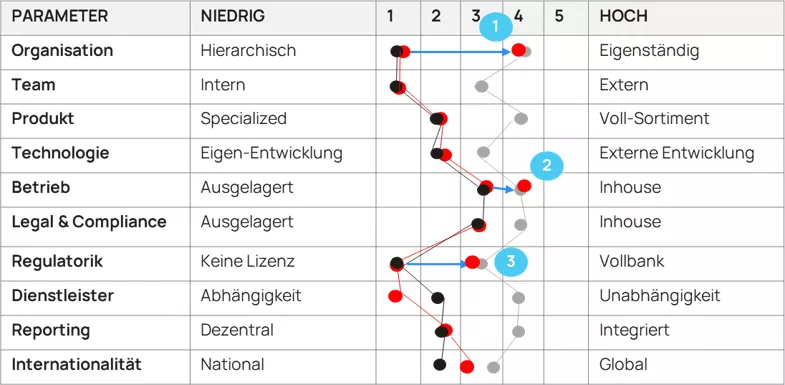
      With the help of a corporate fintech framework, an outside-in analysis is carried out to compare the company along relevant parameters with leading practice companies within the same industry or in other industries.

      Step 2: Develop an understanding of the corporate strategy

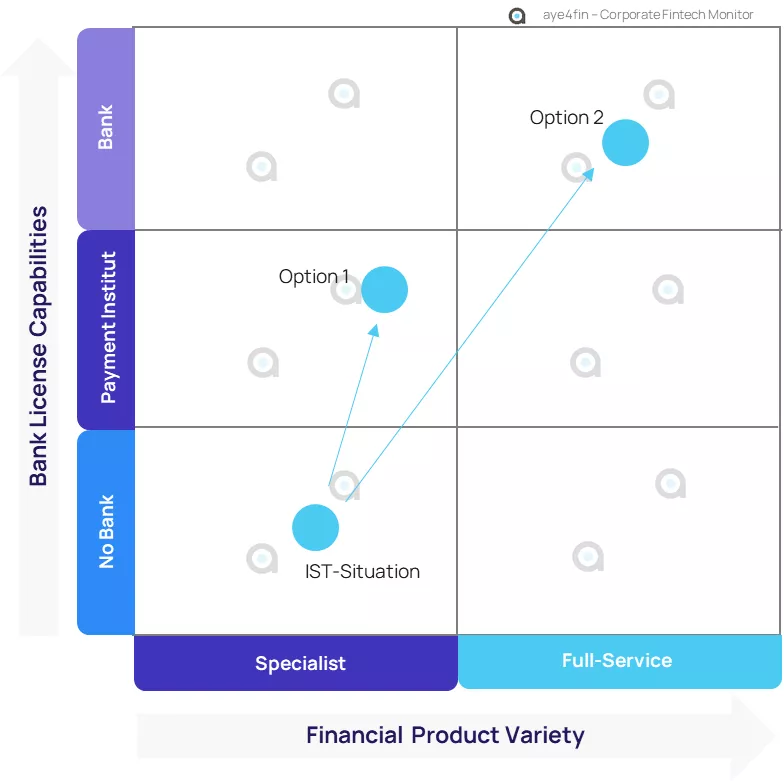
      The strategic target vision and digital payment strategy are then discussed in order to integrate them into the Corporate Fintech Monitor. As a result, one or more target positionings become visible, which differ in terms of available bank licences and depth of financial services.


      Figure 4: Exemplary strategy development

      Source: aye4fin

      Step 3: Detailing the solution options

      Once the strategic objectives are available, supplemented by benchmark information and the target positioning(s), the next step is to detail the possible options. Initial concepts are drawn up and recorded in a catalogue of requirements, which forms an important basis for decision-making in the development of a prioritised solution.

      Step 4: Business case

      The business case, which also contains the planning of the resources required for operation, is the centrepiece of the internal persuasion process. For the calculation, both revenue-increasing activities, through the use of new sales channels, and cost-reducing activities, through the bundling of transaction volumes, which are made possible by the establishment of a corporate fintech, must be taken into account. By utilising outsourcing and cooperation partners, it is also possible to establish regulated institutions with a small team.


      Figure 5: Target operating model for corporate fintech

      Step 5: Implementation planning and realisation

      For implementation, we recommend a pilot that can be implemented quickly and still promises a great return in order to improve group-wide acceptance. This is followed by a structured roll-out process with further use cases according to their priority and complexity. In international projects in particular, there are also numerous differences depending on local regulation and the payment service provider to be integrated, which can be handled efficiently by a corporate fintech.

      Step 6: Continuous review

      When setting up and designing a corporate fintech, rapidly changing framework conditions, in particular regulatory, legal and technical requirements, must be regularly reviewed, as they may make it necessary to adapt the target design. For example, the implementation of the European Payment Service Directive 3 (PSD3) in particular will lead to organisational and technical changes in the coming years.

      Summary:

      The term corporate fintech refers to the bundling of group-wide activities for digital payments in a legally independent company within a company.

      The establishment of a corporate fintech is relevant for all companies that see digital payments as a strategic (additional) service of their company and wish to position themselves accordingly.

      In the practical implementation of projects in companies, the treasury department plays a central role in holistic planning and management. By bundling digital payments activities in an independent company, projects can be implemented more efficiently compared to decentralised setups, despite an increased need for interaction within the organisation and also from region to region.

      The project duration can range from a few months to several years. The duration and effort involved increase significantly, especially if a separate payment service provider licence is required. Some companies wait around 1.5 years for a licence to be issued.

      Analysing the individual approach to digital payments at an early stage sharpens the path to the target image. For many companies, the development of a customised corporate FinTech is a guarantee for maintaining competitiveness.

      Digital Payment Cooperation KPMG & aye4fin:

      As leading consulting firms in the field of digital payments, KPMG & aye4fin advise international companies, marketplaces and payment service providers on the development and expansion of innovative payment solutions. Both companies regularly publish information on exciting market developments.

      Source: KPMG Corporate Treasury News, Issue 139, December 2023

      Authors:

      Michael Gerhards, Partner, Finance and Treasury Management, Corporate Treasury Advisory, KPMG AG

      Sascha Uhlmann, Senior Manager, Finance and Treasury Management, Corporate Treasury Advisory, KPMG AG

      Guest author:

      Thomas Tittelbach, Managing Partner, aye4fin

      ____________________________________________________________

      1 Source: https://www.grandviewresearch.com/press-release/global-digital-payments-market, accessed on 01.10.2023

      2 Source: https://www.trendingtopics.eu/investorin-jedes-unternehmen-kann-auch-ein-fintech-sein/, accessed on 01/09/2023

      More KPMG insights for you

      Finance & Treasury Management

      KPMG's team of experts will show you the right way forward in corporate treasury management.

      Parachutist FTM

      Your contact

      Nils A. Bothe

      Partner, Financial Services, Finance & Treasury Management

      KPMG AG Wirtschaftsprüfungsgesellschaft