Artificial intelligence is already penetrating almost all areas of life at a rapid pace. Whether in software development, financial analysis or medical diagnostics, AI has long been more than just a promise for the future. It quickly becomes clear that if you want to help shape the future, there is no way around having to deal with its possibilities, opportunities and risks. Due to this wide range of possible applications, artificial intelligence is becoming one of the key topics for innovation and efficiency in the 21st century and gave us the reason for this newsletter article.

      Currently, ChatGPT is probably the most prominent and widespread AI tool on the global market. Not so long ago, the applications of such a tool were limited to general text processing and simple question answering. Nowadays, however, it is increasingly used as an interface to operate complex application systems such as programming environments, automation platforms or financial applications more easily and efficiently using natural language.

      Corporate treasury departments can also benefit from this trend and technological progress. However, especially in the treasury area, the question arises time and again as to how helpful a tool such as ChatGPT can actually be in dealing with third-party systems. The primary problem that is often encountered is not a lack of programming skills on the part of the developers, but rather the fact that the chatbot has no direct access to internal system data or proprietary or manufacturer-specific interfaces.

      This inevitably leads to application and efficiency problems, as relevant information cannot be processed automatically or placed in the right context. In addition, there are further functional limitations as the majority of processes are individually configured and highly system-dependent.  

      However, probably the greatest concerns in this context are associated with the issue of data protection. The use of external AI to handle sensitive financial data raises legitimate questions regarding regulatory requirements and data security (Navigating Consumer Data Privacy in an AI World, 2024).

      However, precisely because the need for intelligent, dialogue-based support is so great and in order to prevent the aforementioned problems, many software system providers have started to integrate their own AI tools and machine learning applications directly into their systems. Tools such as "Kyriba Trusted AI" (TAI) or ION Treasury Machine Learning features are designed to increase efficiency and user-friendliness while ensuring maximum data security (Cash Management AI Boosts Accuracy, Efficiency, & Foresight - Kyriba, 2025/ION Treasury Machine Learning, 2024).

      SAP is also integrating intelligent AI functions into S/4 HANA with its AI assistant Joule to provide voice-based support for treasury processes. It seems obvious that the general functions of the various AI solutions overlap greatly, as the basic user requirements are largely identical across all systems. The differences lie more in the respective implementation, as each solution is specifically tailored to the individual system architecture and software environment and thus enables the most efficient use and seamless integration in the respective system context.

      The above list of SAP, ION and Kyriba is only a partial excerpt of the existing AI treasury solutions and therefore does not claim to be a complete representation of the system solutions.
      Definition and delimitation

      Definition and descriptionArtificial intelligence (AI) generally refers to technologies that enable machines to imitate human behaviour such as language processing, decision-making or problem solving. This is not a single system, but a combination of technical processes that together serve to master complex tasks (Fraunhofer IKS, n.d.).

      A central sub-area of AI is machine learning (ML). Here, systems learn independently from large amounts of data by recognising patterns and deriving decisions from them without being given a fixed solution path. The performance of such algorithms improves continuously through repetition and a growing database (Google Cloud, 2025; Fraunhofer IKS, n.d.).

      Development stages of AI in Treasury

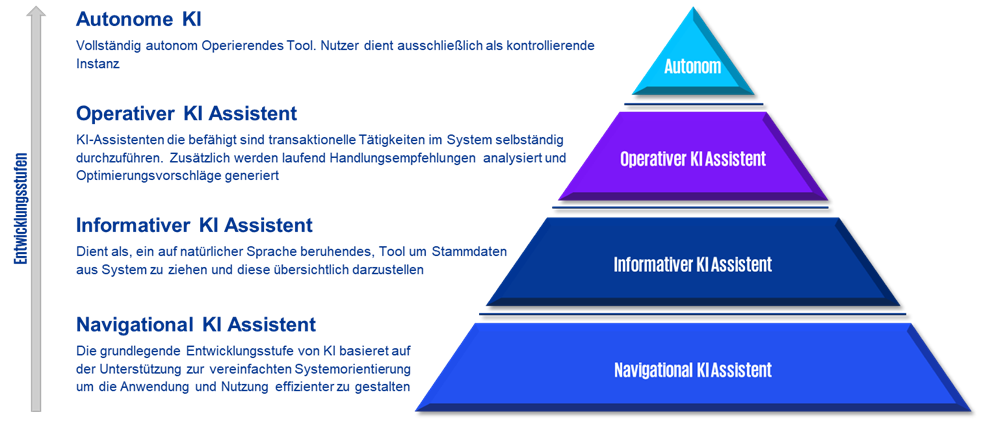
      Artificial intelligence is increasingly finding its way into treasury systems, but is still in the development phase in many places or is only available in its initial stages. Initial solutions show how AI can enable simplified navigation in complex applications, faster provision of information, transaction automation and comprehensive analyses. These areas of application mark the central development directions of AI in the treasury sector in order to make its processes more efficient in the future.

      Abb. 1: Entwicklungsstufen auf dem Weg zur autonomen Treasury-KI Abb. 1: Entwicklungsstufen auf dem Weg zur autonomen Treasury-KI | Quelle: KPMG in Deutschland, 2025

      Navigating functions

      The most basic development stage of AI in treasury is based on navigational features for simplified system use and orientation. Regardless of whether, for example, the tool for creating bank accounts, the display of specific account balances or targeted cash flows are being searched for, users are guided directly to relevant modules, reports or transactions with the help of natural language input. Depending on the system provider, the AI guides the user directly to the desired target module, creates the appropriate link or offers a user-friendly guide that leads step by step to the right area and ideally provides assistance with operation. This eliminates the need for tedious searching in complex menu structures or even memorising transaction codes.

      Informative AI assistant

      Building on this basis of functionality, the next stage of development can be found in informational applications. This type of AI has the ability to react and respond to questions in a targeted manner, providing relevant company or market data in a structured and comprehensible form. It serves as a natural language-based reporting tool, allowing information to be retrieved much faster and more accurately without users having to spend time searching through different treasury systems and reports.

      AI does not replace the underlying database, but acts as an intelligent intermediary by making existing data more accessible, easier to use and interpret in context.

      A practical example in this case would be a treasurer who wants to find out how high the utilisation of his credit lines will be in the next three months. Instead of calling up a report or even manually collating several reports, an AI-supported treasury system immediately provides a clear overview of the desired information.

      Operational AI-assistant

      Beyond the pure provision of information and simplified navigation, artificial intelligence in treasury opens up a third expansion stage, which is based on transactional and analytical properties. It is no longer just a matter of making data accessible or paving the way to certain modules, but of directly carrying out operational activities. Approvals, postings or even the creation of new data records can be initiated and completed directly by AI. Of course, this is done on the basis of a clearly defined set of rules, authorisations and compliance requirements, which can be individually defined in the system in advance.

      In practice, this could look something like a treasurer receiving a notification from their AI-based treasury assistant that there is unutilised liquidity in a UK account. The system automatically checks the relevant investment guidelines, suggests a suitable measure and executes the corresponding booking directly after confirmation. The AI thus takes over activities that previously had to be carried out manually and creates a more efficient working environment.

      It should also be possible to analyse large volumes of data, identify patterns and derive forecasts or specific recommendations for action from them. The results are visualised so that risks, opportunities and anomalies can be quickly identified and proactive measures can be initiated.

      For example, let's look at an internationally active production company that notices that high credit balances have accumulated in several foreign accounts, while the main German company is facing a liquidity bottleneck in the short term. With the help of the AI assistant, the user in charge can now use voice commands to enquire about the current liquidity situation of all companies and how available funds can be optimally reallocated. The AI analyses all account balances, outstanding receivables and liabilities in real time, creates a graphical overview and suggests specific transfers. If desired, the tool can also initiate internal transfers between accounts directly and automatically authorise them according to the user settings. The result is optimised and efficiently distributed liquidity in just a few minutes and without the need to manually collate data or trigger payments individually. Although parts of such tasks can already be automated today using rule-based rules, interaction and decision-making are further supported by AI.

      Autonomes Treasury

      The final development stage of AI in treasury envisages an (almost) fully autonomous system. Operational tasks run independently, while the user only acts as a controlling instance and only receives status reports. This is a vision of treasury that works efficiently, autonomously and with virtually no manual intervention. In one of our next articles, we will take an in-depth look at the requirements needed for this.

      Conclusion

      The various stages illustrate the differentiated development of AI in treasury. These stages build progressively on each other and together span the spectrum from pure information support to "autonomous treasury".

      It is equally true for all treasury systems that the applications of the more advanced levels are not yet fully functional. Although many providers are already advertising solutions that cover expansion stages from informational to analytical AI, in practice almost exclusively informational and navigational functions have so far proven to be fully usable. Transactional and analytical functions are mostly still in pilot phases or on roadmaps, which means that their implementation in everyday working life only makes limited sense at present.


      As a result, we can say that we have identified enormous potential and a wide range of possible applications for various areas of treasury. The opportunities are manifold and harbour the potential to create considerable added value in the long term by increasing efficiency and automation.

      The providers' roadmaps and the perspectives we have outlined sketch a picture of tomorrow, a treasury that works more efficiently, intelligently and autonomously than ever before. This goal has not yet been reached, but it already shows us the direction in which it is developing. Today's solutions are the first steps on a path that will lead us into a future where the vision and reality of an autonomous treasury meet.

      attach_email

      Bestens informiert über Aktuelles im Finance & Treasury Management.

      KPMG's team of experts will show you the right way forward in corporate treasury management.

      Source: KPMG Corporate Treasury News, Issue 158, September 2025

      Authors:
      Börries Többens, Partner, Finance and Treasury Management, Corporate Treasury Advisory, KPMG AG
      Marvin Berning, Manager, Finance and Treasury Management, Corporate Treasury Advisory, KPMG AG


      Learn more

      Artificial intelligence at the interface between humans and the treasury management system
      Learn more

      Your contact

      Börries Többens

      Partner, Financial Services, Finance & Treasury Management

      KPMG AG Wirtschaftsprüfungsgesellschaft