In many organizations, the transition to ISO 20022 in cash reporting was viewed as a purely technical requirement. In practice, however, it has become clear that the shift has changed far more than just the message format.
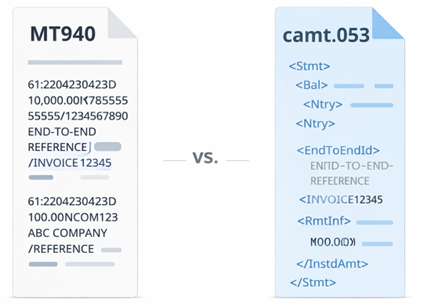
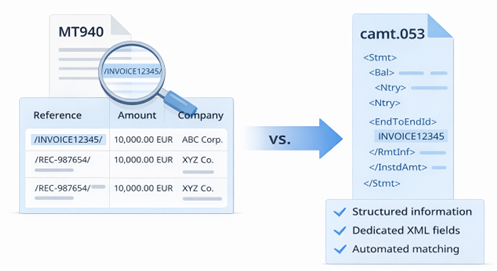
Cash reporting – meaning the provision and analysis of account information such as account balances and account statements – is undergoing a fundamental transformation as a result of the introduction of the ISO 20022 standard. The previous MT formats under the SWIFT FIN standard were based on text‑based messages with fixed tags and limited field lengths. Many details were transmitted in free‑text fields, which made automated processing difficult and often required additional interpretation logic in treasury systems.
With ISO 20022, a modern XML‑based standard has been introduced that structures data clearly and can transmit significantly more information using standardized elements. In cash reporting, this development is most evident in the camt formats, such as camt.053 for electronic account statements, which provide bank information in a much more detailed and structured manner.
Over the past two years, we have supported dozens of migrations from MT940/MT942 to camt.053/camt.052 across various industries. Although the starting point was comparable, the complexity and impact of these projects differed significantly due to client‑specific requirements, the diversity of system interfaces and the different ways information is processed.
Replacing the MT940 and MT942 formats with camt.053 and camt.052 has structurally transformed cash reporting. What initially appeared to be a simple format change proved, during implementation, to be a comprehensive data and process project affecting treasury systems, downstream workflows and collaboration with banking partners.
The key difference between MT and camt lies not only in the technical format but in the underlying data model. Whereas MT formats were highly text‑based and conveyed many details within a few freely usable fields, camt formats require information to be assigned to clearly defined XML elements. Details that were previously consolidated in the remittance information are now distributed across multiple fields, such as counterparty data, references and booking types. This structure provides a foundation for automation and more granular analytics, yet it also demands more precise processing within the treasury system.