Global payment systems are undergoing radical change. While cash is losing importance, central banks around the world are working on digital central bank money - not just as a technical innovation, but as a geopolitical tool to strengthen financial sovereignty. For treasury departments, the question is no longer if, but when and how CBDCs will impact liquidity management, payment processing and bank intermediation. This article looks at current developments in numerous national and international projects and initiatives in different countries and regions. We then look at the relevant changes that treasury functions can expect in the coming years.

      In the current geopolitical landscape, which is characterised by strong headwinds against financial globalisation, the topic of digital central bank currencies is becoming particularly important. Many countries are endeavouring to design their banking systems in such a way that they are less susceptible to external influences. For example, Russia has developed an alternative to SWIFT with SPFS, China is expanding its own cross-border payment system with CIPS, and India is focussing on a national solution with UPI, which is increasingly being used internationally. Similarly, the European Union's digital euro project aims to support "Europe's strategic autonomy and monetary sovereignty" and "contribute to the competitiveness and resilience of [Europe's] payment landscape against payment service providers from non-European countries".1

      At the same time, decentralised financial technologies (DeFi) are increasingly being recognised as an independent area of innovation that opens up new opportunities for financial transactions beyond traditional infrastructures. These are based on blockchain infrastructures and enable financial transactions without centralised intermediaries. They are considered an interesting alternative, particularly in geopolitically sensitive contexts, as they enable cross-border payments that are largely independent of traditional financial systems. At the same time, however, it is clear that stability and stable value continue to play a central role, which is why stablecoins, which are linked to established currencies, are becoming increasingly important and act as a bridge between volatile decentralised currencies and stable means of payment.

      International examples and pilots

      In this context, interest in digital central bank currencies is also growing, which is reflected in an increasing number of pilot projects, studies and international collaborations. Such digital currencies combine the desire for state sovereignty with the demand for technological innovation and elements of decentralised infrastructure: they enable nationally controllable payment transactions that do not have to be processed via foreign infrastructures and at the same time promote the efficiency, transparency and speed of digital payments. In 2024, cash accounted for only 24% of all everyday payments in the eurozone - compared to 40% in 2019 - which underlines the growing importance of a digital alternative to cash.2 We already discussed the definition and technical content of digital central bank currencies in detail in issue 134 of our newsletter dated 20 July 2023. However, technological developments have made this topic both theoretically and practically relevant today.

      Some countries are already pioneering the introduction of digital central bank currencies. For example, the Bahamas has been offering the "Sand Dollar" as a digital currency since 2020 and Nigeria the "eNaira" since 2021. These projects provide valuable and instructive insights into the potential impact of such initiatives. However, the world's most significant initiative in this area can be seen in China, where such a project for "e-CNY" has been in the test phase since 2020 and is gradually being introduced in several regions.3 By June 2024, the total value of digital currency transactions issued by the People's Bank of China had reached 7 trillion yuan (approximately USD 982 billion),4 which is almost four times the level of June 2023.5 Initiatives have also been taken to enable the use of digital currency for yuan payments in other countries, such as Vietnam and Cambodia.6

      China is pursuing a variety of targeted measures to promote the acceptance and use of the e-CNY. These include government-initiated pilot projects in major cities such as Shenzhen, Suzhou and Beijing, where citizens were able to receive digital yuan via lotteries or subsidies.7 The e-CNY has also been integrated into existing digital ecosystems, for example through compatibility with widespread payment platforms such as Alipay and WeChat Pay.8 In addition, the digital yuan is gradually being introduced as a means of payment in the public sector, for example for wages, social benefits or taxes.9 China is also promoting cooperation in a cross-border context - for example with Hong Kong or countries in Southeast Asia - to enable the international use of the e-CNY. This combination of technological integration, financial incentives and institutional support is intended to strengthen confidence in the new form of currency and accelerate its spread.

      As early as September 2024, 134 countries representing 98% of the global economy had launched various initiatives to explore the use of central bank digital currencies.10 However, there are also countries that have so far been sceptical about central bank digital currencies or have recently fundamentally reconsidered their stance. For example, in January 2025, the authorities in the United States were prohibited from taking measures to introduce, issue or promote central bank digital currencies in the United States or abroad.11 Fed Chairman Jerome Powell also declared in February 2025 that the central bank would not develop its own digital currency under his leadership (i.e. until May 2026).12 The decree also ordered the immediate suspension of all ongoing CBDC programmes and created a "Working Group on Digital Asset Markets", which is to submit draft regulations for digital assets and stablecoins within six months, among other things. In this context, increasing competition between stablecoins and digital central bank currencies is to be expected in the future, and their development should be closely monitored in the coming years.

      The global trend towards digital central bank currencies has also led to an increasing number of studies focussing on the interoperability of digital central bank currencies in different countries. The aim of these studies is to make cross-border payments more efficient, cheaper and faster, for example through common technical standards, harmonised legal frameworks and the development of multilateral settlement platforms.

      One prominent example is the mBridge project, in which the People's Bank of China, Hong Kong's Monetary Authority and the central banks of Thailand, the United Arab Emirates and Saudi Arabia (since 2024) have been working together since 2021, with many other countries and international organisations participating as observer members13. The aim of this pilot project is to create a common platform via which the digital central bank currencies of these countries can be used for cross-border payments in real time. Transactions are processed directly between the national CBDCs without the need for an intermediary correspondent banking system. In the long term, such networks of national CBDCs can lead to a significant reduction in bank fees and considerably faster processing times for international transactions, especially for the treasury departments of international companies.

      CBDC Technologist

      Depending on the country and project, different technologies are used in CBDC projects to enable the technical implementation of digital currencies. In this context, three main aspects can be distinguished: the operational model, the IT infrastructure and user authentication.14

      The operational model describes which actors are involved in issuing and managing the digital currency. This raises the question of whether the central bank assumes all operational tasks - such as account management, transaction processing or measures to prevent money laundering - itself (direct model) or delegates these tasks to financial intermediaries such as commercial banks or payment service providers (indirect model). A hybrid approach is also frequently chosen, in which the central bank issues the currency while selected intermediaries assume direct contact with the end users.

      In terms of IT infrastructure, both centralised systems and decentralised technologies - such as distributed ledger technologies (DLT) - are used. While centralised systems offer a high level of efficiency and controllability, DLT-based approaches promise greater transparency, reliability and potentially greater resilience against cyber attacks. The specific choice often depends on the desired scalability, governance structure and national IT framework conditions.

      There are also different models for user authentication. A basic distinction is made between account-based and token-based approaches. Account-based CBDCs require users to be uniquely identified and are particularly suitable for close integration into existing banking infrastructures. Token-based models, on the other hand, enable anonymised transactions in principle - comparable to cash - and could therefore offer attractive features, particularly for smaller payments in everyday life. However, they pose greater challenges in terms of regulatory requirements such as KYC (Know Your Customer) and AML (Anti-Money Laundering).

      Despite the growing interest in digital central bank currencies, their practical implementation poses a considerable challenge. The development and introduction of a CBDC requires not only technological innovation, but also far-reaching regulatory, economic and social adjustments. A large number of complex issues are therefore being addressed in pilot studies and test phases. These include ensuring data protection and cyber security, designing efficient mechanisms to prevent money laundering and identify users, ensuring interoperability with existing payment systems and managing monetary policy effects.

      In addition, issues relating to the technological infrastructure - such as scalability, energy efficiency and reliability - as well as user acceptance and user-friendliness are of central importance. The choice of the exact infrastructure also has far-reaching implications for user privacy. This is why many pilot projects are working intensively on evaluating the various technical options in terms of their impact on data protection and user rights. A delicate balance needs to be struck here: On the one hand, user rights and the confidentiality of transactions should be protected, while on the other, regulatory requirements such as combating money laundering and terrorist financing must be strictly adhered to.

      One intensively discussed solution is to allow anonymous payments up to a fixed maximum amount in order to ensure the protection of privacy in everyday life, while larger transactions are subject to stricter identification and control mechanisms.15 This multitude of technical-institutional interfaces makes it clear that CBDCs are far more than a purely technological project - they touch on fundamental aspects of the modern financial system.

      Status and outlook for the "D€"
      (digital euro)

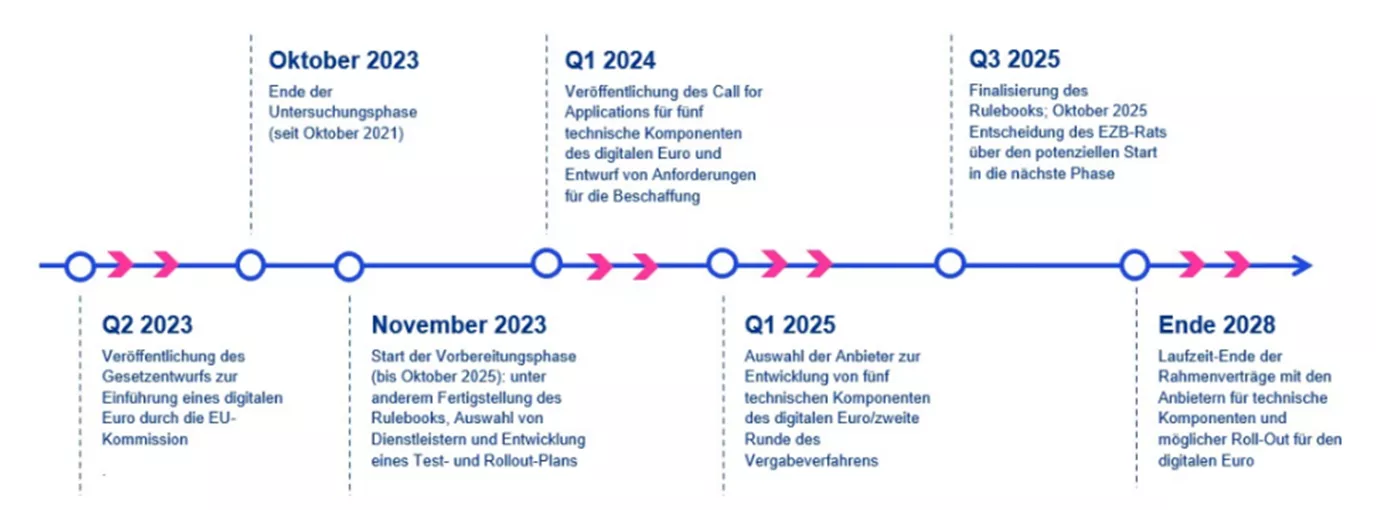
      The European Union is also working intensively on the development and introduction of the digital euro (D€). The official preparatory phase was already initiated in November 202316, with the overarching goal of strengthening Europe's strategic autonomy in digital payments17 and to provide a sovereign digital currency. It should be noted that non-European payment service providers currently process around two thirds of credit card transactions in the eurozone.18

      The published timetable envisages that the so-called "Rulebook" - a comprehensive set of rules for technical and regulatory implementation - will be presented by October 202519.

      The current draft of the rulebook was developed together with consumer organisations, banks and merchants and is based on over 2,500 responses. It contains specifications on how payments with the digital euro should work in the future - for example when used in shops, online or between private individuals. These include standardised rules for user-friendliness, technical processes, security requirements and protection against fraud. New functions such as payment by QR code or link and the option of using the digital euro offline are also planned. Account limits for private individuals and the role of banks in providing the digital euro will also be discussed. However, the Governing Council will not make the final decision on the introduction until the EU legislation has been finalised.

      The complexity and scope of the project are also reflected in the costs: to date, expenditure of around 1.2 billion euros has been estimated for externally awarded contracts, which does not include the costs of the technical infrastructure.20 This sum illustrates the high priority that the EU attaches to this project, as well as the extensive technical, legal and organisational challenges associated with the introduction of digital central bank money at EU level.

      In this context, the question of relevance for corporates and their treasury function arises. This is because a central component of the digital euro is the planned account limit, which sets a maximum upper limit for balances in digital euro accounts. The European Central Bank (ECB) sees this as an important instrument for safeguarding financial stability.21. The background to this is that an unlimited inflow of funds from commercial banks into digital euro accounts could lead to a rapid withdrawal of liquidity from the banking sector. This would restrict banks' refinancing options and potentially make lending to companies and private individuals more difficult. In general, according to the ECB, banks are still envisaged as a central part of the plan, as supervised financial intermediaries such as banks are to play a key role in the distribution of the digital euro.22

      At present, amounts of only between around 500 and 3,000 euros are being discussed as a possible upper limit for the balance in a digital euro wallet. However, payments that exceed this limit could be processed via a "waterfall system" in which the required additional funds are automatically debited from a linked bank account.23 However, final decisions on these issues have not yet been made.

      These points are important from a treasury perspective, as they represent a focus on the end user and influence the extent to which the digital currency can be considered for B2B transactions.24 To date, the digital euro has primarily been designed for retail transactions, B2C and the private sector - with usage limits, offline functionality and data protection features that were developed especially for private individuals. In terms of payment types, the digital euro project has so far focussed on person-to-person (P2P) payments, payments at the point of sale (POS), e-commerce and government transactions (G2X and X2G), including automatically triggered payments.25. GBusiness-to-business (B2B) payments, on the other hand, mark another developmental step to which the ECB has recently devoted increased attention26.

      For traditional B2B payments with larger volumes or regular processing, it remains to be seen whether and how integration can take place. The integration of B2B functionalities would make the digital euro significantly more relevant for the treasury of large companies and expand its potential use beyond the consumer sector. Treasury teams should therefore examine in which use cases CBDCs could actually be relevant - e.g. for refunds to customers, bonus programmes or micropayments in digital business models - as soon as more detailed information on the ECB's plans is available. From October 2025, the published "Rulebook" is expected to provide clarity on these and many other aspects of the EU plan for the digital euro.

      At the same time, survey-based studies are being conducted to test the hypothetical acceptance of such initiatives among the general public. For example, a study commissioned by the Deutsche Bundesbank in April 2024 showed that around half of those surveyed were in favour and could imagine using the digital euro.28 The same study also showed that for many respondents it is important that their privacy is better protected when paying with the digital euro than with existing digital payment methods.

      The work of the European Union is carried out in cooperation with the central banks of the respective member states.

      Over the next few years, it will be crucial to closely monitor the results of these pilot trials: How do technical feasibility, data protection, interoperability, liquidity management and monetary policy influence behave in practice? Only on this basis will it be possible to evaluate the extent to which CBDCs can complement or transform the existing financial system - and what specific effects this will have on treasury processes, bank intermediation and global liquidity.

      It is conceivable that the digital euro will go live in an initial operational expansion stage in the coming years. For treasury managers, the digital central bank money will create new operational and strategic scope - for example, through more efficient payment processing, supplementary payment channels or changed processing models in the cross-border environment, which can bring cost and competitive advantages if they are seamlessly integrated in the end-to-end process.

      At the same time, new dependencies are increasing: on regulatory limits, technical infrastructure such as wallet systems and the future mediating role of banks in the digital Eurosystem. In the long term, the role of treasury in payment transactions could change structurally - not abruptly, but with noticeable shifts, for example in the interplay of account limits, interoperability and integration into existing liquidity management processes.

      Those: KPMG Corporate Treasury News, Ausgabe 155, Juni 2025
      Authors:
      Börries Többens, Partner, Finance and Treasury Management, Corporate Treasury Advisory, KPMG AG
      Alexander Horn, Senior Manager, Finance and Treasury Management, Corporate Treasury Advisory, KPMG AG

      ________________________________________________________________________________________________________________

      1 https://www.ecb.europa.eu/euro/digital_euro/why-we-need-it/html/index.de.html
      https://www.ecb.europa.eu/press/inter/date/2025/html/ecb.in250228~7c25c90e4d.en.html
      3 https://www.atlanticcouncil.org/cbdctracker/
      4 https://www.atlanticcouncil.org/cbdctracker/
      5 https://www.reuters.com/business/finance/trump-could-spur-central-banks-adopt-digital-coins-peacock-2025-04-24/
      6 https://www.reuters.com/world/china/china-ramps-up-global-yuan-push-seizing-retreating-dollar-2025-04-29/
      7 https://cbdctracker.hrf.org/currency/china
      8 https://cointelegraph.com/news/wechat-integrates-digital-yuan-into-its-payment-platform
      9 https://edition.cnn.com/2023/04/24/economy/china-digital-yuan-government-salary-intl-hnk & https://cointelegraph.com/news/residents-of-3-chinese-cities-paying-taxes-and-charges-with-digital-yuan
      10 https://www.reuters.com/markets/currencies/central-bank-digital-currency-momentum-growing-study-shows-2024-09-17/
      11 https://www.whitehouse.gov/presidential-actions/2025/01/strengthening-american-leadership-in-digital-financial-technology/
      12 https://www.cnbc.com/2025/02/11/powell-squashes-the-possibility-that-the-fed-will-develop-its-own-digital-currency.html?&qsearchterm=powell%20cbdc
      13 https://www.bis.org/about/bisih/topics/cbdc/mcbdc_bridge.htm
      14 https://www.bfdi.bund.de/SharedDocs/Downloads/EN/Berlin-Group/20240613_WP-Cental-Bank-Digital-Currency-EN.pdf?__blob=publicationFile&v=2
      15 https://www.bundesbank.de/de/presse/interviews/-der-umgang-mit-den-usa-und-china-wird-rau--948702
      16 https://www.ecb.europa.eu/euro/digital_euro/progress/html/index.de.html
      17 https://www.ecb.europa.eu/press/key/date/2025/html/ecb.sp250408~40820747ef.de.html
      18 https://www.reuters.com/business/finance/trump-could-spur-central-banks-adopt-digital-coins-peacock-2025-04-24/
      19 https://www.ecb.europa.eu/euro/digital_euro/progress/html/ecb.deprp202406.en.html#toc4
      20 https://www.bundesbank.de/de/presse/interviews/-der-umgang-mit-den-usa-und-china-wird-rau--948702
      21 https://www.ecb.europa.eu/euro/digital_euro/how-it-works/html/index.en.html
      22 https://www.ecb.europa.eu/euro/digital_euro/faqs/html/ecb.faq_digital_euro.en.html#q6
      23 https://www.bundesbank.de/en/press/interviews/only-balances-of-500-allowed-what-the-digital-euro-is-intended-to-deliver-and-what-not-933704
      24 https://www.dertreasurer.de/news/cash-management/das-projekt-digitaler-euro-nimmt-fahrt-auf-35847/
      25 https://www.ecb.europa.eu/press/intro/news/html/ecb.mipnews240805.en.html
      26 https://www.bundesbank.de/en/press/speeches/envisioning-tomorrow-the-role-of-cbdcs-in-europe-s-digital-financial-ecosystem-945654
      27 https://klardenker.kpmg.de/financialservices-hub/der-digitale-euro-langsam-wird-es-konkret/
      28 https://www.bundesbank.de/de/presse/pressenotizen/bundesbank-umfrage-digitaler-euro-findet-als-bezahl-option-breite-akzeptanz-in-der-bevoelkerung-933320

      attach_email

      Bestens informiert über Aktuelles im Finance & Treasury Management.

      KPMG's team of experts will show you the right way forward in corporate treasury management.

      Learn more

      Here you will find an overview of the articles from the current and previous issues of Corporate Treasury News.

      Learn more

      Your contact

      Börries Többens

      Partner, Financial Services, Finance & Treasury Management

      KPMG AG Wirtschaftsprüfungsgesellschaft