

Comprehensive German regulations require special attention for inbound and outbound cases
1. introduction
Regulations on the relocation of functions in Germany
It is common practice in multinational groups to restructure business activities across borders. To determine arm's length compensation for the restructured business activities, most countries rely on the guidelines of the Organisation for Economic Co-operation and Development (OECD) in accordance with Chapter IX of the OECD Transfer Pricing Guidelines. According to the OECD guidelines, not every case in which profit potential is transferred automatically gives rise to a claim for compensation.
The German regulations on the transfer of functions, which apply to both inbound and outbound reorganisations, go far beyond the OECD requirements. With effect from the 2022 financial year, the requirements for a transfer of functions in accordance with Section 1 of the Foreign Tax Act ("AStG") have been tightened. A transfer of functions can now already be deemed to have taken place if a function, including the associated opportunities and risks as well as the transferred or provided assets or (previously: and) other benefits, is transferred. Further clarification was provided by the Transfer of Functions Ordinance 2022 and the Administrative Principles on Transfer Pricing 2024. The stricter regulations indicate that a transfer of functions does not necessarily require the transfer of assets, but that the receipt of other benefits could be sufficient, which will potentially lead to an increase in cases in which the German tax authorities assume a transfer of functions.
If the conditions for a transfer of functions are met in principle, a two-sided valuation must be carried out to determine an arm's length transfer price for the so-called transfer package.
This article provides an insight into the comprehensive German regulations on the transfer of functions.
2. definition of function relocation and escape clauses
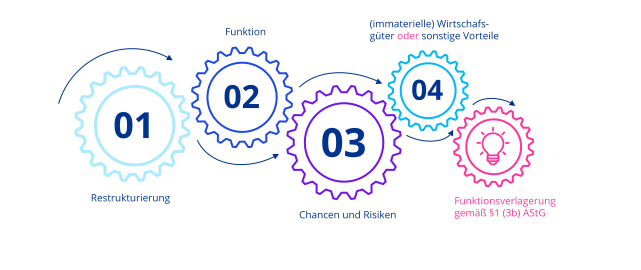
A transfer of functions exists if:
- a transfer or assignment of a function takes place in whole or in part ...
- including the associated opportunities and risks ...
- as well as the assets or other benefits transferred or ceded ...
- so that the function is exercised or expanded at the receiving company.
These requirements must be met cumulatively.
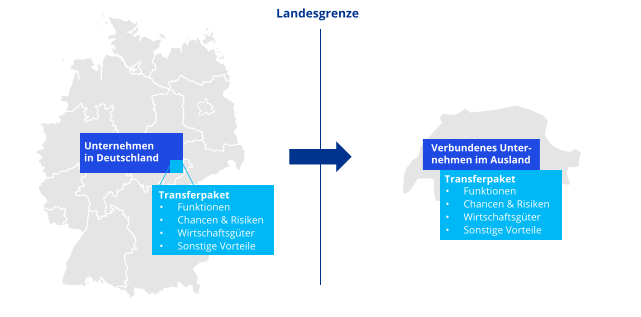
The transfer package consists of a function including the associated opportunities and risks as well as assets or other benefits. It does not necessarily have to be a legally independent unit or operating unit.
The Functional Relocation Ordinance 2022 generally defines a function as a business activity that "consists of a grouping of similar operational tasks that are carried out by certain units or departments of a company. It is an organic part of a company without necessarily being a business unit in the tax sense." Functions can be, for example, business activities from research & development, production, sales, assembly, etc. Risk management and DEMPE functions are also seen as functions in the context of a transfer of functions. In addition, the sale of certain products or product groups can also be considered a transfer of functions.
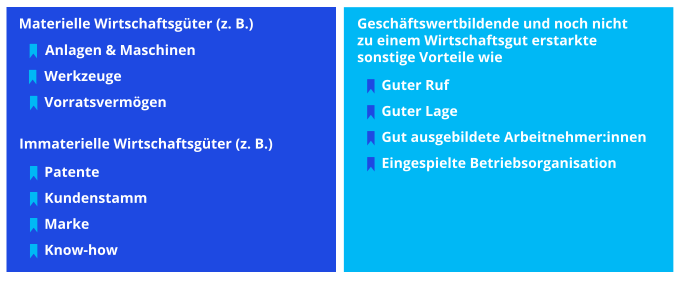
The following table shows a comparison of assets and other benefits that can be part of the transfer package.
The German regulations provide for two escape clauses:
- Outsourcing: If the remuneration of the transferred function is based on the cost-plus method and the function is performed exclusively by the receiving company vis-à-vis the transferring company, there is no transfer of function.
- Duplication of functions: If the transferring company is not restricted in the performance of the function within five years of the transfer of the function by the receiving company, although the other requirements for a transfer of functions are met, there is no transfer of functions.
3. hypothetical arm's length comparison
If the conditions for a transfer of functions are met, the taxpayer must determine an arm's length transfer price for the transfer package.
In the context of a transfer of functions, the valuation object is often unique. If no reliable comparative data from third parties is available, the taxpayer must apply the so-called hypothetical arm's length comparison ("HALM") on the basis of an economically recognised capital value-oriented valuation method (e.g. capitalised earnings value method, discounted cash flow method ("DCF"), royalty price analogy method).
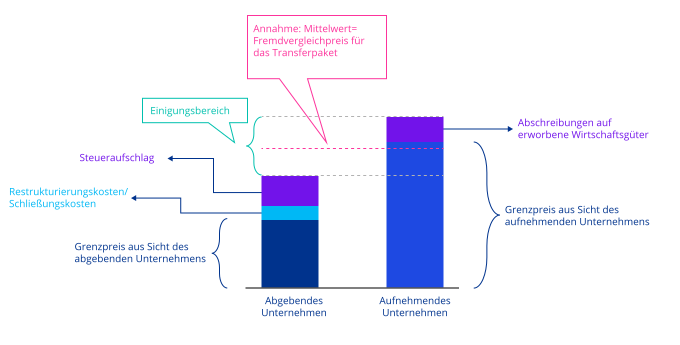
One feature of the German regulations on the transfer of functions is the obligation for a two-sided valuation. The DCF method is regularly chosen in order to determine a minimum price from the seller's perspective and a maximum price from the acquirer's perspective. The application of the HALM simulates the negotiation process between independent parties, at the end of which the price is determined at which both parties would be prepared to enter into the transaction.
As a result, a significant portion of the total profit potential of the transferred function is taxed in Germany, which corresponds to the expected loss of profit potential in Germany, but typically also half of the expected profit potential in the recipient country.
The following diagram illustrates the definition of the scope of the agreement.
4. other aspects to be considered in connection with the relocation of functions
A transfer of functions may have further consequences as well as reporting and documentation obligations:
- Conclusion of a purchase and transfer agreement with a price adjustment clause to set a review date for the bilateral valuation in order to avoid a subsequent review by the tax authorities after seven years.
- Notification of the transaction (in accordance with DAC-6 guidelines) to the competent German authority within 30 days.
- Preparation of transfer pricing documentation for exceptional transactions within six months of the end of the financial year in which the transfer of functions took place. In accordance with Section 90 (3) AO, this documentation must be submitted within 30 days of notification of the audit order without further request.
5. conclusion
The German regulations on the transfer of functions contain numerous special features for taxpayers that go far beyond the requirements of Chapter IX of the OECD Transfer Pricing Guidelines and therefore present stumbling blocks for many internationally active companies based abroad.
As function transfers are a current topic in German tax audits and lead to controversial discussions between taxpayers and tax authorities, it is important to carefully consider the aspects described above.
In our next newsletters, we will provide further insights into current case law on the relocation of functions, including case studies and the special case of the relocation of non-profitable functions.
Our KPMG transfer pricing experts will be happy to assist you with any questions you may have.
