

As part of company acquisitions, the acquirer regularly carries out a purchase price allocation (PPA). This involves allocating the purchase price to the identifiable assets and liabilities at fair value on the acquisition date. Although the PPA is primarily used for accounting purposes, it often includes valuations of intangible assets. This raises a key question: can a PPA serve as a reliable basis for determining arm's length transfer prices in subsequent business relationships between affiliated companies?
Can the values derived from purchase price allocations serve as reliable comparative values?
Transfer pricing methods for transfers of intangible assets: CUP vs. HALA
When determining an arm's length transfer price for business relationships between affiliated companies, the choice of the appropriate method is crucial. From a German transfer pricing perspective, two methods in particular are relevant when transferring assets: the comparable uncontrolled price (CUP) method and the hypothetical arm's length approach (HALA).
The CUP method is preferred if a comparable transaction between independent third parties can be identified. The price of the intragroup transaction is compared with the price of a comparable transaction with or between independent third parties. If a reliable CUP is available, this provides a strong and direct indication of an arm's length price and is preferable to the HALA.
However, in many cases - particularly in the case of unique intangible assets - no reliable price comparisons exist. In such cases, from a German perspective, the application of the HALA is regularly required.1 This approach constructs a theoretical arm's length price by simulating the conditions under which independent parties would negotiate a corresponding transaction. This involves the use of economic valuation approaches that require a careful analysis of the functions, the assets used and the risks assumed by all parties involved.
PPA as a potential CUP
From the perspective of the Organisation for Economic Co-operation and Development (OECD), valuations of intangible assets in PPAs are not relevant for transfer pricing purposes and should only be used with caution and taking into account the underlying assumptions.2 In practice, the question arises as to whether the valuations derived from a PPA can serve as a CUP in the transfer pricing context. A PPA is used to allocate the purchase price to identifiable assets and liabilities for accounting purposes. Although detailed valuations of individual intangible assets - such as brands, patents and technologies - are often performed, the main objective is financial reporting, not compliance with the arm's length principle. For reasons of proper accounting, the valuation of assets recognised in a company's balance sheet is sometimes based on conservative assumptions and estimates. Such an inherently conservative approach can lead to definitions that are too narrow for transfer pricing purposes and to valuation methods that are not necessarily consistent with the arm's length principle.3
Nevertheless, under certain conditions, a PPA can be a useful reference point for determining an arm's length price. For a PPA to qualify as a CUP for an intragroup transaction, the following cumulative conditions must be met: i) the intragroup transaction takes place without significant delay, ii) there are no material differences in the functional and risk profiles of the parties involved compared to the intragroup transaction. If these criteria are met, the values from the PPA can generally serve as a price comparison.
However, determining the transfer price requires a more detailed examination of the valuation parameters and assumptions of the PPA. For example, if the relief-from-royalty method was used to value intellectual property, the implied royalty rate must match the royalty rates observed in comparable third-party contracts. This usually requires a benchmark analysis to confirm the arm's length nature.
In practice, there are often differences between controlled and uncontrolled transactions - for example with regard to the functions, the assets used or the risks assumed. In such cases, adjustments to the PPA values are necessary. For example, a company-specific weighted average cost of capital (WACC) from the PPA may need to be adjusted to market conditions. Other valuation parameters - such as growth rates, discount rates or useful lives - should also be reviewed from a transfer pricing perspective.
The use of PPA as a CUP is illustrated in the figure below:
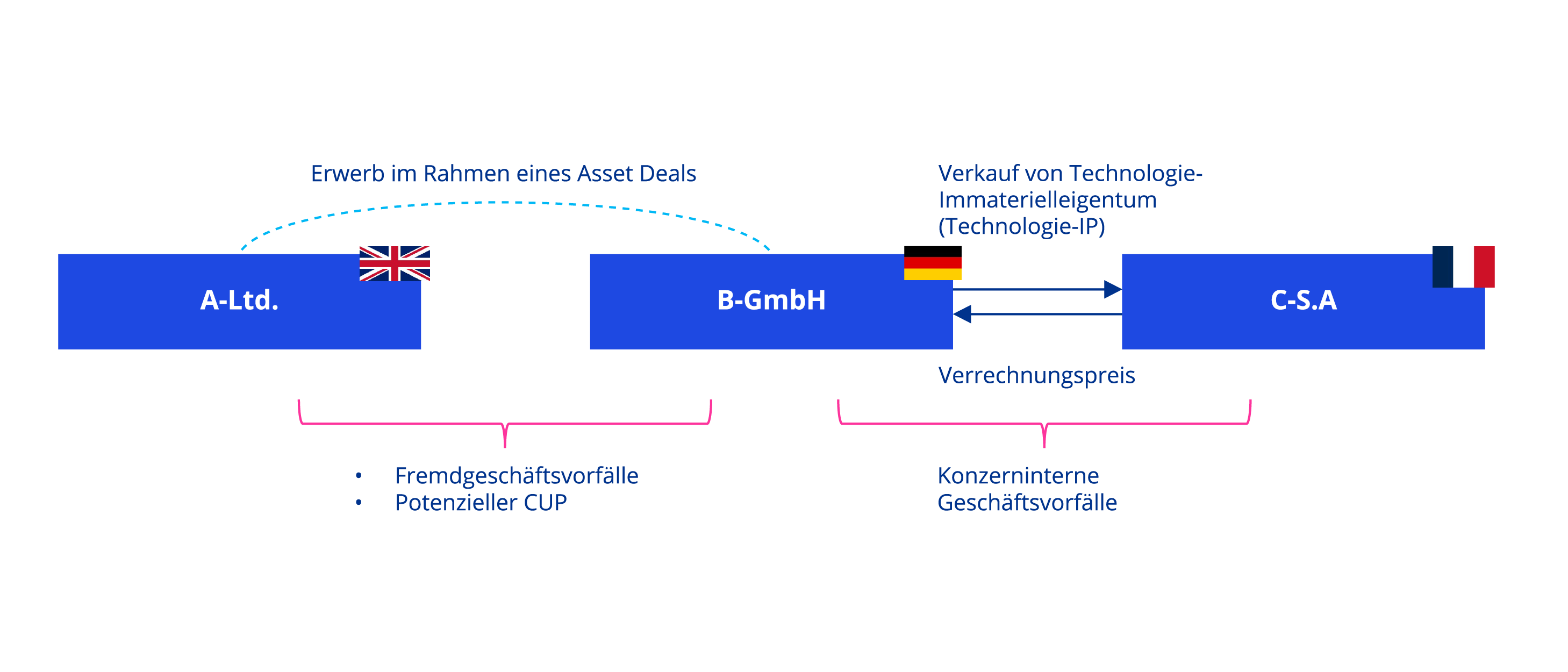
Application of the hypothetical arm's length comparison
If the differences between uncontrolled and controlled transactions are too large to be bridged by adjustments, the PPA cannot be used as a CUP. In such cases, the HALA must be applied in accordance with the German transfer pricing regulations.
The application of the HALA simulates the negotiation process between independent parties. This approach requires a detailed economic analysis of the transaction, taking into account the perspectives of both buyer and seller. It is particularly useful for unique or particularly valuable intangible assets for which no reliable price comparisons exist.
Even when applying the HALA, certain parameters from the original PPA may be relevant - provided they are not influenced by changes in the functional and risk profile. For example, the useful economic life of an intangible asset - such as a patent or software - can continue to serve as an input parameter in the HALA model if it reflects the actual useful economic life. Consistent assumptions can increase the credibility and consistency of the valuation. In addition, useful insights can be gained by reviewing estimates and assumptions that were used in the original negotiations of the company - B-GmbH in the example above.
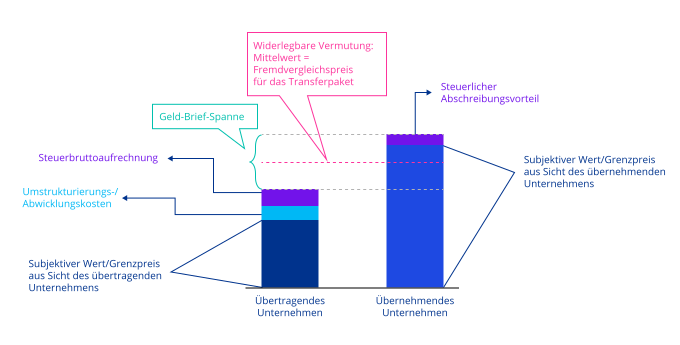
Conceptually, the HALA can be presented as a two-sided valuation model: On one side is the minimum price that the seller would accept, and on the other is the maximum price that the buyer would be willing to pay. The arm's length price lies within this range - where both parties would agree to a transaction. The following figure illustrates the calculation of the range of negotiated values.
Conclusion
To summarise, even if a PPA is not designed for transfer pricing purposes, it can serve as a useful reference point - possibly even as a CUP - under certain conditions. However, this requires a careful examination of the comparability of the transactions and the reliability of the valuation parameters. If there are significant differences or adjustments cannot be made sufficiently, the HALA should be applied from a German transfer pricing perspective.
Ultimately, the key to a defensible transfer pricing position lies in a thorough analysis of all facts and circumstances, supported by consistent and well-documented valuation methods. By understanding the interplay between PPA, CUP and HALA, taxpayers can better manage the complexity of cross-border asset transfers and ensure compliance with the arm's length principle.
Our KPMG transfer pricing experts will be happy to answer any questions you may have.
1 cf. section 1 (3) AStG
2 see para. 6.155 OECD Transfer Pricing Guidelines 2022
3 see para. 6.155 OECD Transfer Pricing Guidelines 2022
Publication date: 30.05.2025

Your contact

Michael Freudenberg
Partner, Tax - Head of Global Transfer Pricing Services
KPMG AG Wirtschaftsprüfungsgesellschaft