

In the context of German transfer pricing documentation regulations, the so-called extraordinary transaction ("AGV") is often neglected. Nevertheless, the German legislator has provided for strict regulation of the documentation of AGVs, as AGVs have the potential to shift considerable profit potential out of Germany (e.g. in connection with the relocation of functions). In this respect, pitfalls often arise in the context of German tax audits.
In contrast to regular transfer pricing documentation for ordinary business transactions ("AMCs"), AMCs require proactive and timely documentation within six months of the financial year in which the event took place. The new transfer pricing rules, which came into force on 1 January 2025, further tighten the already strict rules by introducing a requirement for proactive filing (i.e. previously on request, the filing period now starts as soon as the audit request is received). This article looks at the key aspects of documenting AGVs and highlights the importance of compliance and the impact of the recent regulatory changes.
Definition of extraordinary business transactions
The term extraordinary business transaction or AGV is an undefined legal term in German tax law. In general, AGVs must be seen as the opposite of so-called GGVs and therefore deviate significantly from the normal course of business, which often leads to significant changes in income. The following transactions can be regarded as extraordinary business transactions under German tax law:
- the conclusion and amendment of long-term contracts that have a significant impact on the amount of income of the taxpayer from its business relationships (e.g. tax audits often consider long-term loan agreements to be covered by this definition).
- Asset transfers as part of corporate reorganisation measures.
- The transfer and provision of assets in connection with significant changes to functions and risks within the company (e.g. relocation of functions or corporate restructuring).
- business transactions in connection with a change in business strategy that is significant for transfer pricing the conclusion of levy agreements.
As mentioned above, the most common case of an EGV is the (cross-border) transfer of functions within a multinational group that leads to significant operational changes (e.g. the relocation of a production function for certain products from Germany).
Review: Documentation requirements until 2024
The German legislator has always applied stricter standards for the documentation of AGVs than for the documentation of GGVs. Ordinary transfer pricing documentation could be prepared and submitted within 60 days of a request from the tax authority ("FA") (old legislation until 2024). The extraordinary transfer pricing documentation had to be prepared proactively and in a timely manner, i.e. within six months of the end of the financial year in which the extraordinary event took place and filed within 30 days of a request from the FA. Example: If an AGV occurred in 2023, the documentation had to be prepared by June 2024 (i.e. financial year ending in December). In this context, the difficulty for the FA was how to check whether the AGV documentation was actually prepared in a timely manner as long as it was submitted within 30 days of the request.
However, we have increasingly observed that tax audits in the recent past have tried to classify such documentation as unusable if it was not prepared within these deadlines and then estimate a higher income, while at the same time trying to shift the burden of proof to the taxpayer. In these cases, the question arose as to what could alternatively be considered as elements of timely documentation if necessary (e.g. old project documents, etc.) and to what extent it could be argued that (partially) late documentation had no bearing on its reliability in a specific case.
Documentation requirements from 2025
Significant new regulations for transfer pricing compliance came into force in Germany from 1 January 2025, introducing changes such as a shortened filing deadline of 30 days for extraordinary and ordinary transfer pricing documentation (i.e. local file including a newly introduced transaction matrix and master file. More on this in TaxNewsFlash - Transfer pricing documentation). The FA can also request transfer pricing documentation (ordinary and extraordinary) at any time (previously normally only during tax audits). A brief summary of the changes to the rules for submitting documentation for AGVs and GGVs can be found in the following table:
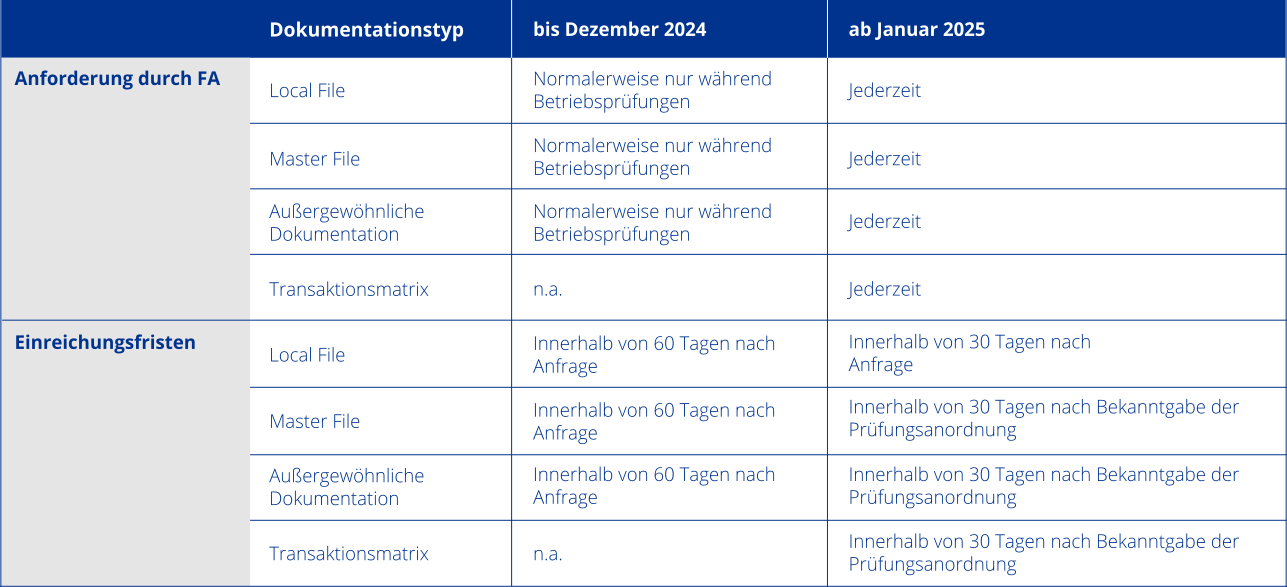
Not only has the submission deadline been shortened upon request (only for ordinary transfer pricing documentation), but the requirement for mandatory submission during a tax audit has also been introduced for the first time. From 1 January 2025, extraordinary transfer pricing documentation must be submitted within 30 days of receiving a notice of audit order. It is important to note that the notice of audit order does not have to explicitly include the requirement for ordinary or extraordinary transfer pricing documentation. The new submission deadline applies to transfer pricing documentation for all "open" financial years prior to 1 January 2025 if an audit order is issued for the relevant documentation period after 31 December 2024.
Conclusion and important considerations
The new and partially shortened filing deadlines (and in particular the requirement for proactive filing) may pose significant challenges for the preparation of sufficient extraordinary and ordinary documentation in the short term. In particular, internationally active groups with restructuring activities (relocation of functions from Germany) and/or business connections to Germany are therefore strongly advised to review their transfer pricing documentation in the coming months and update it if necessary.
If you have realised extraordinary business transactions in 2024, we recommend that you prepare the relevant documentation by 30 June 2025 in order to comply with the German requirements and be well prepared for future tax audits.
Our KPMG transfer pricing experts will be happy to answer any questions you may have.
Publication date: 27.03.2025
Your contact

Michael Freudenberg
Partner, Tax - Head of Global Transfer Pricing Services
KPMG AG Wirtschaftsprüfungsgesellschaft