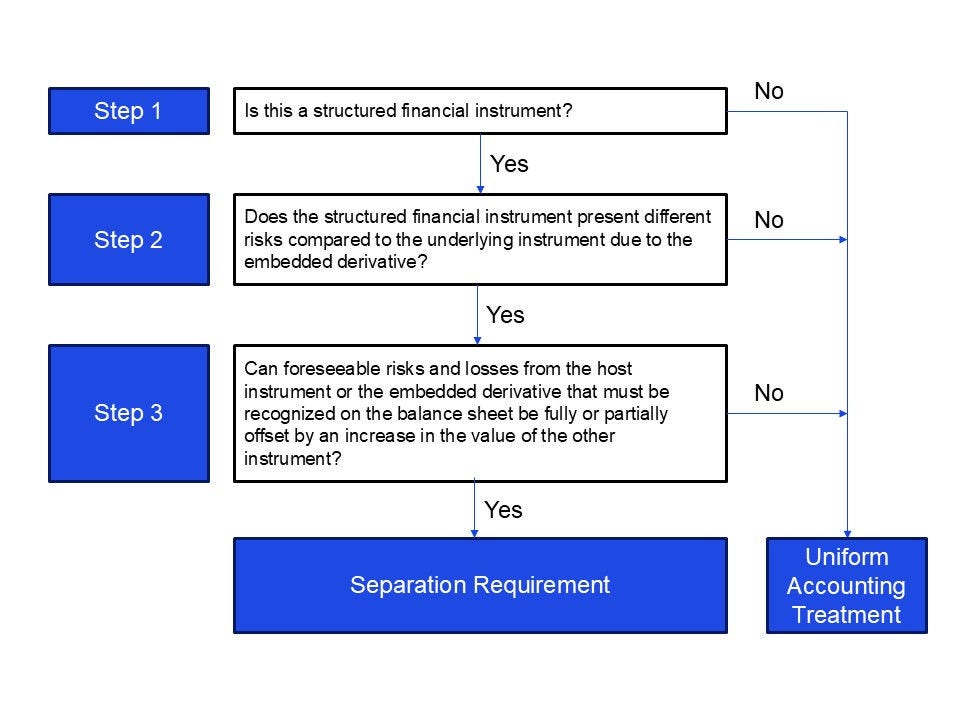
In February 2026, the Financial Reporting Expert Committee (FAB) of the IDW published the draft of a fundamentally revised statement on the accounting treatment of structured financial instruments under German commercial law (IDW ERS FAB 22). The draft is intended to replace the currently applicable IDW RS HFA 22 issued in 2015 and is to be applied for the first time to financial years beginning after 31 December 2026. The draft is currently still in the consultation phase and is primarily aimed at companies preparing financial statements in accordance with the provisions of the HGB and using structured financial instruments.
For structured financial instruments that were already accounted for prior to the initial application of the new standard, companies may continue applying the existing accounting treatment under IDW RS HFA 22 for simplification purposes.
The scope of application remains largely unchanged and continues to cover primarily traditional financial instruments such as bonds, loans or structured deposits, which in practice are often supplemented with additional contractual features. These include, for example, financings with variable or index-linked interest rates, early repayment options or payment mechanisms linked to specific market parameters. In practice, these are therefore often “classic” financing instruments whose cash flows are rendered more flexible or complex through additional contractual components.
The objective of the revision is to provide conceptual clarity and simplify the distinction between single-instrument and bifurcated accounting for structured financial instruments. While the previous standard was heavily based on a symmetrical view of opportunities and risks, the draft now explicitly places the German commercial law principle of prudence and the recognition of losses at the center of the analysis.
This shift in perspective is accompanied by a noticeable streamlining of the rules: numerous special cases, exceptions and illustrative separation tests included in the previous version are eliminated. At the same time, it is clarified that opportunities or value appreciation potential alone no longer trigger a requirement to separate components. The assessment therefore focuses consistently on prudence and loss recognition considerations, resulting in a more systematic and legally robust framework.
For corporate treasury functions, the draft entails in particular:
- a clearer, more principles-based decision logic
- less discretion in complex structuring scenarios
- and a greater focus on the question of whether and when loss risks must be recognized under German commercial law.
In the following, we compare the key changes introduced by the draft IDW ERS FAB 22 with the existing requirements and assess their implications for treasury practice.