

In recent years, the predictability of market cycles has decreased and the need to adapt quickly to changes has increased. While many DAX companies have undergone transformation programmes, adjustments in the SME sector have tended to be less extensive. These companies account for almost 90 per cent of all German companies and employ almost 57 per cent of the workforce.
The impact of global megatrends on family businesses and SMEs
Medium-sized, family-run companies should drive their transformations forward independently, utilising their advantages such as smaller management teams and a high level of transparency, but also taking into account restrictions in terms of financing and resources. Crucial details such as succession planning can drive the transformation, as they often require adjustments to governance structures.
But what factors need to be considered to ensure both resilience and the foundations for future growth in times of rapidly changing market conditions and global turbulence?
"PERFORM" plan
In our view, there are three decisive levers that should be addressed by company management as part of a given strategy.
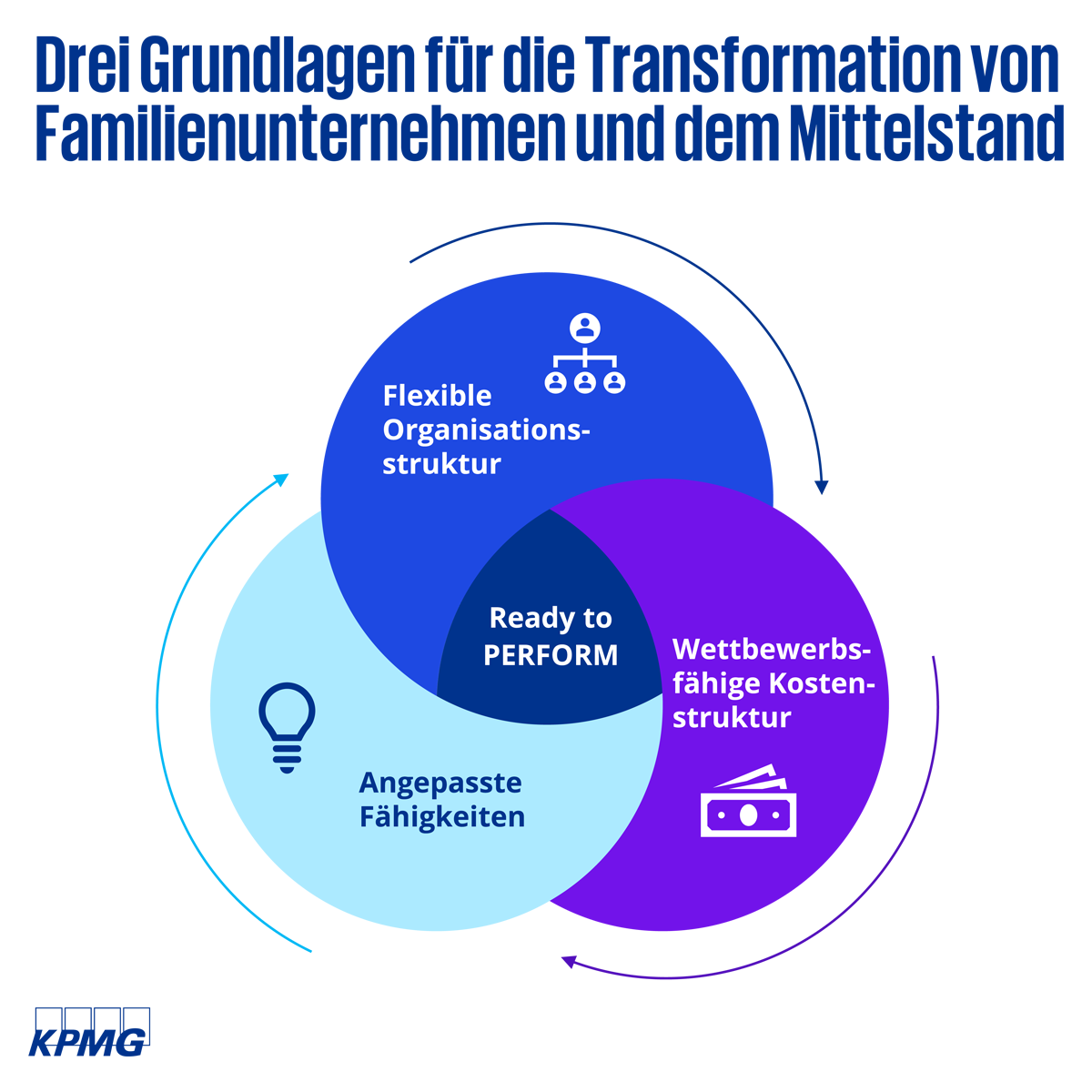
Flexible organisational structure
Under the responsibility of a coordinated management team, the organisation should be structured flexibly and have clear responsibilities. In volatile environments, this enables effective responses to organic and inorganic growth opportunities as well as a proactive approach to external business challenges.
Competitive cost structure
Transparency in cost structures and lean structures in the support functions ensure that the organisation can invest more strongly and flexibly in its core business.
Customised skills
Companies should clearly define the skills required for their strategy. An outlook on current and future requirements enables an optimised talent, recruitment and location strategy.
Flexible organisational structure
Under the responsibility of a coordinated management team, the organisation should be structured flexibly and have clear responsibilities. In volatile environments, this enables effective responses to organic and inorganic growth opportunities as well as a proactive approach to external business challenges.
Competitive cost structure
Transparency in cost structures and lean structures in the support functions ensure that the organisation can invest more strongly and flexibly in its core business.
Customised skills
Companies should clearly define the skills required for their strategy. An outlook on current and future requirements enables an optimised talent, recruitment and location strategy.
Standardised approach is not expedient
Every medium-sized company is different. That is why we do not rely on a standardised approach. We are convinced that a customised approach in cooperation with the company management and shareholders makes sense. However, our experience shows that some basic principles apply to all:
Coordination with the management and shareholders
To ensure the long-term success of transformations in family-run companies, owners and management should harmonise ambitions and restrictions at an early stage. This includes understanding the owners' preferred opportunity and risk profile and taking into account relevant influences and non-negotiables such as generational planning and independence.
Secure starting point
We believe it is crucial to create a data-based starting point for every transformation project. This has three advantages for every transformation project:
- A clear view of factual project restrictions
- Indications of potential that can be addressed in a PERFORM plan
- A coherent starting point against which project success can be measured
Together, these perspectives enable an understanding of corporate goals, potentials and limitations, which serve as the basis for formulating a "PERFORM" plan.
How companies can implement the "PERFORM" plan
We recommend that medium-sized, family-run companies create their plan using a flexible, modular and pragmatic approach that involves stakeholders in design workshops at an early stage. In this way, initial results can be achieved quickly based on a shared understanding of the requirements. The "PERFORM" plan should enable leaders to lead the transformation and achieve quick wins, but also to pursue long-term, structured initiatives to optimise the use of the company's resources and ensure flexibility and agility.
From the field: "PERFORM" plan for a family-run industrial company
A German family-run industrial company needed a customised transformation to improve its efficiency, profitability and performance during a generational transition. The PERFORM programme helped secure the foundation for future growth and resilience. It optimised service functions and overhead structures in sales, procurement, finance, HR, IT and marketing as the company prepared for its new growth strategy.
We first liaised with leadership and shareholders to define transformation guidelines and gather key data points. On this basis, the "PERFORM" implementation plan was created and the key departments were transformed. Experts conducted two-day workshops with senior team members from each department. Departmental structures were redefined, roles and responsibilities clarified and cross-departmental functions developed.
Within 14 weeks, the company initiated the most significant transformation in its history. The result: improved decision-making, fewer process errors, increased profitability and efficiency and strengthened competitiveness in the industrial manufacturing sector.
Your contact

Frédéric Pirker
Partner, Performance & Strategy, Enterprise Performance
KPMG AG Wirtschaftsprüfungsgesellschaft