Source: KPMG AG
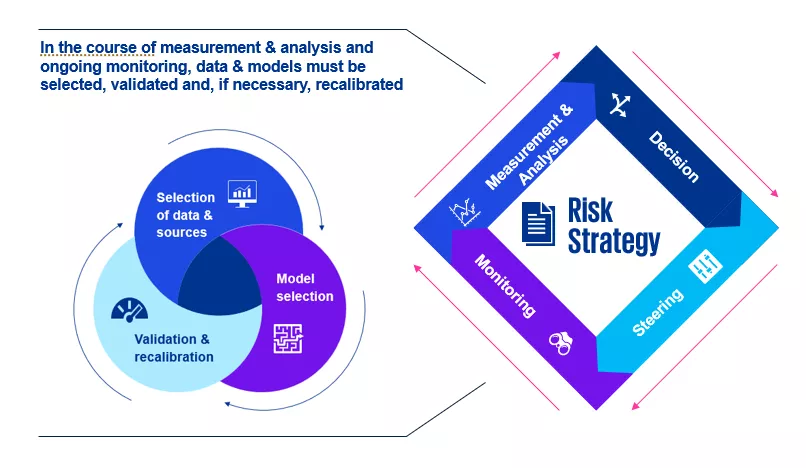
The following remarks primarily relate to the determination of the probability of default.
In the simplest case, data provided by rating agencies can be standardised to a uniform measure with the aid of translation tables. For example, a Baa rating from Moody's corresponds to a BBB rating from Standard & Poor's or Fitch and harbours a moderate credit risk (https://www.boerse-frankfurt.de/wissen/wertpapiere/anleihen/rating-matrix) with an average probability of default of 1.9% p.a. (https://www.deltavalue.de/credit-rating/). It should be noted that ratings are generally prepared for capital market-oriented companies or companies that want to present themselves to a mostly international investor audience.
Credit agencies or credit insurers can act as information service providers for small or medium-sized companies. Here too, the data is provided in various formats, for example a Creditreform creditworthiness index of 208 corresponds to an annual probability of default of 0.12% (https://www.creditreform.de/loesungen/bonitaet-risikobewertung). A Dun & Bradstreet Failure Score between 1510 and 1569, on the other hand, means an average default risk of 0.09% per year (https://www.dnb.com/resources/financial-stress-score-definition-information.html). Regional expertise should also be taken into account when deciding on a data provider. Schufa, for example, has a high level of market coverage in Germany, while Kreditschutzverband is the leader in the Austrian market (https://www.finanz.at/kredit/kreditschutzverband/).
Advanced approaches use scorecards in which various criteria, such as balance sheet ratios or macroeconomic factors, are weighted and summarised into a probability of default using a corresponding credit risk model. In addition to the service providers mentioned above, possible sources for this data are the respective commercial registers. These provide annual financial statements or balance sheets. However, it is also conceivable to connect market data providers such as Refinitv or Bloomberg and, for example, take into account interest rates, CDS spreads, unemployment figures or inflation figures in the analysis, which can either provide direct information about the company or about the economic framework in which it operates.
Recently, additional data sources have also come into focus, such as content in social media and other publicly available information on the internet. However, there is also a risk of obtaining a subjectively distorted picture that may have been created on the basis of herd effects, for example if many people indiscriminately subscribe to an opinion that is then interpreted as relevant or correct and is not necessarily rational. On the other hand, information could also be available here that indicates risks far earlier than is the case with conventional data sources, which are often published with a time delay. The insolvency of Silicon Valley Bank is a good example of this. On 9 March 2023, before the start of trading, investors were already intensively exchanging information on Twitter, presumably fuelling the bank run that caused the bank to collapse on 10 March 2023 (https://fortune.com/2023/05/02/did-twitter-cause-silicon-valley-bank-run-financial-panic-economists-research/).
The valuable company information that can be incorporated into the analysis, such as the historical payment behaviour of customers, should also not be underestimated. The challenges here often lie in the insufficient availability of data, which is often due to fragmented IT landscapes. Another question arises with regard to interpretation. If a counterparty has never paid late or even defaulted, can this counterparty be considered risk-free?
In light of rapidly advancing technological developments, modern approaches integrate artificial intelligence into the analysis process. However, it is necessary to create the right conditions for this. Artificial intelligence must be adequately "trained" using data. A high level of data quality must be ensured, regardless of whether the data is available in-house or obtained externally. Common problems are: Inconsistency, inaccuracy, incompleteness, the presence of duplicates, obsolete information, irrelevance, lack of standardisation and others (cf. https://www.forbes.com/sites/garydrenik/2023/08/15/data-quality-for-good-ai-outcomes/). The first approaches for tools are already providing a remedy by using artificial intelligence to perform quality assurance and data cleansing (https://blog.treasuredata.com/blog/2023/06/13/ai-ml-data-quality/) Large language models have also found their way into credit management, for example in the processing of companies' annual financial statements. They already provide employees with relevant information in compressed form or feed default probability models directly with the necessary data for further processing.
In addition to quality, a sufficiently large number of data points is required to increase the informative value of a forecast produced by an AI model. However, even with sufficient data quality and quantity, there is still the risk that correlations in the historical data are only partially captured, for example the supply chain disruptions caused by the container ship "Ever Grand" running aground in the Suez Canal in March 2021, the ECB's historic interest rate turnaround at the beginning of 2022 or the Houthi attacks on trade routes in the Red Sea, which lead to monthly additional costs in the double-digit million range for Hapag Lloyd alone (https://www.wiwo.de/politik/ausland/rotes-meer-diesen-einfluss-hat-der-konflikt-mit-den-huthi-auf-unternehmen/29597872.html). Such events and their consequences reinforce the multi-crisis environment mentioned in the KPMG study. Here, the utilisation of data from news and social media offers a real opportunity to balance out this historical distortion (https://fastercapital.com/de/inhalt/Trends-bei-der-Kreditrisikoprognose--So-bleiben-Sie-mit-Trends-und-Innovationen-bei-der-Kreditrisikoprognose-auf-dem-Laufenden.html), as the machine can analyse huge amounts of data very quickly and recognise potential correlations that remain hidden to humans or cannot be identified at the same speed.
The use of artificial intelligence therefore offers advantages, especially when processing mass data. On the other hand, excessive use can lead to blind trust in the technology, although the phenomenon of AI hallucinations has already attracted a great deal of attention and has led to data protectionists filing complaints against Open AI (https://www.zeit.de/digital/datenschutz/2024-04/datenschutz-chatgpt-open-ai-beschwerde). There is also a risk that (sometimes unconscious) prejudices contained in the source data may have an undesirable influence on the result. For example, companies that are currently experiencing a strong media presence could be favoured, although this does not necessarily correlate with creditworthiness. To prevent this, it is advisable to always have AI provide transparency about how decisions were made and which sources were analysed. This continues to pose major challenges for current models and approaches.
Regardless of the type of model used, it must always be checked whether it is still up to date and delivers reliable results, especially in the case of non-linear, complex and unique framework conditions. For example, the expected default risks of many borrowers increased during the COVID pandemic due to supply bottlenecks or impairment of the business basis, for example in the catering industry. However, this development was partially counteracted by adjustments to German insolvency law and intensive financial measures. This experience shows that even short-term, very comprehensive model adjustments may be necessary in order to adequately assess the current reality.
The models used should therefore always be powerful, stable, rational and efficient. Combinations of statistical models and artificial intelligence could contribute to an improvement in credit risk forecasting in the future. In any case, the benefits predicted from the use of the models must be subjected to a comprehensive cost analysis and the framework conditions in the company itself and the market environment must be taken into account.
Those: KPMG Corporate Treasury News, Issue 145, July 2024
Authors: Nils Bothe, Partner, Finance and Treasury Management, Corporate Treasury Advisory, KPMG AG
Philipp Knuth, Senior Manager, Finance and Treasury Management, Corporate Treasury Advisory, KPMG AG