In today's business world, ensuring liquidity is a strategic necessity. Companies are confronted with volatile markets, geopolitical tensions and unpredictable economic developments. In this environment, companies are looking for innovative ways to manage their working capital efficiently while optimising their financial strategies. One increasingly common solution is dynamic discounting, which enables companies to pay their suppliers before the invoice date and grant flexible discounts.

      This tool has been around for a number of years, but has become increasingly popular due to the economic situation and improved technical conditions.

      More than just a financial buffer: strategic influence on working capital

      A company's current assets play a key role in its financial health and ability to act. It not only serves as a buffer to bridge liquidity bottlenecks, but also forms the basis for investments and the ability to react dynamically to market changes. Effective working capital management creates the necessary balance between liquidity and profitability and helps to minimise financial risks. Targeted management of working capital should be deeply embedded in the strategic orientation of a company. Optimised management of liabilities enables companies to plan their cash flow efficiently, reduce capital costs and improve their competitive position.

      Dynamic discounting supports this strategy by managing current assets in a targeted manner. By making early payments, companies can actively organise their liabilities and thus reduce their capital costs. The increase in efficiency in the management of working capital leads to a more stable cash flow, which in turn increases the financial scope for investment in innovation and expansion.

      Especially in times of economic uncertainty, a stable cash flow is crucial in order to avoid financial bottlenecks and react flexibly to challenges. Companies that integrate dynamic discounting into their financial planning can preserve their liquidity while ensuring long-term stability.

      Early payments, flexible use

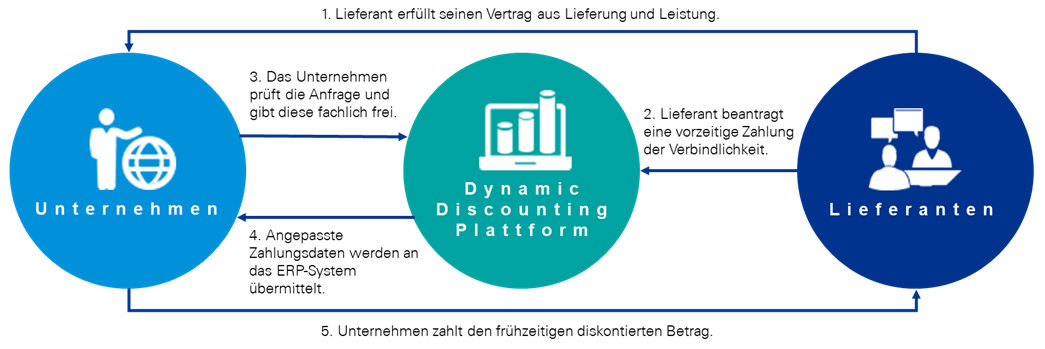
      Dynamic discounting allows companies to offer their suppliers early payments that are discounted over the remaining term of the liability, depending on when the payment is made. Unlike factoring, where a third-party provider, often a bank, is involved, the financing is provided entirely from the company's own funds. This gives companies more control over their liquidity and allows them to strengthen direct relationships with their suppliers. The following diagram illustrates the process of an exemplary programme:

      Abb. 1

      With this solution, companies can not only benefit from cash discount advantages, but also stabilise their cash flow and optimise their working capital. Suppliers who want to be paid early can react flexibly to the company's offers. This not only strengthens supplier relationships, but also improves the company's financial freedom for its own investments.

      Advantages of dynamic discounting

      This option offers companies a number of advantages that go far beyond mere liquidity management:

      • Improving cash flow: By making early payments to suppliers, the company can actively manage its liabilities and optimise cash flow.
      • Cost savings: Early payments allow for discounts on payables, which significantly reduces the cost of capital.
      • Strengthening supplier relationships: Suppliers benefit from earlier payment, which increases their financial stability and strengthens co-operation.
      • No external financial partner required: Financing is provided from the company's own resources, eliminating the need for a banking partner and avoiding additional costs and complexities.
      • Flexibility in liquidity management: Companies retain control over the timing and amount of payments, allowing them to manage their liquidity as required.

      Digitalisation as a lever for precise control

      There are a large number of fintech providers for dynamic discounting solutions, which can vary in their design. Providers of these solutions include Taulia, C2FO and Kyriba, which specialise in the digitalisation of working capital solutions. The company relies on cloud-based platforms that can be seamlessly integrated into existing ERP systems. These platforms enable companies to manage their liquidity in real time and flexibly decide which discounts to grant their suppliers. The result is a scalable solution that can be optimally adapted to a wide range of market conditions.

      However, implementing this in practice is no trivial matter. The target operating model of the finance department (TOM) must be harmonised with the digital solution in order to ensure smooth implementation and use. The integration of dynamic discounting into existing end-to-end processes - from purchasing to accounting to treasury - can only be optimised with a customised TOM. A seamless connection with ERP systems also ensures that all relevant data such as invoices, payment terms and liquidity planning are synchronised in real time, which further automates the entire process.

      Another important aspect is the integration of suppliers. They must be integrated into the platform and encouraged to actively participate. The added value must also be communicated to external participants, as tangible effects can only be achieved with a critical mass. It is usual to start with the key suppliers. Successful implementation therefore requires targeted communication strategies and training measures in order to convincingly convey the added value of dynamic discounting.

      In addition to integration into existing processes, it must also be ensured that the various payment formats and regions in which the company operates are taken into account. The platform must be able to map different currencies and country-specific requirements in order to enable global utilisation.

      Digitalisation also makes it possible to automate the entire payment processing procedure. With automated systems for creating and accepting quotes, companies not only reduce manual errors, but also increase the efficiency of their processes. Suppliers can view these offers in real time and decide flexibly when they want to accept payments.

      Conclusion: A modern tool for liquidity management and strategic financial planning

      Dynamic discounting is therefore not only a means of improving liquidity, but also a strategic tool for optimising working capital. By actively managing liabilities and integrating digital solutions, companies can improve their financial stability, take advantage of growth opportunities and minimise risks - all without having to rely on external financial partners. In an increasingly uncertain economic environment, dynamic discounting can be a decisive lever for a company's long-term success.

      Source: KPMG Corporate Treasury News, Issue 147, September 2024

      Authors:

      Börries Többens, Partner, Finance and Treasury Management, Corporate Treasury Advisory, KPMG AG

      Daniel Lichtenberg, Manager, Finance and Treasury Management, Corporate Treasury Advisory, KPMG AG

      More KPMG insights for you

      Finance & Treasury Management

      KPMG's team of experts will show you the right way forward in corporate treasury management.
      Fallschirmspringer FTM

      Your contact

      Börries Többens

      Partner, Financial Services, Finance & Treasury Management

      KPMG AG Wirtschaftsprüfungsgesellschaft