In-house banking has become an important tool for companies to optimise some of their key financial operations and minimise risk. In recent years in particular, interest from companies has risen sharply and some interesting trends and developments have emerged in this area.

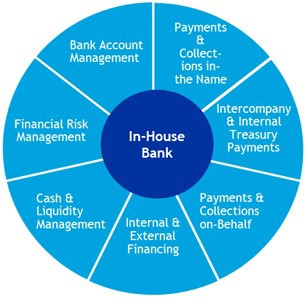
      As the term in-house bank is used very differently in literature, industry and the market for treasury management systems (TMS), we would like to start with a definition that is as practical as possible. By in-house bank, we mean a group of essential services (shown below) that companies typically obtain from an external bank, which is made available to the company and its subsidiaries via an internally operated counterpart, the in-house bank.

      Abb. 1: In-House Bank

      Kreisdiagramm-Abbildung

      Those: KPMG AG


      The following four key trends can be observed across the industry in the functional areas presented, which can be divided into system and functionalities, compliance, data quality and cash management integration.

      1. Technological innovations


      In-house bank as an integrated part of a TMS

      The traditional providers of treasury management software in particular have invested a great deal in the area of in-house banking in recent years. The respective modules in this area are more technically mature and have a wider range of functions than a few years ago, the convenience for users has increased and the options for integration into other modules, such as daily planning, liquidity planning or reporting, are now fully developed. These developments facilitate and shorten the technical introduction.

      => Market maturity: high


      Integration of payment and trading platforms

      A second stage of technical innovation is the integration of various external platforms for virtual credit cards, digital wallets and the first cryptocurrencies into in-house banking systems. These enable payments to be processed more quickly and international transactions to be carried out more cost-effectively. Integration with trading platforms has also become even more convenient. Most TMS providers have a standardised API to the platforms, which saves companies from having to operate their own interface.

      => Market maturity: medium


      Artificial intelligence and co.

      There are also initial prototypes in the area of innovative technologies that could soon be ready for the market. Predictive analytics with the support of AI in the areas of liquidity planning, account statement processing, risk management and reporting are some of the already known use cases from treasury. The use of blockchain for communication with banks is another. Interesting here is the first productive proof of concept of a company's own blockchain-based coin for the settlement of internal receivables and liabilities at some companies. Although the opportunities for treasury appear to be very high, driven by the media attention, system providers and companies are still in the development phase.

      => Market maturity: low

      2. Stricter compliance requirements

      With increasing regulatory requirements and growing risk awareness, companies are placing greater emphasis on adhering to compliance regulations. TMS with in-house bank modules are therefore increasingly being equipped with functions for monitoring transactions to prevent fraud and to comply with regulations such as KYC (Know Your Customer) and anti-money laundering guidelines.

      3. Increased use of data analyses

      Companies are increasingly using data analysis tools to gain insights into their cash flows and make informed decisions. By analysing transaction data on the one hand, companies can anticipate liquidity bottlenecks, identify payment patterns and optimise their cash management strategies. In addition to transaction data, well-maintained master data is also becoming more important in order to ensure efficient processes. Acquisitions in particular quickly create a data graveyard that persists for years. For example, multiple sets of supplier master data make so-called whitelisting in payment transactions virtually impossible.

      4. More comprehensive cash management solutions

      In-house banking systems are developing into key data suppliers for cash management through the aforementioned integration of modules within a TMS, in particular functions such as liquidity planning, cash pooling and risk management. Only when these are fully interlinked in the form of short-term planning and classic 13-week planning is comprehensive and efficient liquidity management possible.


      Overall, companies are faced with the challenge of keeping pace with the constantly changing requirements for financial management and compliance. However, especially in treasury, companies are constantly working on ways to make their processes more efficient and secure. However, by implementing innovative technologies within and outside their TMS and integrating platforms, they can optimise their in-house banking systems and thus their financial processes. It pays to stay on the ball here. A cost/benefit analysis shows which trends can create added value for your company.

      Those: KPMG Corporate Treasury News, Ausgabe 142, April 2024
      Authors:
      Nils Bothe Partner, Finance and Treasury Management, Corporate Treasury Advisory, KPMG AG
      Hansjörg Behrens-Ramberg, Senior Manager, Finance and Treasury Management, Corporate Treasury Advisory, KPMG AG

      More KPMG insights for you 

      Finance & Treasury Management

      KPMG's team of experts will show you the right way forward in corporate treasury management.
      Fallschirmspringer FTM

      Your contact

      Nils A. Bothe

      Partner, Financial Services, Finance & Treasury Management

      KPMG AG Wirtschaftsprüfungsgesellschaft