Back in 1994, Bill Gates said: "Banking is necessary, banks are not". This motto gained renewed relevance in the aftermath of the 2007/08 financial crisis when the weaknesses in the banking sector became apparent and young companies set out to exploit these weaknesses to their advantage by using new technologies (Financial Services + Technology = FinTech).

      Since then, many new business models and companies have emerged that are particularly popular with private users and have become an integral part of everyday life, such as Wise, Robinhood and N26.

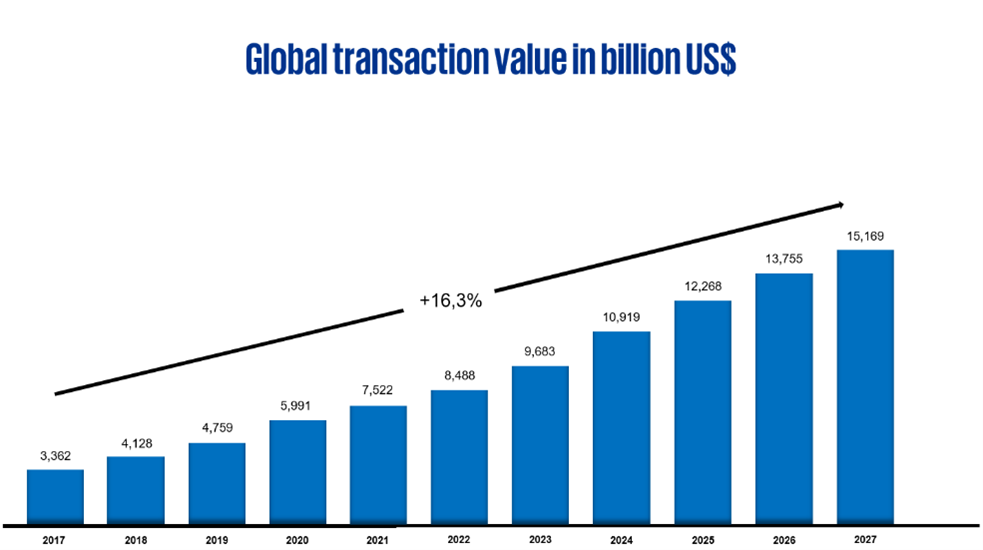
      The market for digital consumer payments alone is expected to grow by 16.3% p.a. by 2027. 


      Grafik: Market Data Analysis and Forecast
       

      Source: statista Report FinTech


      These and other developments pose challenges for treasury departments, but also offer opportunities to make a sustainable contribution to overall corporate success through innovation and cost efficiency. 

      Further on, the FinTech, start-up and new solution offerings along the treasury task spectrum are identified and the potential added value analysed.

      Cash- und Liquiditätsmanagement

      The disruptive potential of new solutions is changing various aspects of cash and liquidity management. This is where efficiency, transparency and control can be increased.

      Real-time insights into liquidity: The tools provide corporate treasuries with real-time insights into their liquidity positions. These tools analyse cash flows, investment and repayment plans in real time and provide a comprehensive overview of a company's liquidity.

      Cash and liquidity forecasting: Predictive analytics and machine learning can be used to more accurately forecast cash and liquidity needs. These forecasts can help treasurers to reduce necessary liquidity buffers and, as a result, liquidity costs.

      Financing: More efficient and flexible financing options are the focus of the solutions on offer. For example, platforms for syndicated loans, blockchain promissory notes or bonds and pay-per-use models are used. New providers of innovative supply chain finance solutions are also entering the market in the area of working capital management. 

      Investment: Innovative platforms, robo-advisors and automated trading systems make it easier for companies to explore and manage investment opportunities for surplus liquidity in various asset classes, taking individual risk preferences into account. Providing data-driven insights, advanced analytics and cost-effective investment options helps treasurers optimise financial performance.

      Examples include: HighRadius (AI-based order-to-cash and treasury management provider), Tesorio (cash flow forecasting and management) and GTreasury (comprehensive treasury management system provider), Taulia (supply chain finance), Othoz (AI-based investment strategies), Treasuryspring (financing and investment provider) and VC Trade (platform for private placement of debt financing offers), Finledger (blockchain platform for the settlement of promissory notes)

      payment transactions

      The digitalisation of payment transactions has far-reaching consequences for treasury departments.

      Changes in the B2C environment: Consumer behaviour has changed massively in recent years, particularly in the areas of digital commerce (online shopping and direct payment), mobile point-of-sale payments (payment by smartphone via wallets or other mechanisms) and digital remittance (especially cross-border payments, often peer-to-peer).

      In addition, an entire ecosystem of additional services is being created around payment processing, for example an expansion of the range of services to connect to online shops (payment gateways) or through the implementation of buy-now-pay-later offers. This creates additional flexibility in the B2C sector, which can potentially result in greater customer willingness to buy and therefore higher sales.

      New digital currencies are also gaining relevance. For example, Tesla accepted Bitcoin payments and El Salvador introduced Bitcoin as its national currency. Although the success and the knock-on effect have not materialised, some central banks are looking into implementing central bank digital currency (CBDC). This will potentially lead to faster and cheaper cross-border payments, greater transparency and security and a boost to the digital economy.

      Changes in the B2B segment: The Payment Service Directive II & III, which obliges banks to open up their infrastructure and enable third-party services by providing data via Application Programming Interfaces (APIs) (Open Banking), opens up the market to competition and promotes innovation.

      An important development in corporate banking is real-time transfers, which allow more precise planning of money movements and can therefore reduce liquidity costs.

      It is also possible to check whether customers' bank accounts actually exist. This currently still requires penny testing.

      In addition, buy-now-pay-later models are also being implemented in the B2B sector, allowing companies to set themselves apart from the competition, as credit checks and debt collection processes are too expensive, especially for small companies.

      Treasury as a corporate FinTech: In the past, FinTechs were primarily active in the B2C segment and development in the corporate client business was slow, but the new technologies and providers will also become established in payment transactions between companies. Treasury must define a strategy with global standards for dealing with FinTechs that defines a framework for action that fits the overall corporate strategy. It is also necessary to build up the necessary technology expertise to accompany the IT implementation or connection to ERP & treasury management systems so that a frictionless customer experience is made possible. Furthermore, the effects on cash and liquidity planning need to be analysed, as not every service provider provides daily or even real-time settlements or the existing credit balance is actually paid out in full.

      For example, the following should be mentioned here: 

      • AliPay, Venmo, Paypal, amazonPay, Shopify, Mondu, Adyen (digital commerce)
      • ApplePay, Samsung pay, paytm (mobile POS payments)
      • Wise, Remitly Xoom (digital remittance)
      • Yodlee (fraud prevention - checking the existence of accounts)

      Bank Management

      Although the FinTechs have set out to replace the banks, it is clear from the market that this seems unlikely, at least in the short term. Some neobanks have established themselves, but other specialised FinTechs are increasingly focusing on collaboration in order to serve corporate customers and thus treasury departments more comprehensively. Therefore, the management of banking relationships will most likely continue to be necessary. 

      Improved cost tracking and reporting: Cost analysis and management is a crucial aspect of bank management. Fintech apps and software provide cost tracking and reporting tools that simplify the process. This creates transparency, which is the first step towards optimising costs.

      Neobanks: offer digital business bank accounts that can be opened and managed entirely online. These accounts often have lower fees and lower account management fees compared to banks. Many neobanks offer APIs for various financial services, including account opening. This optimises the onboarding process. Multibank APIs for instant account opening allow users to access a wide range of banking services and open accounts with multiple financial institutions through a single interface.

      Examples include: Stripe (payment processing platform), NDepth & Fiserv (bank fee analysis), Revolut (Neobank) and Brankas (multi-bank API for account opening)

      Risk management

      In view of the various geopolitical developments, key interest rate trends, fears of recession and the associated increase in volatility on the financial markets, financial risk management is becoming increasingly important.

      Forecasting risk parameters: New technologies utilise data from various sources, such as credit agencies, news and social media, to produce a forecast of various risk parameters, for example to create credit ratings for a wide range of companies. This can also be applied to traditional market price risks, which are managed by the treasury department. With the help of artificial intelligence, models can be optimised in order to predict default probabilities and loss amounts more accurately, for example.

      Realtime risk management: There is also the option of real-time monitoring in order to identify potential risks at an early stage. The data is collected and analysed in real time to identify trends and patterns that may indicate potential risks. If a potential risk is recognised, a warning message is automatically issued. This results in an improvement in the efficiency and effectiveness of risk management processes.

      Examples include Quantexa (data analytics and artificial intelligence (AI) solutions for financial crime detection and risk management), Credit Benchmark (credit consensus ratings and analytics), Onspring (real-time reporting and risk insights)

      Reporting

      Treasury reporting often faces the challenge that data collection and preparation is very time-consuming 

      Robotics and Process Automation: The data sources for reporting are often highly fragmented. Especially when it comes to data collection and preparation, RPA technology can help bring together information from different sources in different formats (e.g. database, emails, Excel files on network drive) and prepare it for consolidation, leading to greater efficiency and accuracy in reporting. 

      Balance confirmations: As part of the annual audit, obtaining balance confirmations often involves an increased communication effort, as the partner banks have to be addressed and reminded individually. Confirmation platforms enable auditors to check assets directly at the source.

      Examples include Automation Anywhere (robotic process automation), Blue Prism (robotic process automation), Kofax (document capture and business process automation), Circit (balance confirmation retrieval) 

      Conclusion

      FinTechs and start-ups are also becoming increasingly relevant in treasury, but this development is more evolutionary than disruptive.

      Before collaboration can begin, a strategy is required that sets out a framework for action and defines collaboration models as well as qualitative and quantitative criteria for measuring success and risk. This must also fit in with the overall corporate strategy.

      Potential candidates are then identified in the sometimes confusing market and analysed in detail. It should be noted here that these are usually start-ups, whose continued existence is subject to greater uncertainty than is the case with established companies. New markets are regularly hit by waves of consolidation and not all start-ups survive, as is evident from the examples of Cringle, Nuri or Fintura. 

      In the case of traditional banking services in particular, the focus is on the reliability of the providers, which banks have been able to demonstrate through their long business relationships, and the high level of regulation to which they are subject. A trial-and-error approach does little to inspire confidence at this point. 

      It is also important to ensure that the offerings and technologies can be efficiently integrated into the existing treasury IT system landscape and that their use fits in with the IT strategy. 

      A comprehensive business case is required that clearly focuses on the strategic and economic added value. 

      Source: KPMG Corporate Treasury News, Issue 138, November 2023

      Authors:
      Michael Gerhards, Partner, Finance and Treasury Management, Corporate Treasury Advisory, KPMG AG 
      Philipp Knuth, Manager, Finance and Treasury Management, Corporate Treasury Advisory, KPMG AG


      More KPMG insights for you

      Finance & Treasury Management

      KPMG's team of experts will show you the right way forward in corporate treasury management.
      Fallschirmspringer FTM

      Your contact

      Nils A. Bothe

      Partner, Financial Services, Finance & Treasury Management

      KPMG AG Wirtschaftsprüfungsgesellschaft