The relationship between a corporate treasury organisation and its core or partner banks is a strategic partnership that goes far beyond the processing of pure payment transactions. Companies depend on their banks not only being reliable and economically stable, but also offering cost-efficient services. Especially in times of constant change in the banking landscape, be it changing financing conditions or possible bank mergers, the trusting and successful cooperation between Corporate Treasury and its banking partners is more important than ever.

      This issue of our newsletter focuses on internal bank ranking within a treasury department. It aims to optimise cooperation with banking partners and strengthen the company's financial strategy.
      Factors for successful cooperation

      Treasury departments can take various approaches to ensure a systematic evaluation of banking relationships. However, in order to implement this in a structured manner that is comprehensible to third parties, it is advisable to regularly carry out a bank analysis or a bank ranking.

      The term "bank ranking" refers to the - usually public - evaluation or classification of banks and their services. In the context of working with a corporate treasury organisation, however, we understand it in a narrower sense as a comprehensive analysis of banking partners within a treasury department, which aims to systematically evaluate and compare their performance and stability. This should help to make well-founded decisions and select the best banking partners for the specific needs of a company.

      Treasury has a centralised overview of all relevant topics that are to be covered by the partner banks. This includes both product-specific and geographical service coverage, which Treasury can best assess and compare corresponding bank offers. Here it is important to collate, weight and then evaluate all current and expected future relevant requirements.

      The treasury internal bank ranking process usually comprises several steps:

      1. Define relevant criteria: The treasury department defines the necessary evaluation criteria.

        The following categories can be considered:

        a. Bank charges: Cost management as a central criterion
        A decisive factor in the evaluation of banks is the transparency and structure of the fees incurred. In addition to the general account management fees, this also includes the basic fees for payment transactions, the costs for each individual transaction execution and for confirmations in the payment process, for example in pain.002 format. Also relevant are the fees for account statements, which can vary considerably depending on the format and number per bank.
        For companies that use guarantee credit lines, the costs for guarantee lines and the issuing fee for each guarantee, including a minimum fee, are also important. Additional costs can arise from unutilised guarantee volumes, which are often subject to a commitment fee.
        In the area of loans, the relevant costs include the fees for taking out and managing loans, the commitment fee for unutilised loan lines and the interest rate for drawn loans.

        b. Service and offering: bank performance in an international context
        In addition to the costs, the scope and quality of the services offered are decisive for the evaluation of a bank. This includes technical support both during the initial connection and during ongoing operations. The technical infrastructure plays an essential role, as different forms of connection such as host-to-host, SWIFT or EBICS offer different levels of security and automation standards and every company has different requirements.
        In addition, service coverage in different countries is an important factor, especially for companies with an international presence. A bank should be able to offer its services in the relevant markets with the required products (e.g. bank accounts or available guarantee lines in the countries required by the company) so that the treasury can cover all the needs of day-to-day operations. It is also relevant whether a bank is represented by its own branches or only by partner banks in the respective countries. Depending on this, processing times for transactions and pricing conditions can differ significantly.
        Another aspect that should not be neglected is the banks' KYC process. The more standardised and structured it is, the easier it is for Corporate Treasury to provide the requested documents. In addition, efficient processing with short response times is a significant advantage for adjustments to the bank or account landscape.

        c. Financial stability:
        The financial stability of a bank is another decisive criterion in the assessment by Corporate Treasury. Solid financial stability ensures that the bank is able to meet its obligations in the future and thus minimises the risk of default. A key criterion for this is the bank's capitalisation, in particular the equity ratio.
        For this purpose, the classifications of renowned rating agencies such as Moody's and Standard & Poor's (S&P) provide an objective assessment of a bank's creditworthiness and financial stability. Higher ratings indicate a lower probability of default and are an important indicator of a bank's long-term reliability. The economic and political stability of the country in which the bank has its headquarters primarily means security for companies - in terms of deposits but also the ability of the bank to fulfil contractual obligations, such as credit lines granted. Companies also rely on stable and economically stable banking partners with regard to derivatives concluded to hedge FX or interest rate risks, for example, in order to minimise their own risks.

        d. E(nvironmental), S(ocial), G(overnance) criteria:
        The fulfilment of ESG criteria by the respective company plays an increasingly important role in the evaluation of banking partners. Banks often assess ESG aspects through bonus-malus regulations that, for example, enable more favourable financing conditions for sustainable projects. When analysing these criteria, the treasury department must check what data the company must provide, in what form and who defines the required data points. For example, are the published annual financial statements sufficient or does a separate sustainability report need to be provided? The timeline for provision must also be agreed in order to ensure that the ESG data is up-to-date and relevant. It is also important to consider whether a bank excludes certain sectors, products or countries due to its ESG strategy, or would like to exclude them in the future.
        Banks also provide quantitative or qualitative ESG data to demonstrate their own sustainable and responsible business practices. This can be taken from company reports and other disclosures. Here too, it is necessary to analyse whether a bank fits in with the company's ESG goals and to what extent the relevant data points are available.


      2. Weighting of the criteria: Based on the importance of the criteria for a company's banking strategy, the weighting of the individual points is determined and knock-out criteria are defined.

      3. Collecting data: The structured collection of data can be done in several ways. On the one hand, the data can be requested from the banking partners using a query form. On the other hand, the data can be supplemented via various trustworthy sources, such as data from official market data providers, annual reports, etc.

      4. Assessment: The responses of the banking partners to a query form are critically analysed and assessed in each of the defined categories.

      5. Analysis & comparison: Adding the pre-defined weighting results in a well-founded and targeted analysis or ranking.

      6. Reporting: Production of a report that presents the methodology, results and conclusions of the ranking in a way that is comprehensible to a third party.

      Exemplary analysis

      A company is currently working with three different banking partners (Bank A; Bank B and Bank C). In particular, the company would like to intensify its cooperation with the bank that offers favourable conditions for guarantees. It also wants to ensure that the banking partner pursues sustainable and responsible business practices. The company also wants to switch payment transactions from host-to-host to EBICS, which is why both the technical offering and service quality (availability of customer service, regional coverage and fees for the switch) are relevant.

      Procedure according to the process described above:

      1. Determine relevant criteria: The most important criteria result in particular from the focus areas described above, including favourable conditions for guarantees, sustainable business practices (ESG factors), and service quality, especially with regard to the conversion from host-to-host to EBICS. Other common measurable criteria are also included.

      2. Weighting of the criteria: The company opts for a weighting of the criteria of, for example: 30% fee structure, 20% service quality, 30% financial stability, 20% ESG. The high weighting of the fee structure and financial stability ensures that cost-efficient and secure banking partners are selected. At the same time, the service quality and sustainability of the banking partners are appropriately considered to ensure a holistic assessment and selection of the best banking partners.

      3. Collecting data: Collecting the relevant data is a crucial step in the bank ranking process. It ensures that the evaluation of the banking partners is based on sound and up-to-date information.
        For the fee structure, a centralised survey of fees can be used or obtained through direct enquiries with the banking partners. Service quality is assessed on the basis of internal experience during the EBICS changeover. Important information on financial stability and ESG compliance can be obtained by reviewing the banks' annual reports.

      4. Rating: After detailed data collection, the three banks are rated on a scale from 1 (very poor) to 10 (very good).

      5. Analysis & Comparison: The results of the ratings are summarised in a table to enable a direct comparison of the banking partners.
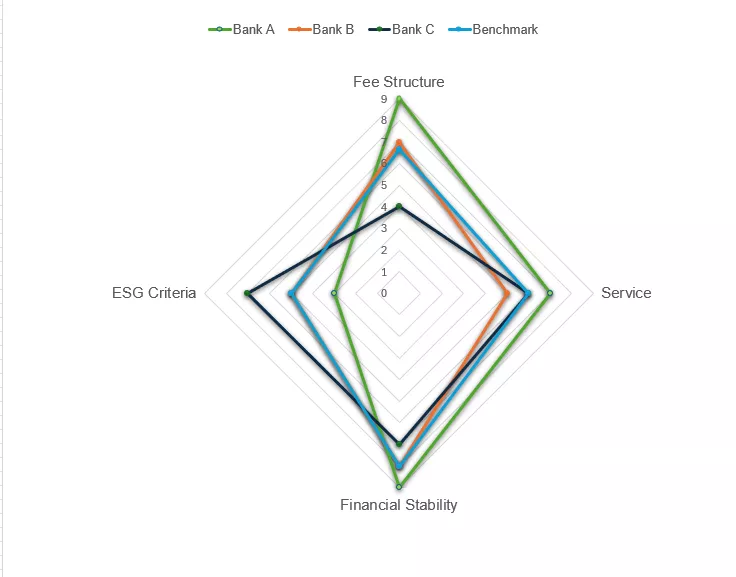
        The analysis in our example shows that Bank A achieves the highest overall rating, followed by Bank B and then Bank C. Bank A is particularly impressive due to its financial stability and favourable fee structure, while Bank B scores points for its excellent ESG performance. Bank C has average ratings in all categories and performs worst overall.

      6. Reporting: The results of the analysis are summarised in a report that clearly presents the methodology, evaluation criteria and results of the ranking. To present the results clearly, the company opts for a network diagram. 

      Figure 1: Example evaluation of a bank ranking


      Source: KPMG AG


      Conclusion

      Selecting the right banking partner requires a detailed analysis of various criteria. A systematic approach helps to reduce the effort involved and ensures that the results are precise, reliable and comprehensible. It is also important to note that not all criteria are of equal priority and therefore not all criteria are knock-out criteria.

      In addition to transparent fee structures, technical connectivity, service quality, financial stability and ESG criteria usually play an increasingly important role in our experience.

      Treasury should analyse both potential new banking partners and existing banking partners at regular intervals in order to achieve efficient and targeted bank coverage at all times.

      Those: KPMG Corporate Treasury News, Issue 152, March 2025
      Authors:
      Nils Bothe, Partner, Finance and Treasury Management, Corporate Treasury Advisory, KPMG AG
      Maximilian Gschoßmann, Manager, Finance and Treasury Management, Corporate Treasury Advisory, KPMG AG

      attach_email

      Bestens informiert über Aktuelles im Finance & Treasury Management.

      More KPMG insights for you

      Finance & Treasury Management

      KPMG's team of experts will show you the right way forward in corporate treasury management.
      Fallschirmspringer FTM

      Your contact

      Nils A. Bothe

      Partner, Financial Services, Finance & Treasury Management

      KPMG AG Wirtschaftsprüfungsgesellschaft