
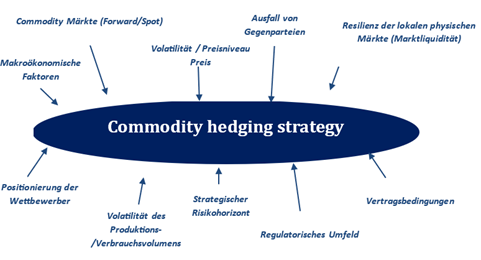
      Commodities such as metals, agricultural goods, energy and energy sources are of crucial importance to the global economy. Their prices are highly volatile due to factors such as changes in supply and demand, geopolitical events, currency fluctuations and changes in economic policy (Fig. 1). This volatility leads to unpredictability in production costs, complicates financial planning and liquidity management and has a negative impact on long-term investment decisions, making companies more cautious in uncertain markets. In order to ensure the necessary planning security, it is crucial that companies analyse their exposure to the commodity and energy markets in detail and develop effective hedging strategies. These strategies must be regularly adjusted to take account of geopolitical events, market volatility and regulatory changes in order to minimise financial risks and ensure stability. In addition, inflation affects the purchasing power of currencies and thus the price level of all commodities.

      In view of these challenges, it is crucial for companies in the commodity and energy-intensive industries not only to adjust their hedging strategies, but also to regularly review the associated risk strategy. This review should ensure that the strategy is in line with the company's objectives and that all relevant risks are adequately taken into account. In addition, it is important to evaluate the reliability of the risk metrics in relation to the company's performance.

      As part of the exposure survey, it is necessary to precisely determine the volume and timing of the commodity risk. Different types of business and possible time delays in risk transfer must be taken into account. Furthermore, the risk-bearing capacity must be defined in order to determine what level of risk is acceptable and which risk measurement methods should be used.

      A clear hedging strategy that is regularly reviewed for its effectiveness is also of great importance. This strategy should not only include methods for measuring success, but should also be adaptable in order to be able to react to changes in the market.

      Finally, it is crucial to establish clear governance structures that clearly regulate the framework conditions and responsibilities in commodity trading. These structures help to ensure that the risk strategy is effectively implemented and continuously improved.


      Source: KPMG AG


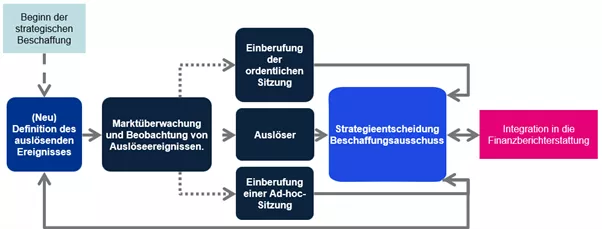
      Risks arising from changes in market prices can be managed in different ways depending on the type of risk. Regardless of whether it is a buy or sell contract, the risk can be reduced by closing out a financial position that counters the position defined in the underlying transaction. If no financial instruments are available, other measures can be taken, such as organisational changes or closing out positions on the physical commodities market. One example of an organisational change is the establishment of a risk committee in which an event-driven decision-making process (trigger) initiates a series of measures with the aim of reducing risk (Fig. 2).

      Fig. 2: Example of a risk committee process

      Analysing and managing price risks in the raw materials and energy-intensive industry

      Many companies in the commodity-intensive industry and commodity trading are faced with the challenge that they are often unable to adequately determine their exposure from open positions in procurement and sales. Companies that purchase commodities and sell a more complex product after processing (e.g. oil and diesel, wheat and flour, etc.) conclude contracts for the purchase of raw materials and the sale of sales products at different times. Market price changes lead to risk, as either sales are agreed at a variable price and purchases at a fixed price, or vice versa. The following explains how the risk can be analysed and how hedging instruments are selected to reduce the risk. 

      In order to analyse the risk from fixed-price contracts for various commodities, different types of input data must be collected and a systematic calculation of the exposure carried out. Firstly, the contract details such as term, fixed prices, quantities and delivery dates must be recorded. In addition, current and historical prices of the relevant commodities are collected from commodity exchanges or market data providers. The production or procurement quantities of the commodities should also be determined and the historical price volatility of the products analysed in order to estimate the potential price risk. 

      The calculation of the exposure begins with the determination of the quantities per (exposure) unit from the contract details of all existing contracts or from quantity expectations via price lists, e.g. measured in metric tonnes, barrels or from the energy input in MWh. A potential price change is multiplied by these specific quantities to determine the total financial risk. In addition, historical price volatility or price volatility implicitly derived from options is used to estimate the potential future risk, which can be done by applying risk models such as Value at Risk (VaR) or simulation techniques such as Monte Carlo simulations. Where appropriate, the associated currency risk should also be assessed by analysing the potential volatility of exchange rates and their impact on contract values and risk metrics.

      Finally, regular risk reports should be prepared on the exposure and risk position and risk management strategies, such as hedging or adjusting contract terms, should be developed based on the results of the analysis. This systematic analysis enables the effective management of risks from commodity fixed-price contracts and, based on this, well-founded operational decisions.

      Following an initial determination of the exposure, strategies must be selected to effectively manage the exposure. The possibility of entering into market timing or strategic positions in the degrees of freedom of operational implementation must be taken into account. The methodology for measuring the success of the hedging strategy must be defined and carried out regularly (e.g. using various benchmarking methods). The aim is to ensure that the hedging relationships continue to be effective in economic and accounting terms, taking into account the current market situation (e.g. effectiveness of proxy hedges).

      As part of a feasibility study, our experts carry out specific analyses using our standardised and industry-specific methods for calculating exposure based on the approach described and demonstrate the potential benefits of new or adapted hedging strategies using KPIs defined together with our clients. Based on this, we jointly define necessary adjustments to the target operating model as well as a roadmap for operational implementation and help you with the operational implementation of the hedging strategy. 

      Source: KPMG Corporate Treasury News, Issue 146, August 2024
      Authors:
      Ralph Schilling, CFA, Partner, Head of Finance and Treasury Management, Treasury Accounting & Commodity Trading, KPMG AG
      Bardia Nadjmabadi, Senior Manager, Finance and Treasury Management, Treasury Accounting & Commodity Trading, KPMG AG


      More KPMG insights for you

      Finance & Treasury Management

      KPMG's team of experts will show you the right way forward in corporate treasury management.
      Fallschirmspringer FTM

      Your contact

      Ralph Schilling

      Partner, Audit, Head of Finance & Treasury Management

      KPMG AG Wirtschaftsprüfungsgesellschaft