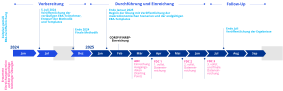
As in previous years, the EBA publishes a draft for the dialogue with the banking sector in the summer before the stress test is carried out. The final specifications are expected at the end of 2024. However, banks should already anticipate the most important changes on the basis of the draft methodology and templates and begin preparations. Because the last few years have shown: After the first draft of the stress test, the EBA still adjusts fine details and corrects errors. However, there have never been any fundamental changes to the EBA's first draft in the final versions, and they are not to be expected this time either.
With its draft, the EBA has built on the requirements of previous years, reviewed weaknesses and, as in the last stress tests, also aimed for continuous further development towards greater transparency for the supervisory authorities. For banks, this often leads to increasing data requirements with simultaneously decreasing degrees of freedom.
The central innovation of the 2025 stress test is the inclusion of the third Capital Requirements Regulation (CRR3), which will apply from 1 January 2025. The new requirements for calculating risk-weighted assets (RWA) for credit risk, credit valuation adjustment (CVA) and operational risks must be integrated into the projections from the starting point. The decision to postpone the Fundamental Review of the Trading Book (FRTB) in the EU is also taken into account in the EBA stress test. The calculation of capital requirements for market risks is still based on the CRR2 rules. At the same time, the output floor is being introduced, which requires a second calculation for the internal models in the standardised approach (SA). Only in the FRTB-SA and the SA for operational risks are the calculations of the output floor limited to the starting point, while a complete RWA simulation of the internal ratings-based (IRB) portfolios in the standardised approach (SACR) is required for credit risk in particular. This is a significant cost driver for IRB banks with a potential impact on results.
Read below to find out how the entry into force of CRR3 with the shift of the FRTB affects credit and market risk, what role the additional requirements of market price risk and the centralisation of net interest income (NII) play and what effects the additional proportionality has.