

Artificial intelligence is shaping today how economies grow, how companies compete, and how societies build trust.
Decisions are increasingly being made under conditions of high uncertainty – often without reliable, structured future scenarios that systematically show how the global AI environment could develop.
This is precisely where our English-language study ‘AI Geopolitics 2030: The new power distribution through strategic AI sovereignty’ comes in, which was produced in collaboration with the German AI Association.

Why AI leadership is more than technological excellence
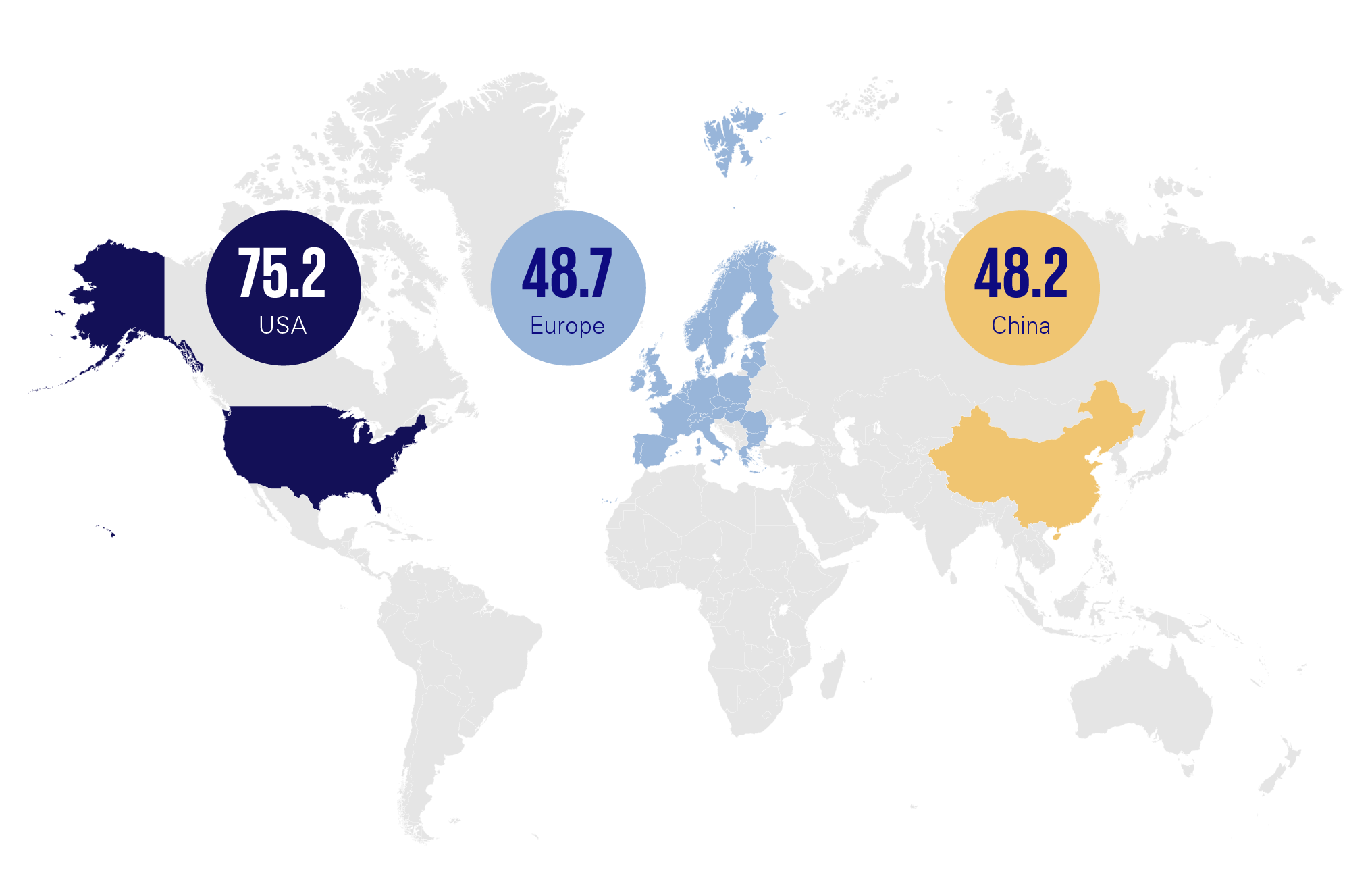
Our Strategic AI Capability Index (SACI) enables a comparison of the AI capabilities of the United States, Europe and China.
The index is based on three pillars – economy & infrastructure, strategy & governance, and research, development & skills – and combines a global survey with in-depth secondary research.
All results are standardised on a scale of 0 to 100, enabling robust, cross-regional comparisons for strategic decision-making.
Strategic AI Capability Index: A meaningful basis for strategic AI comparisons
The index shows a clear pattern: lasting AI leadership does not come from isolated technological breakthroughs, but from the ability to transform potential into impact – consistently, responsibly and on a large scale.
The most important findings of the current survey in concrete figures
The results of the study show:
Scenarios for 2040: Four possible visions of the future of AI
Based on the SACI index, the study analyses possible development paths for global AI architecture and condenses them into four scenarios for 2040. The four scenarios cover two key dimensions:
- the distribution of AI power (distributed vs. centralised), and
- the geopolitical order (cooperative vs. fragmented).
- 1. Federated Future
- 2. Platform Supremacy
- 3. Sovereign Blocs
- 4. Algorithmic Convergence

Distributed AI power in a cooperative order – common standards and interoperable infrastructures promote trust.
Global AI ecosystems are created through common standards, interoperable infrastructures and coordinated governance. Those who enable integration and coordination gain influence. For Europe: actively shape standards and use interoperability as a strategic advantage.

Platform dominance in a fragmented world order – global providers control computing power, models and energy.
State sovereignty remains intact, but operational power is concentrated in the hands of a few tech giants. Europe's challenge: reducing dependencies and building its own resilient platforms.

Regional alliances with centralised AI – power is concentrated in geopolitical blocs.
Autonomous systems are based on security, trust and cultural priorities. Competitiveness arises from internal coherence rather than global dominance. For Europe: opportunity for a “Europe First” strategy. However, this requires speed and scaling.

Global technological convergence despite political fragmentation – control through technology architecture.
While states draw boundaries, AI systems are converging. Architecture and learning logic determine the distribution of power. State levers of influence are losing their effectiveness. Europe's levers: governance and key technologies for algorithmic systems.
Find out how Europe can strengthen its strategic position. All results and recommendations for action
can be found in our study.
Supplementary content on the topic of AI Geopolitics 2030


Your contacts


Ashish Madan
Managing Partner, CTO, Head of Technology Services
KPMG AG Wirtschaftsprüfungsgesellschaft
- 1
- 2