
The journey to implementing a Treasury Management System (TMS) is both exciting and demanding, beginning with the careful selection of the right system. In our first article, we explored why a TMS is essential to meet the complex requirements of today’s treasury function. The selection process involved analyzing both functional and non-functional requirements, engaging all relevant stakeholders, and prioritizing the criteria that would pave the way for a solution tailored to your needs. These steps are critical to choosing a system that not only addresses current demands but is also equipped for future developments.
Once the decision in favor of a TMS is made, the real work begins with implementation. This phase is much more than a technical exercise; it’s a transformation that elevates the organization to new heights of efficiency and security. Careful planning and organization are vital to set the stage for a project that runs smoothly and effectively. The choice of project management methodology, be it agile, traditional, or a hybrid approach, as well as its integration with your existing IT landscape are key factors that will shape the success of your implementation. Well-structured test management and the early involvement of all stakeholders are essential to ensure a successful rollout, user acceptance and a stable foundation for ongoing operations.
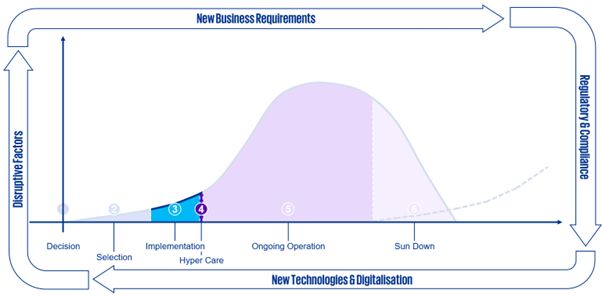
The following graphic places these two phases within the broader project lifecycle:
Figure 1: Own illustration: The TMS life cycle
Source: KPMG AG
Successful Implementation – How to Ensure a Smooth TMS Rollout
Once you have selected the right TMS, the next step is implementation. Achieving a successful system launch requires meticulous planning, a clear project structure, and the active involvement of all relevant stakeholders. A well-organized project team lays the groundwork for effective collaboration and communication. It’s equally important to identify and address the needs and expectations of stakeholders throughout the project.
Another crucial aspect is selecting the right project management approach based on your specific requirements. This choice forms the framework for the entire project. While agile methods offer flexibility and quick adjustments, the waterfall approach provides clear phases and structure. Often, companies find that a hybrid solution works best.
Once the framework is set, you can begin developing business process concepts that clearly and thoroughly describe your target processes. Visual aids such as diagrams help illustrate and deepen understanding. In this context, it is essential to consider how the processes are to be mapped. This stage is also a valuable opportunity to streamline workflows and adopt best practices. There’s no need to carry over every process step exactly as before.
The next step involves the system integrator developing a technical concept, detailing how the requirements will be met through software customization. Close cooperation between business units and the system integrator is essential, as requirements and implementation are closely linked and some systems offer more out-of-the-box processes than others. This collaboration can help reduce both implementation and future maintenance costs.
When defining both business and technical concepts, it’s important to clearly separate requirements that are out of scope for the current implementation. This helps set a realistic and achievable project plan. The MoSCoW method is an efficient technique to prioritize and categorize all requirements by importance and impact. Collaborative categorization with stakeholders creates shared, transparent expectations for the project. Any requirements that emerge as relevant during implementation should be prioritized in the same way, though they may require additional resources or budget.
After successfully defining the project scope, it’s time for the actual implementation and rollout. Experience shows that, at this stage, companies often ask about the best testing strategy. The need for dedicated test management and documentation is undisputed. Project delays frequently impact the testing phase, and insufficient testing can lead to serious issues – such as incorrect bookings, valuation errors, insolvency or compliance breaches. These examples show how important thorough testing is to avoid costly consequences. Modern test management is a proactive way to address the known challenges of system implementation. By addressing requirements set during the RfP phase early and combining them with key performance indicators, you ensure maximum transparency1 and accurate effort estimation for testing. Test management tools also provide clear progress tracking, tailored reporting, and serve as a control mechanism. Early planning is recommended to ensure a comprehensive, audit-compliant approach for the subsequent year-end audit, since TMS systems feed critical data into ERP systems and influence accounting. This relevance should always be considered in both implementation planning and audit compliance. A project-accompanying audit (in line with ISAE3000 standards) can help identify and resolve issues early, safeguarding project success.
A classic driver of project complexity and cost is the integration with other systems, both internal (like accounting) and external (like payments). That’s why it’s important to consider your existing IT architecture and involve affected departments as early as possible. For a smooth transition to regular operations, clarify responsibilities, especially with IT, early on. Clear division of roles is crucial for efficient operations and to avoid misunderstandings.
In addition to technical and organizational planning, change management is a central success factor. “Clear roles and communication channels are the foundation of effective implementation. Alongside technical expertise, soft skills such as communication and problem-solving are vital for team members.”2 It’s wise to leverage existing employees, skills, role concepts, and responsibilities, while building knowledge about the new system and any related process changes. Early involvement of future users is another key aspect. Targeted testing and training help users become familiar with the new system. Comprehensive communication is essential to foster acceptance and address any resistance. This structured approach ensures not only the technical implementation but also the sustainable integration of the system into daily operations.
After successful testing and sign-off by stakeholders, it’s advisable to conduct a “dress rehearsal” in a test environment before the TMS goes live. This allows you to check timelines and uncover any inconsistencies in processes or manual tasks, so they can be resolved in advance. Any issues that remain unresolved but are not critical for go-live should be documented. A structured handover of open items enables smooth operations and prioritized resolution of outstanding points. Be sure to set a go-live date to ensure everything is completed on time.
After Go-Live – Stabilization and Effective Operations
Once open issues from implementation are handed over and the TMS is live, you enter the so-called hypercare phase. In this period, targeted actions are taken under real-world conditions to stabilize the system and ensure it runs smoothly. For new system launches, it’s advisable to set aside about two weeks – or, depending on system complexity, until after the first month-end close – during which all parties remain available and in close contact to quickly address and resolve any issues that arise in a joint effort. This phase is crucial for identifying and fixing potential problems early, whether they’re process-related, technical, functional or at the interface level. Intensive monitoring and rapid response help ensure system stability.
To lay the foundation for successful ongoing operations, it’s also important to establish a clear change request process between business, IT and the software vendor. This process supports efficient implementation of changes. When assessing the criticality and necessity of a change, consider factors such as the reason for the change, its impact, and associated risks. This approach creates a shared understanding among all parties. Proper documentation ensures traceability (for example, during audits) and preserves the knowledge gained during implementation.
The brief hypercare phase concludes with the final handover to regular operations, marking the end of the implementation project. From this point on, all previously defined processes and procedures come into effect. Regular operations in the new TMS can now begin. This is the longest phase of the lifecycle, and it’s time to reap the rewards of your hard work, even though the TMS journey doesn’t end here.
Looking Ahead
While the implementation and hypercare phases lay the groundwork for TMS operations, it’s just as important to look to the future. Our next and last article on this topic will focus on ongoing operations and the eventual phase-out of the TMS. We’ll explore how the system can be continuously optimized and, if needed, replaced to meet changing requirements. Readers can look forward to a deep dive into the long-term use and evolution of the TMS, ensuring it continues to meet the company’s high standards. Regular reviews and adjustments are necessary to maintain system performance in light of changing requirements, new technologies, and regulatory demands. This phase is an opportunity to learn from implementation experience and feed those insights into the continuous improvement of your treasury system.
Source: KPMG Corporate Treasury News, Edition 155, June 2025
Authors:
Nils Bothe, Partner, Finance and Treasury Management, Corporate Treasury Advisory, KPMG AG
Philipp Knuth, Senior Manager, Finance and Treasury Management, Corporate Treasury Advisory, KPMG AG
___________________________________________________________________________________________________________
1 KPMG Corporate Treasury Advisory Newsletter no. 121, May 2022, article “Modernes Testmanagement im Rahmen von TMS Veränderungen” [State-of-the-art test management in the context of TMS changes]
2 VdT, Treasury Bulletin 1-2025, S. 3, https://www.vdtev.de/artikel?/media/treasury-bulletin-12025/2128

Nils A. Bothe
Partner, Financial Services, Finance and Treasury Management
KPMG AG Wirtschaftsprüfungsgesellschaft