Skip to navigation

      The Swiss healthcare system is under increasing pressure.

      An aging population, rising costs and higher expectations for quality and accessibility are fundamentally changing the demands placed on healthcare delivery

      At the same time, patients now expect seamless, digital and personalized care.

      Yet many organizations continue to face fragmented systems and limited digital capabilities. As a result, healthcare digitalization in Switzerland is progressing more slowly than expected in many areas. 

      Against this backdrop, the concept of Connected Health is gaining importance. 

      The goal is a connected healthcare system in which people, processes, data and technology work together seamlessly and information is available throughout the entire care pathway.

      Michael Herzog

      Partner, Sector Head Healthcare, Head Audit Not-for-profit organizations and public sector

      KPMG Switzerland

      Christoph Marschner

      Director, Digital Transformation

      KPMG Switzerland


      Why the status quo is no longer enough

      Existing healthcare structures have often evolved over time and remain only partially integrated. Disparate systems, breaks between digital and manual processes and siloed organizations make efficient, seamless care delivery difficult. 

      Against this backdrop, digital transformation in healthcare is evolving from an operational task into a strategic lever. 

      It is becoming essential to sustainably improve quality, efficiency and the patient experience and to enable new digital health solutions. 

      At the same time, practice reveals a clear gap between strategic ambition and operational execution. 

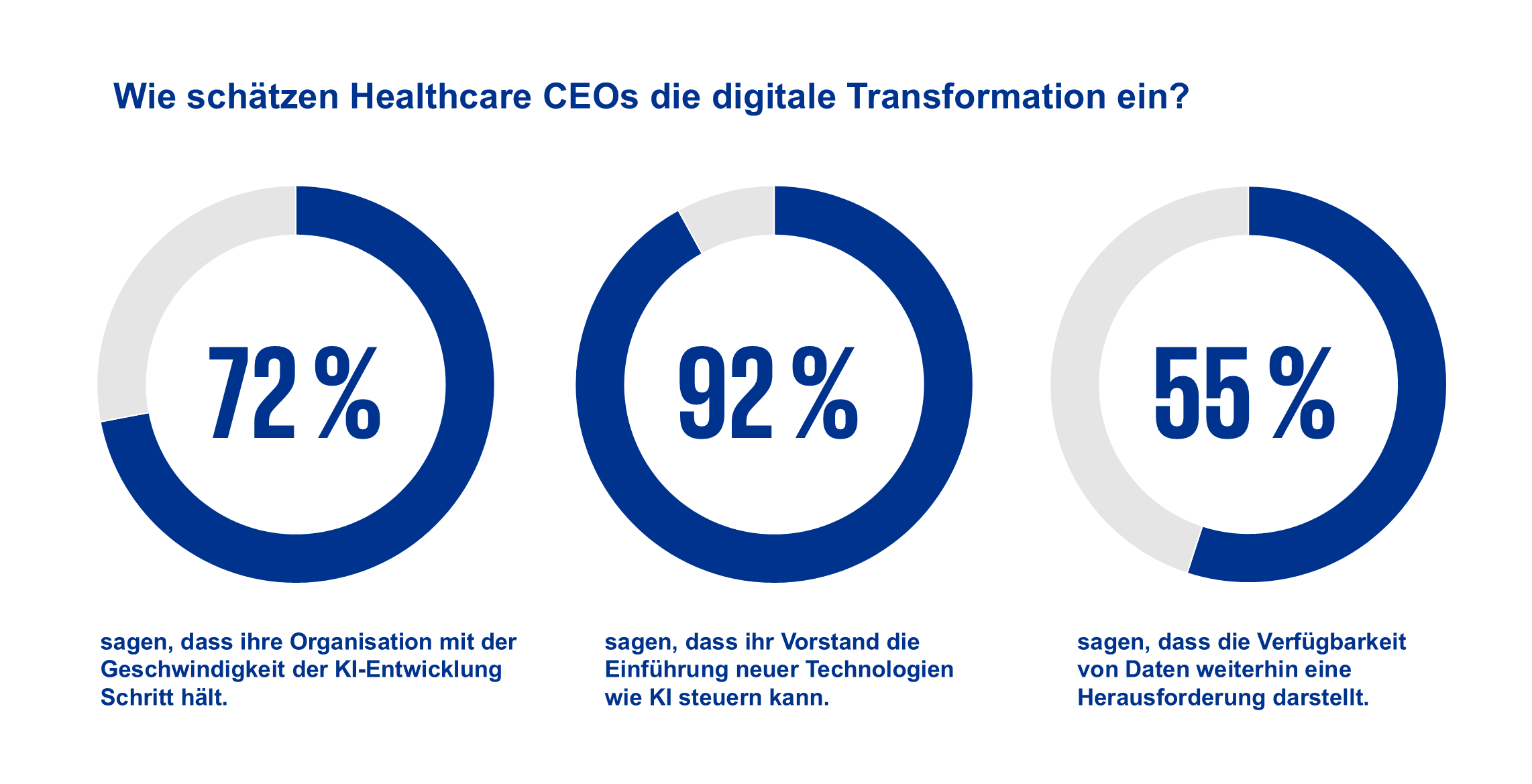
      According to the KPMG Global CEO Outlook - Healthcare, this gap is also evident worldwide:

      • 72% of healthcare CEOs say their organization is keeping pace with advances in artificial intelligence (AI)
      • 92% believe their board is capable of steering the adoption of new technologies such as AI
      • 55% continue to see challenges related to data availability

      Despite increasing digital innovation in healthcare, implementation therefore remains a key challenge.

      From stand-alone systems to a connected health ecosystem

      A connected health ecosystem lies at the heart of the transformation. It connects patients, healthcare professionals, data and processes throughout the entire care pathway.

      The electronic health record (E-GD) is intended to support this objective by facilitating the exchange of health information across institutions, thereby creating an important foundation for integrated care.


      EA key technology element for enabling Connected Health

      The shift toward Connected Health is supported by several factors. Advances in data platforms, AI and automation enable more efficient workflows and better-informed decisions.

      At the same time, interoperable systems and digital interfaces are becoming more important because they form the foundation for collaboration across organizations.

      Modern hospital information systems (HIS) play a central role. They serve as the digital backbone of healthcare delivery and enable data exchange throughout the care pathway.

      How hospitals can successfully shape digital transformation in healthcare across strategy, culture and technology, with a focus on Connected Health.


      Why many digital initiatives fail

      Despite technological progress, implementation remains challenging. Many organizations continue to struggle with limited data availability, heterogeneous IT landscapes and a lack of standardization.

      Aditional obstacles include regulatory requirements, rising cyber risks and a growing shortage of skilled professionals, all of which make transformation more difficult.

      “There is no question that digitalization will serve as a critical catalyst in shaping the future of care delivery models. The greatest challenge lies in the scale of transformation required to achieve the return on investment in digital initiatives that leaders expect.”

      Dr. Jaz Dhaliwal

      Global Digital Healthcare Lead, Partner

      KPMG International, KPMG UK


      Why culture determines transformation success

      The success of digital transformation depends to a significant extent on organizational and cultural factors. New technologies create impact only when they are integrated into existing ways of working and accepted by employees.

      This is also reflected in the study The role of culture in successful digital transformation, which surveyed healthcare leaders.

      Trust, transparent communication and active workforce involvement are essential to supporting digital transformation sustainably. Leaders play a key role by providing direction and modeling the change.

      What is Connected Health and what are its benefits?

      Connected Health creates the foundation for a connected healthcare system in which information is available throughout the entire care pathwa.

      For healthcare organizations, this offers several benefits:

      • Improved collaboration among healthcare providers
      • Greater transparency and availability of relevant information
      • More efficient processes and fewer breaks between digital and manual workflows
      • A stronger focus on patients
      • A better basis for data-driven decisions

      Hospital information systems (HIS) provide an important foundation. At the same time, the KPMG study Clarity on Healthcare 2026 shows that sustainable transformation depends not only on technology, but equally on the organizational and cultural changes that accompany it.

      Conclusion: Healthcare digitalization requires an integrated approach

      Digital transformation in healthcare marks the shift from isolated solutions to integrated care delivery systems.

      Connected Health represents a future state in which data, processes and stakeholders are seamlessly connected.

      Organizations that actively shape this change create the foundation for more efficient care, better treatment outcomes and sustainable healthcare services for the Swiss population.

      What leaders need to do now

      For decision-makers, this means embedding digital transformation as an integral part of organizational strategy.

      At the same time, organizations must break down silos and strengthen collaboration across specialist functions and institutions.

      Alongside technology investments, shaping cultural change is becoming particularly important. It is also critical to measure progress systematically and communicate it transparently.

      Shaping change together – with foresight and impact

      Digital transformation in healthcare requires a holistic approach. 

      Our expert teams support organizations in developing and implementing sustainable digital strategies for hospitals – from current-state assessments, governance and transformation considerations to the practical implementation of connected healthcare solutions.


      Your contacts

      Michael Herzog

      Partner, Sector Head Healthcare, Head Audit Not-for-profit organizations and public sector

      KPMG Switzerland

      Christoph Marschner

      Director, Digital Transformation

      KPMG Switzerland

      Further articles and information

      Clarity on Healthcare 2026 – KPMG Study on financial performance, cybersecurity and artificial intelligence in Swiss hospitals

      Digital and technological transformation in the healthcare industry.

      Digital transformation is much more than the introduction of new technologies.