As a technology leader, you are overwhelmed with questions, pitches, and expectations around the capabilities and opportunities of Artificial Intelligence (AI). The accelerating rise of autonomous AI agents has created a seismic shift in how organizations operate. From boosting productivity to enabling new business models, AI is no longer an experimental technology: it is becoming the backbone of next-generation enterprise performance. Boards and shareholders see the enormous potential and are willing, eager even, to invest. But with investment comes pressure. Many expect rapid returns, influenced by market narratives that promise dramatic efficiency gains and step-change innovation.
Recent market indicators support this inflection point. KPMG’s AI Pulse Survey has shown a significant increase in AI investments throughout 2025. Meanwhile, 51% are actively exploring AI agents and 37% are piloting them, yet only 12% have scaled. While most organizations are heavily focusing on prioritizing and deploying use cases and agents and establishing the technology and data foundations, the biggest challenge to scale is not about technology, but more about “how” to operationalize your ‘Augmented Workforce’. Establishing a functioning ‘Augmented Workforce’, in which humans and agents smoothly interact and collaborate, requires structural change management and transformations in skills, capabilities, ways of working, and controls, among other things.
For most enterprises, the CIO has become the central figure in translating AI ambition into real, measurable value, and in steering human-centered adoption across the entire enterprise. Every function is pursuing its own vision for AI-driven productivity and innovation, creating both opportunity and risk. The opportunity: IT can accelerate and enable adoption by aligning efforts around human-centered design, change management, and shared standards. The risk: fragmented, technology-led initiatives without a focus on people drive duplication, increase security exposure, and result in low adoption, ultimately diluting impact.
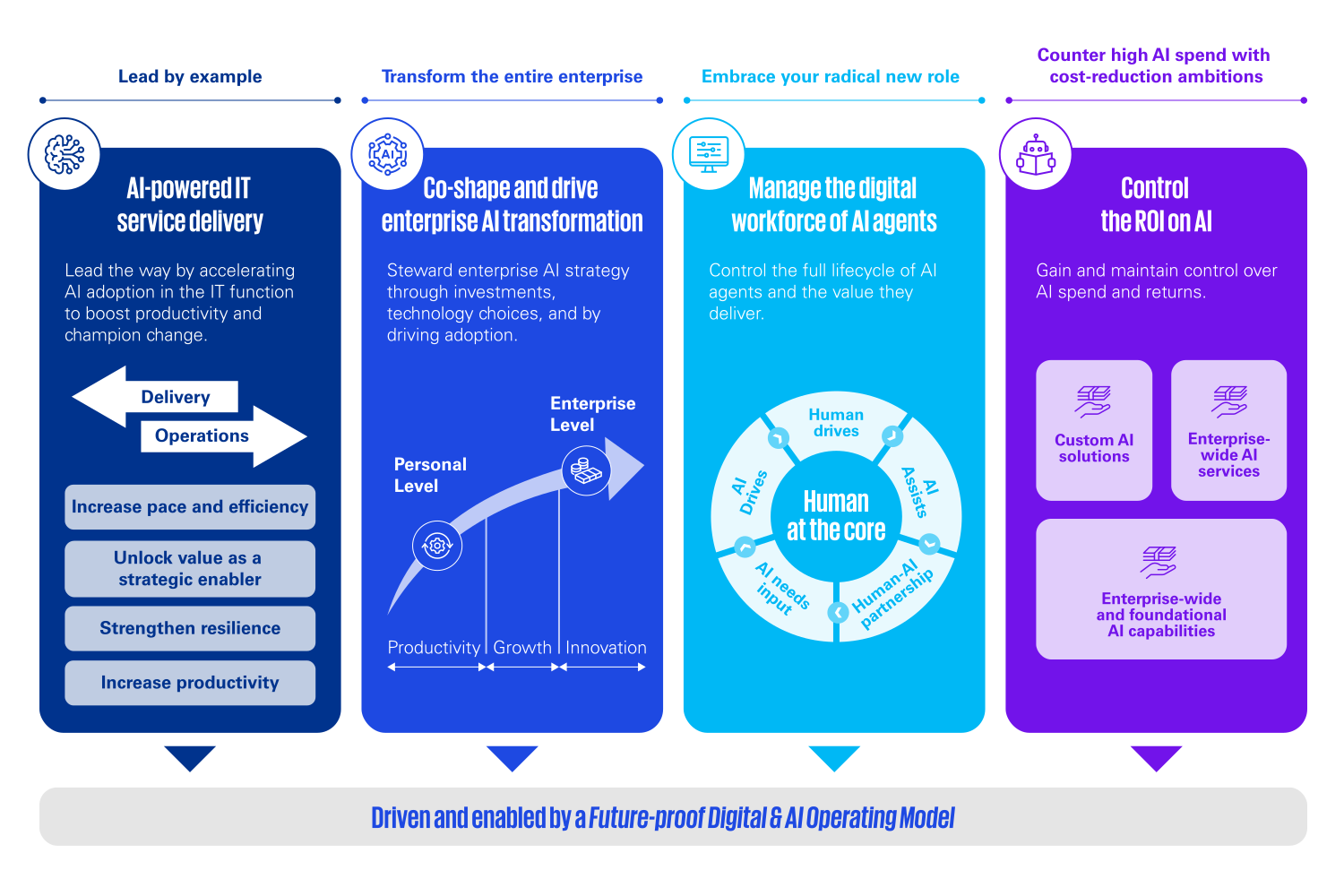
At the same time, the IT service delivery landscape is being reshaped. AI agents are not just tools; they are digital workers that augment, or autonomously perform, tasks once owned by IT teams. The quality of their integration with human teams will decide whether AI becomes a competitive advantage or an expensive layer of complexity. This is precisely where the Technology Leader must step in, defining how people, processes, controls, and platforms evolve, by embracing four essential roles that will reshape the Target Operating Model.
To unlock the true value of AI within IT and across the enterprise, and to lead from the front, you as a Technology Leader need to embrace the four essential roles below, which will structurally influence your Target Operating Model.