
      The government has proceeded with the much-debated cap on indexations for salaries over EUR 4.000. The index cap[1] limits automatic wage indexation for higher wages, but also introduces new employer contributions on the realized savings.

      The rules are complex to say the least and will require careful payroll follow‑up. We have summarized the key elements and action points for employers.

      1. Concept: capped indexation for wages above EUR 4,000

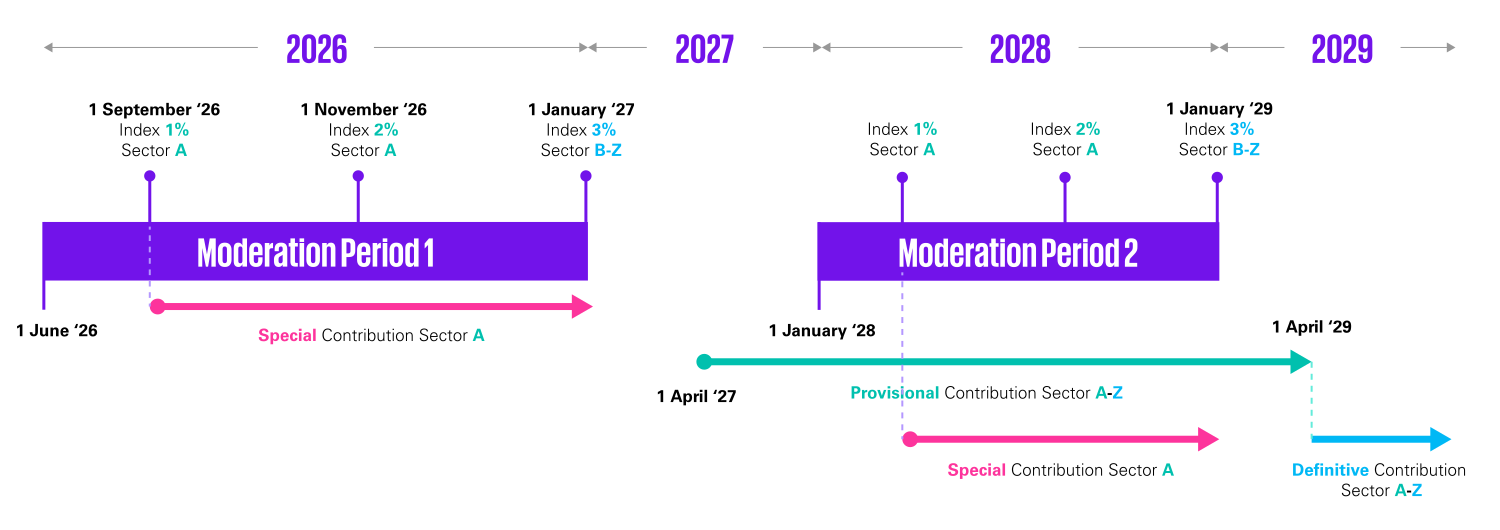
      The cap has been designed based on two moderation periods[2]. Period 1: 1 June 2026 until 31 December 2027. Period 2: As from 1 January 2028.[3] The threshold of EUR 4.000 will be indexed for the 2nd moderation period.

      Practically speaking, the system works as follows: In each “moderation period”, monthly wages up to EUR 4.000 remain fully indexed. For the portion above EUR 4.000, the indexation is capped. The index will be applied after a 2 % deduction. For instance:

      Index of 3 %

      First moderation period

      Total gross salary

      6.000,00

      Salary up to EUR 4.000

      4.000,00

      Salary over EUR 4.000

      2.000,00

      Index on first tranche (3 % on EUR 4.000)

      120,00

      Index on second tranche (1 % on EUR 2.000)

      20,00

      Total salary increase (new system)

      140,00

      Total salary increase (regular system)

      180,00


      This mechanism applies until a cumulative 2% indexation has been reached in the relevant moderation period; afterwards, the regular indexation mechanisms will resume.

      2. Which amounts are taken into account?

      The index is calculated on the reference wage, i.e. the fixed monthly base salary, excluding variable elements such as bonuses, overtime, year‑end premium, and holiday pay. For part‑time employees, the salary must be converted to a full‑time equivalent to determine whether they cross the EUR 4,000 threshold. 

      3. What about new hires

      Employees hired during a moderation period are treated as if they have undergone all index adjustments since the start of that period. Depending on the timing, they may either benefit from normal indexation if the full moderation effect has already been realised; or still be subject to moderation for subsequent index adjustments.

      4. Pay moderation contributions

      The cap on salary indexation essentially reduces personnel costs. As a countermeasure for budgetary purposes, the legislator simultaneously introduces a pay moderation contribution, i.e. a new monthly employer social security contribution that partially “claws back” the savings generated by the limited indexation.

      The calculation theoretically distributes the savings equally between the employer and the State, factoring in also the saving on employer social security contributions. In practice, though, the two are not fully linked.

      The new employer contribution consists of three components:

      I. Special Pay Moderation Contribution[4]

      Due: During the first ánd second moderation period. Starting point: the month of the first indexation subject to the moderation mechanism in period 1 and in period 2. Ending point: when all sectors have been subject to a 2 % indexation.

      Calculation: Based on the formula prescribed by law. In our earlier example:

      Index of 3 %

      First moderation period

      Total gross salary before indexation

      6.000,00 EUR

      Total gross salary after (moderated) indexation

      6.140,00 EUR

      Special Pay Moderation Contribution (monthly amount)

      25,25 EUR


      II. Provisional Consolidated Contribution[5]

      Due: Starting point: the quarter following the month during which all sectors have been subject to the first 2 % indexation (first moderation period). Ending point: the quarter prior to the applicability of the definitive consolidated contribution.

      Calculation: yet to be determined by Royal Decree.


      III. Definitive Consolidated Contribution[6]

      Due: Starting point: the quarter following the month during which all sectors have been subject to the second 2 % indexation (second moderation period). Ending point: None, the contribution is indefinite. 

      Calculation: yet to be determined by Royal Decree.

      Important to flag is that during the second moderation period (1 January 2028 - …), there will be overlap between the special contribution (I) and the provisional consolidated contribution (II), which you can also see on the visualization:


      Interestingly, the pay moderation contribution will be due also on termination payments, but only to the component relating to the base salary.

      5. Key action points for employers

      As the index cap adds a new layer of complexity to the HR-landscape, HR-teams are advised to take action: 

      A. Review the affected population and calculate cost impact

      For companies working with an international workforce, not all employees will be impacted by the legislation. Outbound assignees subject to non-Belgian labour law as well as simultaneously employed individuals for whom Belgium is not the habitual place of work will in principle not be subject to the legal index mechanism and its recent amendments. 

      Due to the complexity of the additional employer contributions, calculating personnel cost provisions will prove to be a much more burdensome exercise. KPMG can assist with hypothetical or actual wage impact calculations where relevant.

      B. Links with other pay elements

      If certain pay elements are linked to either the monthly salary or specific indexation mechanisms, we strongly recommend to check the applicable policies to verify to what extent the changes in the indexation mechanism may have an impact, and to what extent the wording of the policy may need to be adjusted or where employee communication will be required.

      C. Verify flexible benefit plans and salary sacrifices

      The index cap principally applies to all employees subject to automatic indexation. That also means that for individuals who have contractually reduced their salary, employers will need to comply with the updated legislation. Depending on the contractual agreements, adjustments may be required to those agreements to avoid risk of non-compliance with the updated legislation. 


      [1] “centenindex” or “loonmatiging” / “Indexation en centimes” or “indexation plafonnée”

      [2] “matigingsperiode” / “période de moderation”

      [3] The timing could be adjusted depending on the realization of a cumulative 2 % indexation across the moderation period.

      [4] “bijzondere loonmatigingsbijdrage” / “cotisation spéciale de modération salariale”

      [5] “voorlopige geconsolideerde loonmatigingsbijdrage” / “cotisation de modération salariale provisoire consolidée”

      [6] “definitieve geconsolideerde loonmatigingsbijdrage” / “cotisation de modération salariale consolidée définitive” 

      Olivier Vanneste

      Partner, Head of People Services | Tax, Legal & Accountancy

      KPMG in Belgium

      People services

      Tax expertise on Immigration, Payroll, Reward, Social Security & Employment and Tax Advisory, Compliance and Coordination.
      People walking in office hallway

      Stay informed

      Be the first to know about top business trends that can drive success for your company.

      stay informed