
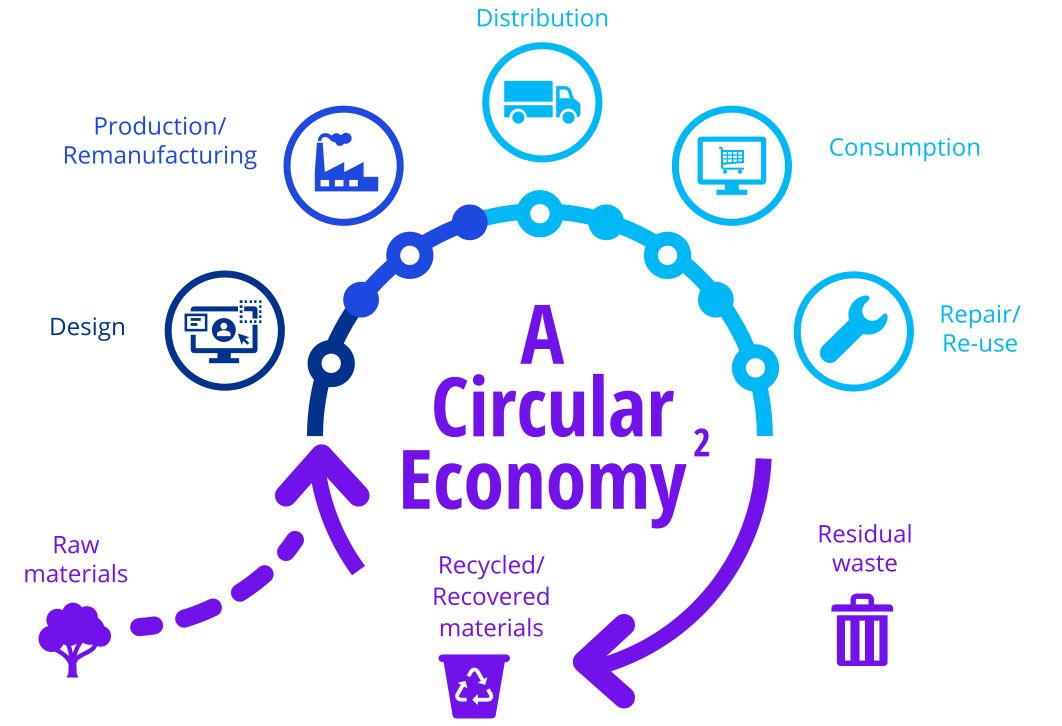
      The circular economy aims to create a sustainable economic model by eliminating waste, circulating products and materials, and regenerating nature. Tax and non-tax measures play a crucial role in facilitating this transition across different phases of a product's lifecycle.

      At the design and production phase, tax measures such as raw material resource taxes are implemented to discourage the use of virgin materials and promote the use of recycled materials. These taxes raise costs for businesses, encouraging innovation and research and increase the demand for second-hand goods. Non-tax measures include promoting eco-design principles that focus on creating products that are easier to repair, reuse, and recycle, thus extending their lifecycle. Businesses should not lose sight of the available (tax and non-tax) grants and incentives in this phase.

      In the use phase, tax incentives like reduced VAT rates on repair services are used to encourage the repair and reuse of products. Belgium offers reduced VAT rates on repairs for items such as textiles and bicycles. Non-tax measures include the EU "Right to Repair" legislation to be introduced, which will mandate manufacturers to make products easier and more cost-effective to repair, thus reducing e-waste.

      At the end-of-life stage, taxes are used to manage waste through a hierarchy that imposes higher taxes on landfill, lower taxes on recycling and no taxes on reuse. This encourages waste prevention, reuse, recycling, and energy recovery from waste. For example, environmental levies on landfill and incineration are designed to promote sustainable waste management practices. Non-tax measures include extended producer responsibility schemes to improve waste collection and recycling infrastructure, ensuring that materials are efficiently recovered and reintegrated into the production cycle.

      Businesses must navigate this evolving and challenging landscape as part of their strategy to integrate circular economy principles, which involves rethinking supply chains, product designs, and overall business models in response to regulatory changes and market expectations. In this respect, qualitative data collection throughout the business is a challenging but essential step to provide the necessary insights and data for mandatory or voluntary ESG-reporting.

      Taxation and the Circular Economy: What it means for Business

      Taxation and the Circular Economy: What it means for Business

      This paper seeks to explain what is generally meant by the circular economy, considering what taxes, tariffs, and incentive levers are being used or proposed to drive a more circular economy.

      Kris Eeckhout

      Executive Director | Tax, Legal & Accountancy

      KPMG in Belgium

      What is the circular economy?

      Proponents of the circular economy argue that the traditional economic system of production is a linear economic model. This model operates under the principles of ‘Take, Make, and Waste’ and does not have sufficient regard for the limitation of the globe’s resources.

      A circular economy approach is said to involve the following three key principles:

      1. Design out waste and pollution
      2. Keep products and materials in use
      3. Regenerate natural systems


      Key insights

      Tax & the Circular Economy

      Businesses should be aware of the different levers that have been used by governments to support and speed-up the transition to a circular economy. Of relevance are taxes, tariffs, and reliefs/ subsidies.

      Tax at the end-of-life stage

      Tax on raw materials only impact external costs from extraction or production processes but not from waste disposal. There may be both downstream and upstream impacts that need to be considered, and taxes have been introduced at end-of-life stage of products to address this.

      Tax and subsidies at the use stage

      Globally, interoperability is a big problem in healthcare. At the 2023 Oracle Health Conference, an announcement was made that Oracle was going to be open and connected — even for health systems or providers who have made investments into other EHR systems. What guidance are you giving your clients about their strategies for working with Oracle in the future, specifically when they already have a different EHR?

      Tax at the production stage

      From an implementation perspective there are several issues to consider such as:

      1. Increasing costs, particularly in the short-term as alternative raw materials sources/technology might not be available;
      2. the impact of cross material substitution effects and
      3. potential impact on trade and industries from a broader perspective.

      How KPMG professionals can assist in this process

      There are four key areas where KPMG professionals can assist businesses in embracing the circular economy. These are:

      • ESG specialists who can identify government initiatives that impact the circular economy including determination of the carbon footprint for an organization
      • Supply chain specialists who can consider the role of supply chain both for specific businesses and as a broader component of supply chain
      • R&D and grant specialists who have experience with grants and concessions globally
      • Tax specialists who can assist when considering environmental taxes and tax aspects of the circular economy

      Stay informed

      Be the first to know about top business trends that can drive success for your company.

      stay informed