

On May 11, 2026, the EU published a new Anti-Corruption Directive, a consolidated framework which aims to harmonize the definition of corruption across Member States and helps to reinforce the fight against corruption in both the public and private sector. The new Directive has an integrated enforcement architecture to enable a more effective mechanism to combat corruption. It also enables the “direct effect,” meaning that certain provisions of an EU Directive may have a direct effect under specific circumstances, where they are sufficiently clear, precise, unconditional, and have not been properly transposed into national law.


Key priorities
Below, we outline some of the key provisions of the Directive and explain these upcoming requirements to help you understand the potential implications for your organization:
The new Directive aims to harmonize the definitions of seven offence categories and broaden the scope. This will result in a unified framework to combat corruption across Member States, leaving less room for national variations. The framework also includes several additional offence categories compared to the previous framework, including trading in influence and illicit enrichment from corruption.
The Directive holds companies liable when someone in a leading position commits an offence, within the scope of their authority, and in doing so benefits the company, or in case of inadequate supervision by someone in a leading position enables the offence (“failure-to-supervise”).
The Directive establishes minimum levels for penalties and allows for a range of non-financial measures. Actual penalties will depend on Member State implementation.
The new Directive highlights the implementation of effective internal controls, ethics awareness, and compliance programs as relevant factors when assessing corporate liability and sanctions. This underscores the importance of having an appropriate compliance program and governance framework in place. The Directive also recognizes the value of rapid and voluntary disclosure to competent authorities, as well as timely remedial actions. This further emphasizes the importance of effective reporting, detection, investigation, and response mechanisms.
The Directive requires an authoritative body to be established in the Member States to help enforce the provisions foreseen in the Directive.
The EU also wants to improve the information exchange and collaboration among national authorities of the Member States and EU bodies, including OLAF, Europol, Eurojust and the European Public Prosecutor's Office (EPPO) regarding bribery and corruption for cross-jurisdictional cases.
Anti-Bribery and Corruption is not only about timely detection of breaches; prevention is even more important. Hence, the Directive asks Member States to make a sample set of preventive measures available.
The examples listed in the Directive include transparency measures, conflict of interest declarations, rules regulating interactions between public and private entities – all of which can help you improve your Anti-Bribery & Corruption program.
Timeline
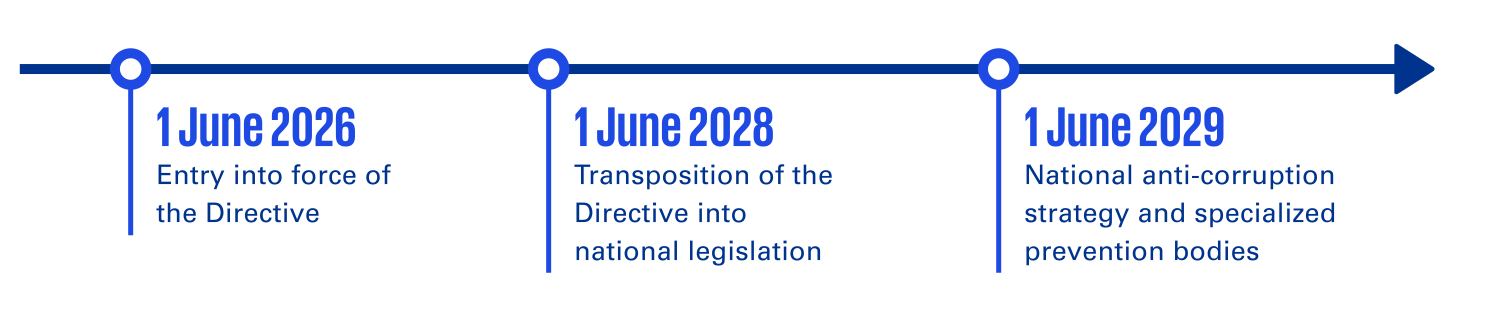
Member States are required to take a phased approach to strengthening their anti-corruption frameworks. By 1 June 2028, they must transpose the Directive into national law by updating criminal codes to include the harmonized offences and by establishing the corresponding minimum criminal and administrative penalties. By 1 June 2029, they must further reinforce these efforts by adopting a national anti-corruption strategy and setting up specialized bodies dedicated to prevention.
Is your ABC compliance program fit for purpose?
Most organizations believe their existing compliance program is sufficient. However, research from ACFE shows that the median duration of fraud schemes - such as bribery and corruption - is 12 months. This can vary depending on the type of fraud scheme, but the longer a fraud scheme lasts, the more financial damage your company will suffer. That’s why it is important for companies to have an effective ABC compliance program in place, to help prevent and detect cases of non-compliance in a timely manner. A practical readiness review can help you identify the requirements relevant to your organization, assess gaps in your current ABC framework, and prioritize remediation before national implementation accelerates.
How KPMG can help
Unsure where your organization stands? Our ABC specialists can help you translate the Directive into a focused readiness assessment and a prioritized remediation roadmap. Our team has extensive experience helping organizations strengthen their anti-bribery and corruption (ABC) frameworks, whether through ABC risk assessments, gap analyses, policy development, training, or broader compliance program enhancement.
A robust ABC framework is more than a compliance requirement; it is a cornerstone of ethical and sustainable business. Contact us to learn how we can help your organization strengthen its resilience to bribery and corruption risks.

