As a technology leader, you are overwhelmed with questions, pitches, and expectations around the capabilities and opportunities of Artificial Intelligence (AI). The accelerating rise of autonomous AI agents has created a seismic shift in how organizations operate. From boosting productivity to enabling new business models, AI is no longer an experimental technology: it is becoming the backbone of next-generation enterprise performance. Boards and shareholders see the enormous potential and are willing, eager even, to invest. But with investment comes pressure. Many expect rapid returns, influenced by market narratives that promise dramatic efficiency gains and step-change innovation.

Recent market indicators support this inflection point. KPMG’s AI Pulse Survey has shown a significant increase in AI investments throughout 2025. Meanwhile, 51% are actively exploring AI agents and 37% are piloting them, yet only 12% have scaled. While most organizations are heavily focusing on prioritizing and deploying use cases and agents and establishing the technology and data foundations, the biggest challenge to scale is not about technology, but more about “how” to operationalize your ‘Augmented Workforce’. Establishing a functioning ‘Augmented Workforce’, in which humans and agents smoothly interact and collaborate, requires structural change management and transformations in skills, capabilities, ways of working, and controls, among other things. 

For most enterprises, the CIO has become the central figure in translating AI ambition into real, measurable value, and in steering human-centered adoption across the entire enterprise. Every function is pursuing its own vision for AI-driven productivity and innovation, creating both opportunity and risk. The opportunity: IT can accelerate and enable adoption by aligning efforts around human-centered design, change management, and shared standards. The risk: fragmented, technology-led initiatives without a focus on people drive duplication, increase security exposure, and result in low adoption, ultimately diluting impact.

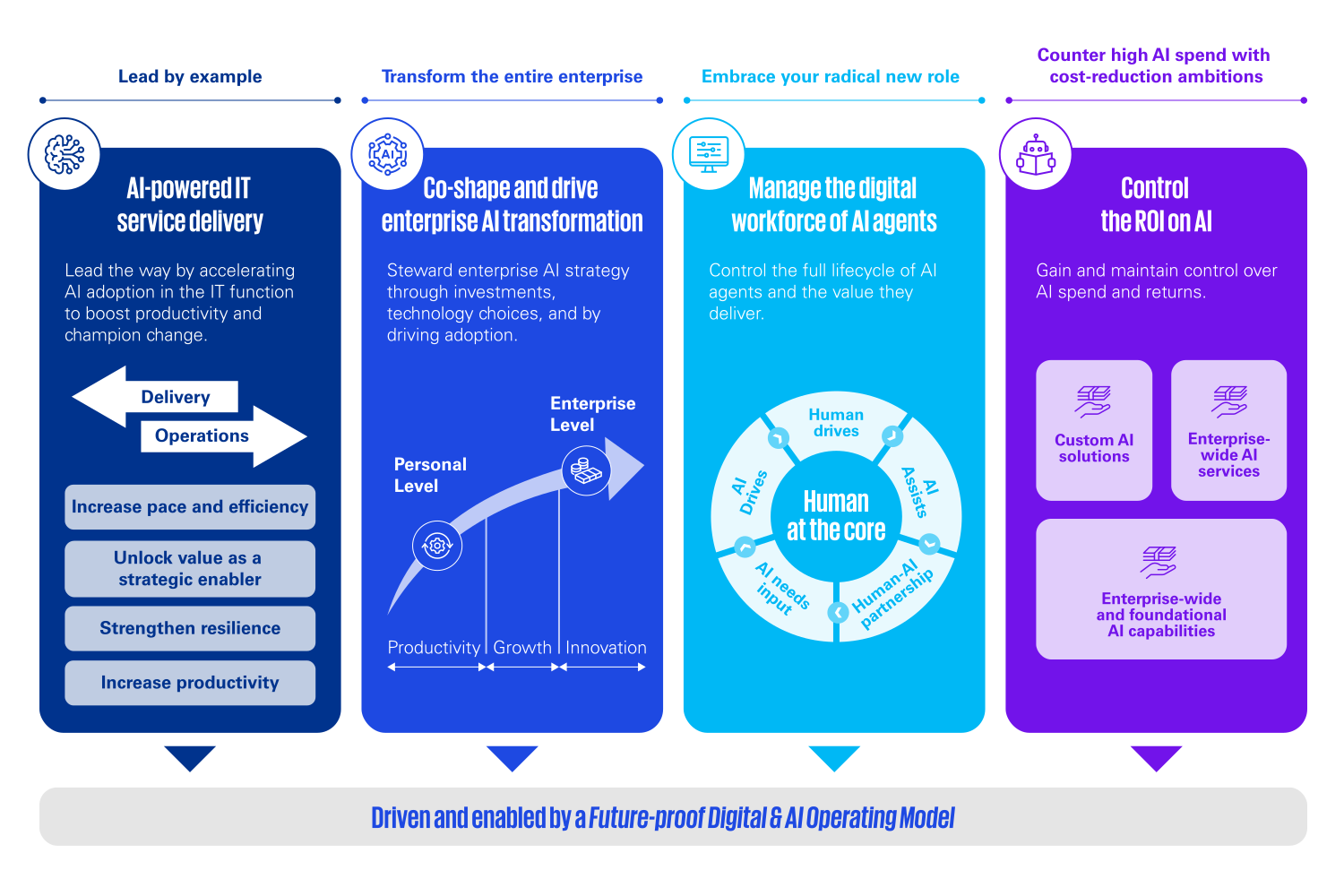
At the same time, the IT service delivery landscape is being reshaped. AI agents are not just tools; they are digital workers that augment, or autonomously perform, tasks once owned by IT teams. The quality of their integration with human teams will decide whether AI becomes a competitive advantage or an expensive layer of complexity. This is precisely where the Technology Leader must step in, defining how people, processes, controls, and platforms evolve, by embracing four essential roles that will reshape the Target Operating Model.

To unlock the true value of AI within IT and across the enterprise, and to lead from the front, you as a Technology Leader need to embrace the four essential roles below, which will structurally influence your Target Operating Model.

1. AI-powered IT service delivery

To boost your credibility, it is essential to enhance and AI-power your IT service delivery and lead by example. By identifying, prioritizing, and embedding AI-driven productivity use cases within IT service delivery, you can deliver rapid, measurable value and build organizational confidence.

As there is a wide range of optimization opportunities, from delivery to operations, it is essential to focus on the most value-adding areas, such as automated incident resolution, intelligent asset lifecycle management, AI-accelerated SDLC, predictive capacity planning, and policy and compliance copilots. This can be achieved by optimally leveraging the embedded AI capabilities in your IT solution landscape.

2. Co-shape and drive enterprise AI transformation

The CIO must evolve from platform provider to co-strategist with business leaders. This means defining governance for responsible AI adoption, shaping enterprise-wide data and architecture foundations, orchestrating cross-functional AI portfolios, and ensuring that innovation occurs without compromising security, ethics, or technical coherence. You are uniquely positioned to balance acceleration with discipline and to ensure that AI investments compound rather than collide.

3. Manage the digital workforce of AI agents

Imagine a workplace where people are free to explore their creativity and imagination, realizing their full potential while AI agents handle data analysis, processing, project management, and administration. Humans and AI collaborate seamlessly, each operating at their best to maximize value in a human-at-the-core model. This future is within reach today.

However, as AI agents mature, enterprises need a coherent operating model for digital labor: defining how AI workers are onboarded, governed, trained, monitored, and integrated with human roles. CIOs must partner with HR to design frameworks for digital labor management, workforce augmentation, reskilling pathways, and the culture required for human–AI collaboration.

Managing AI agents is not just a technical challenge; it is an organizational one.

4. Control the ROI on AI

As AI ambitions accelerate across the enterprise, the CIO must assume a fourth role: guardian of AI investments. Leadership expects rapid cost savings, productivity gains, and operating leverage, yet few organizations can track where AI spend occurs, how it scales, or whether promised savings materialize.

By partnering with Finance, the CIO needs to close this expectation–realization gap by imposing disciplined governance, establishing controls to monitor and validate ROI, and tying investments to measurable value: not diffuse experimentation.

Realizing these four dimensions demands more than ambition. It requires a fit-for-purpose operating model. Traditional structures, roles, and delivery rhythms are not equipped to support the speed, autonomy, and cross-functional orchestration AI requires.

CIOs must therefore rethink how IT organizes, governs, and collaborates: by transforming skillsets and capabilities, AI service delivery models, AI-native ways of working, modernized architecture and platforms, and established digital labor governance.

Only an operating model designed for this new reality can sustain the pace of innovation, safeguard the enterprise, and unlock the full value of AI at scale.

How & where to start?

Do you want to know more about how to jumpstart your AI Orchestration role? 

Register here for our upcoming event to unlock the real value of AI, lead the transformation, and go beyond the hype. 

Author:
Mathew Mertens, Senior Manager Advisor