
The Supply Chain Academy series launched on 20 November 2025, with an opening session on customs and VAT integration, introducing key challenges and opportunities in managing modern global supply chains. The four-part series brings together critical topics such as customs duties, VAT, transfer pricing, export controls, sanctions, and sustainable supply chain practices:
- 20-11-2025 | Supply Chain Taxation: VAT, Customs, Excise and Beyond
- 22-01-2026 | Customs Valuation & Transfer Pricing
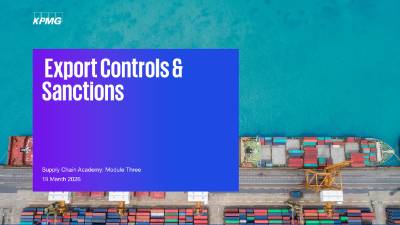
- 19-03-2026 | Export Controls & Sanctions
- 23-04-2026 | Sustainable Supply Chain
You can find the key takeaways from all Supply Chain Academy sessions summarized below:

First session: taxation
Integrate customs and VAT into your supply chain strategy
Customs and VAT considerations should be built into supply chain planning from the start rather than treated as afterthoughts. Aligning tax compliance with operational decisions enhances efficiency, reduces unexpected costs, and supports smoother cross-border transactions.
Establish a repeatable customs and VAT risk assessment method
A structured approach to regularly assessing customs and VAT risks helps identify vulnerabilities before they turn into costly issues. This proactive discipline supports compliance amid evolving regulations and enables continuous process improvement.
Leverage trade data to detect customs risks and opportunities and to substantiate VAT deductions and exemptions
Strong data analysis helps you spot patterns, uncover savings, and provide the documentation needed to substantiate VAT claims and exemptions. Technology-enabled insights also strengthen your ability to respond confidently to audits and regulatory inquiries.
Move from reactive to proactive management
Shifting from a reactive to a proactive customs and VAT model enables your team to anticipate regulatory changes and market developments. This approach not only reduces compliance risks but also positions your supply chain as a source of strategic value and resilience.
Second session: transfer pricing and indirect taxes
Integrate transfer pricing into your VAT and customs strategy from the start
Take ownership of your data to correctly assess VAT and customs impacts
Accurate, complete, and well‑structured data is essential to determine whether TP adjustments fall inside VAT scope, affect customs value, or require corrective invoicing. Strong data governance enables defensible reporting, smoother audits, and consistent application of TP methodologies across indirect tax processes.
Acknowledge that CJEU cases address only the specific questions raised; many TP–VAT–customs interactions remain unresolved
Recent CJEU decisions and opinions (e.g., Arcomet, Stellantis) provide valuable direction, but they address narrow legal questions. Significant uncertainty remains on how different types of TP adjustments should be treated for VAT and customs purposes. Future case law, administrative commentary, and EU‑level guidance will be needed to clarify these open points.
Move from reactive corrections to a proactive, documented TP–VAT–customs alignment
A proactive framework supported by clear contracts, functional analyses, data monitoring, and scenario testing helps anticipate how pricing changes affect indirect tax outcomes. This reduces audit exposure, avoids year‑end surprises, and positions indirect tax as a strategic enabler rather than a corrective function.
Third session: export controls and sanctions
The global export regime is interconnected, constantly evolving, and complex
European businesses can be impacted by multilateral organizations, such as the United Nations, extraterritorial regulations from the United States, EU‑wide sanctions, and domestic laws of individual member states. It is critical to remain attuned to this evolving landscape.
Understand whether your products are in scope and, if so, under which export jurisdictions
While the sanctions and export control environment is complex, the most important first step is understanding whether your products are in scope and, if so, under which export jurisdictions. This foundational step can make a vast and technical topic much more manageable.
Leverage data to move from a reactive to a proactive approach to export controls
Every company has some form of relevant data available. The use of data can follow a simple framework:
- Identify and understand the data you have available.
- Define a clear use case that supports your business and develop a process for transforming that data to achieve your objective.
- Establish ongoing audit and troubleshooting procedures to ensure that your data transformation process remains accurate and effective.
Register for the Supply Chain Academy

Explore



Connect with us
- Find office locations kpmg.findOfficeLocations
- kpmg.emailUs
- Social media @ KPMG kpmg.socialMedia