

Tax liabilities relating to business transfers, share transfers and enterprise mergers
(Prakas no. 584 MEF.Prk.GDT, dated 29 July 2026)
(Prakas no. 584 MEF.Prk.GDT, dated 29 July 2026)
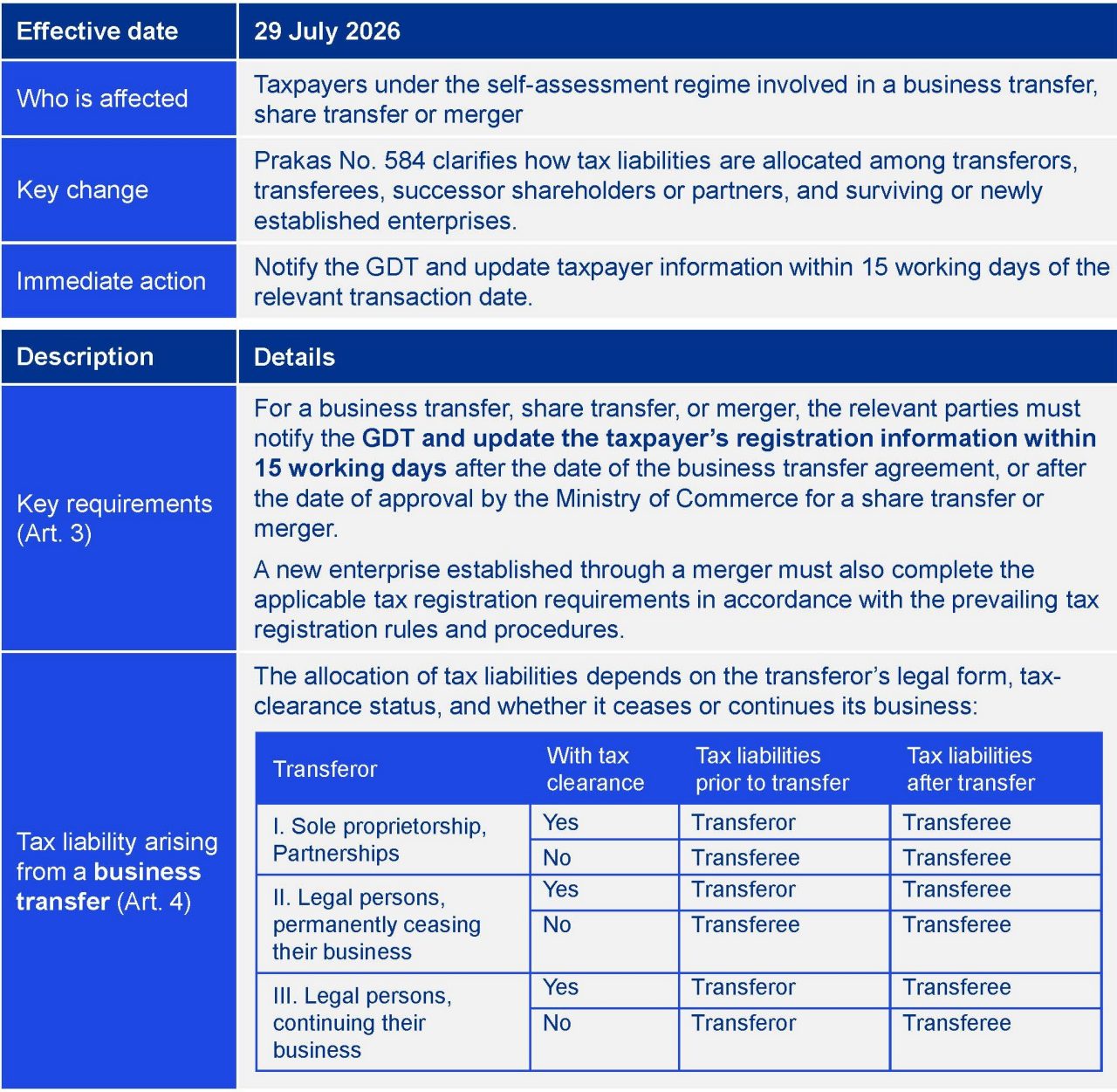
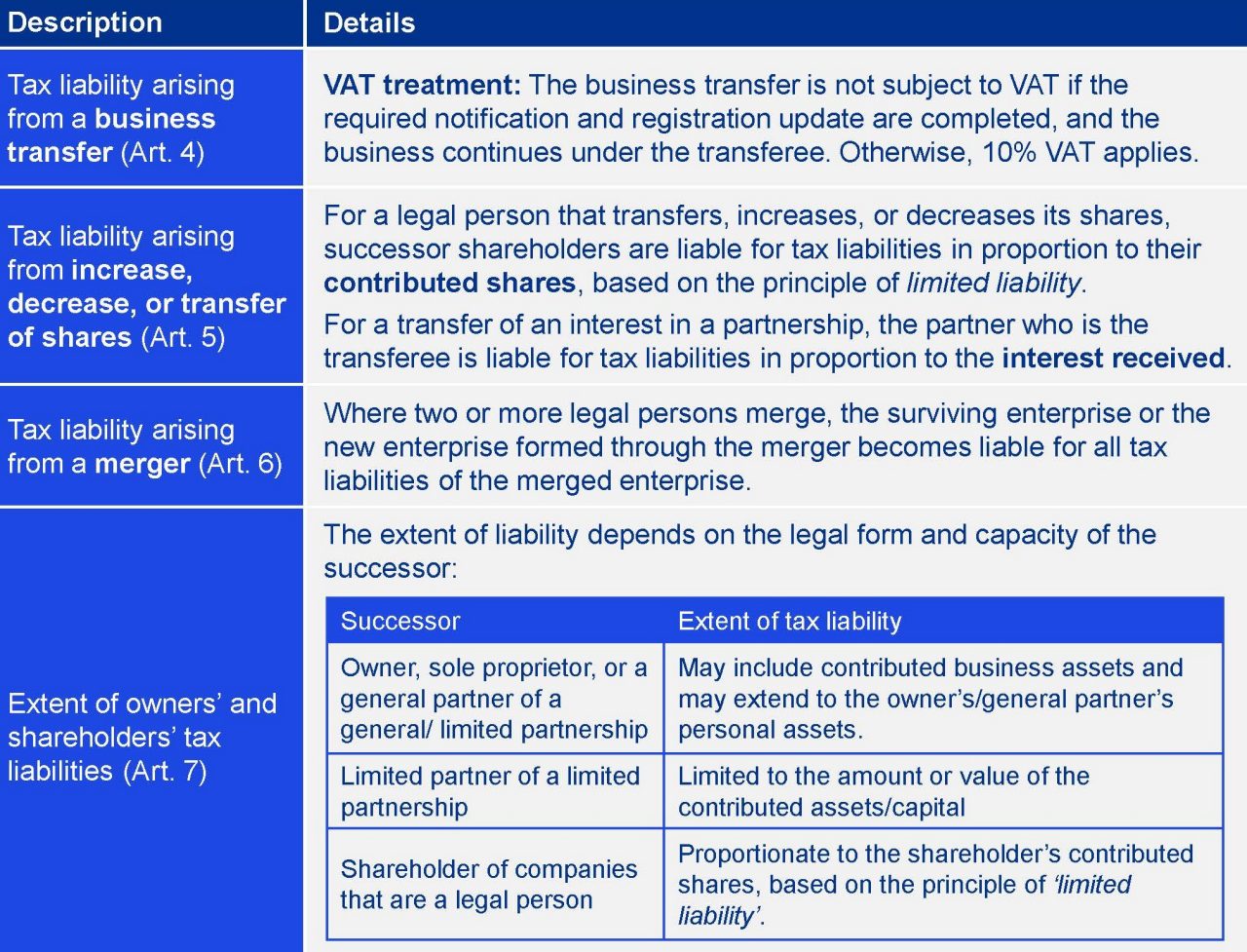
This guidance is particularly relevant to business acquisitions, internal reorganizations, changes in ownership, business succession arrangements, and corporate mergers. It provides a clearer framework for allocating historical and future tax liabilities among transferors and transferees, outgoing and incoming shareholders or partners, and surviving or newly established entities involved in business restructuring transactions.
Given the potential transfer of tax obligations and exposures, taxpayers should undertake appropriate tax planning and comprehensive due diligence before implementing any business transfer, share transfer, restructuring, or merger. This can help identify and mitigate unforeseen tax liabilities arising from the transaction.
Transaction documents should therefore clearly define and allocate responsibility for historical tax exposures, while also incorporating appropriate indemnity, warranty, and recourse provisions to safeguard the interests of the parties involved.
Taxpayers should likewise pay close attention to the applicable administrative requirements, including the obligation to submit the required notifications and update tax registration records within the prescribed 15-working-day period. The importance of obtaining the necessary tax clearance should not be overlooked, as it may facilitate a smoother transition and reduce potential compliance risks.
In addition, the tax regulations provide potential VAT exemptions on certain qualifying business transfer transactions, subject to specific conditions. Taxpayers should therefore assess the availability of these exemptions as part of the overall transaction structuring process to help minimize the tax cost associated with the transfer.
Ultimately, taxpayers involved in mergers and acquisitions, business transfers, or corporate restructurings should carefully assess the proposed arrangement’s tax implications, evaluate historical tax exposures, complete the required tax clearance procedures, coordinate the relevant requirements of the MOC and the GDT, and retain sufficient supporting documentation to substantiate the transaction and its tax treatment.
(Instruction no. 014 MEF.Instr.GDT, dated 17 August 2026)
Instruction No. 014 reaffirms that the provision of dentistry services is not subject to VAT. This treatment applies to a broad range of professional dental services, including examination, treatment, preventive care, restorative procedures, and related dental interventions, such as:
1. Dental examination and consultation
2. Dental and/or periodontal treatment
3. Tooth extraction, tooth replacement, dental implant surgery, oral surgery, tooth transplantation, and all types of soft-tissue and bone grafting
4. Restorative, preventive, prosthodontic, orthodontic, and cosmetic dental procedures
This Instruction becomes effective from the date of issuance onward.
Instruction No. 014 provides important clarification that qualifying dental services are treated as non-taxable supplies for VAT purposes. It enhances certainty and consistency in the VAT treatment of dental services and reduces ambiguity regarding the treatment of various dental procedures. Dental service providers should review their service offerings and related supplies to ensure that the appropriate VAT treatment is applied.
As committed tax advisors to our clients, we welcome any opportunities to discuss the relevance of the above matters to your business.