


      On 18 August 2026, the Non-Bank Financial Services Authority issued Prakas No. 063 FSA.PrK on annual financial statement filing and independent audit obligations (the “New Prakas”). The New Prakas took effect on the date of issuance and applies to enterprises and not-for-profit entities (NFPEs), excluding small taxpayers. It replaces Prakas No. 563 FSA.PrK, dated 10 July 2020. The Accounting and Auditing Regulator (ACAR) subsequently issued Notification No. 033/26 ACAR, dated 26 August 2026, concerning its implementation.

      The New Prakas revises the financial statement filing and independent audit requirements. Enterprises and NFPEs meeting the new audit criteria must comply with the audit requirements from the 2026 financial year onward. The key changes are summarized below.

      • Annual filing (extended filing period): Entities not subject to an independent audit must file their annual financial statements with ACAR within three months and 20 days after the financial year-end, while entities subject to an independent audit must file their audited annual financial statements within six months and 20 days after the financial year-end. Compared with the Old Prakas, the New Prakas therefore provides an additional five days for filing.
      • Mandatory audit categories (expanded scope): In addition to public enterprises, public interest entities (PIEs), and Qualified Investment Projects (QIPs), the New Prakas expands the mandatory audit requirement to branches of foreign companies and casino enterprises. Additionally, a financial statement audit is also mandatory for real estate enterprises with annual turnover of KHR 8 billion (approx. USD 2 million) or more.
      • Audit thresholds for other enterprises (higher and sector-specific thresholds): For enterprises outside the mandatory audit categories, the New Prakas introduces different annual turnover thresholds depending on the sector, as outlined in the table below. An independent audit is required where an enterprise meets at least two of the following three criteria.
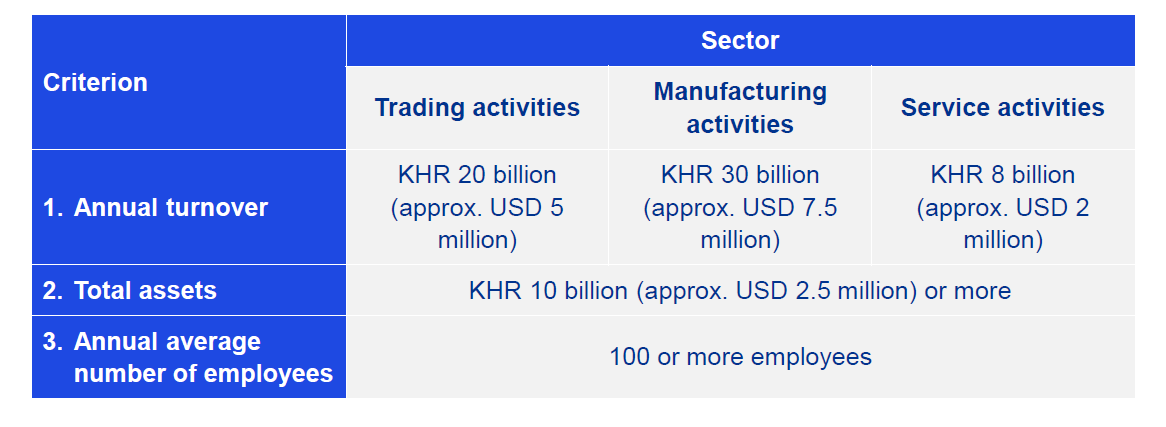
      Compared with the Old Prakas, the New Prakas introduces sector-specific turnover thresholds and raises the annual turnover and total asset thresholds, thereby providing relief for many enterprises while retaining the existing employee threshold.

      • Continuing audit requirement (narrower application): An enterprise that meets the threshold-based audit criteria in one year must continue to undergo an independent audit for at least three consecutive years only if its annual turnover is KHR 5 billion (approx. USD 1.25 million) or more. This limits the continuing audit requirement under the New Prakas and may provide relief to enterprises with turnover below that amount.
      • NFPEs (stricter project-level audit criterion): Under the New Prakas, an individual project must undergo an independent audit where its total expenditure exceeds KHR 2 billion (approx. USD 0.5 million), making the project-level expenditure criterion more stringent than under the Old Prakas. Additional expenditure, employee, project duration, and notification requirements may also apply.
      • Audit exemptions: Entities subject to mandatory audit may request an exemption if they have had no trading activity for at least 12 months following the end of the latest audited financial year. A threshold-based enterprise that no longer meets the criteria may also request an exemption if its annual turnover is below KHR 5 billion (approx. USD 1.25 million).

      Penalties for late filing

      Late filing of financial statements with ACAR may result in an administrative penalty. For enterprises, the penalty is calculated from the applicable filing deadline until ACAR receives the entity’s official letter, at a rate of KHR 2 million (approx. USD 500) for each month of delay, subject to a maximum of KHR 12 million (approx. USD 3,000). For NFPEs, the penalty is calculated at KHR 1.2 million (approx. USD 300) for each month of delay, subject to a maximum of KHR 7.2 million (approx. USD 1,800). Further enforcement measures may apply if the penalty is not paid within the prescribed period.


      Our Comments

      The New Prakas introduces significant and more complex changes to the framework established under the Old Prakas. Enterprises and NFPEs should promptly assess their filing and audit obligations, determine whether they are eligible for an exemption, engage an independent auditor where required, and ensure that their financial statements and audit reports are completed and filed with ACAR within the prescribed deadlines.

      Our team would be pleased to discuss how the New Prakas may affect your business and to assist you in meeting your financial statement filing and audit compliance obligations.

      Read

      New Financial Statement Filing and Audit Requirements

      Prakas No. 063 FSA.PrK, dated 18 August 2026