Skip to navigation

      The EU’s Ecodesign for Sustainable Products Regulation (ESPR) introduces one of the most significant product compliance changes in recent years. At the center of the regulation is the Digital Product Passport (DPP), a new framework requiring companies to provide structured information on product composition, sustainability performance, circularity, traceability and compliance. 

      While the first product-specific requirements will be introduced gradually between 2026 and 2029, organizations should not underestimate the scale of transformation ahead. Preparing for the DPP requires more than understanding regulatory requirements. Organizations need access to reliable product data, stronger supplier collaboration, and the right governance and technology capabilities. 

      For Swiss companies exporting products to the European Union, the question is no longer whether the Digital Product Passport will apply, but whether the organization is ready when it does. This makes early preparation critical for protecting future market access and avoiding costly reactive compliance programs. 

      Julian Meitanis

      Director, Corporate Sustainability Services

      KPMG Switzerland


      Key takeaways

      • The Digital Product Passport

        The Digital Product Passport (DPP) is a key component of the EU Ecodesign for Sustainable Products Regulation (ESPR).

      • Swiss companies

        Swiss companies exporting products to the EU may be affected depending on future product-specific requirements. 

      • DPP implementation

        Successful DPP implementation depends on product data, supplier information, governance, and technology capabilities. 

      • Go-Live

        The EU DPP Registry went live in July 2026. 

      • Early preparation

        Early preparation can help reduce implementation risks and avoid costly remediation efforts.


      What is a Digital Product Passport?

      The Digital Product Passport (DPP) is a structured digital record designed to provide information about a product’s composition, sustainability performance, circularity, and compliance. Depending on the applicable product requirements, the DPP may contain information on material composition, substances of concern, repairability, recycled content, environmental performance, and end-of-life options.

      Digital Product Passport requirements are being introduced under the EU Ecodesign for Sustainable Products Regulation (ESPR) and will be defined through product-specific legislation over time.


      What is the ESPR?

      The Ecodesign for Sustainable Products Regulation (ESPR) is the EU’s most comprehensive product sustainability regulation. In force since July 2024, it requires nearly all physical goods placed on the EU market to meet mandatory sustainability requirements, covering durability, repairability, recyclability, energy and resource efficiency, recycled content in products and environmental footprint.

      At its center is the Digital Product Passport (DPP): a structured digital record with a unique product identifier, containing data on origin, sustainability performance, material and chemical composition, circularity and life-cycle information like installation, refurbishment, and end-of-life options as well as compliance information. Product specific legislation under the ESPR will determine which products require a Digital Product Passport and what information must be included.

      Where required, Digital Product Passport information must be accessible through a data carrier, such as a QR code, which may be provided on the product itself, the packaging, or accompanying documentation.

      The EU DPP Registry went live in July 2026 and provides the infrastructure supporting future Digital Product Passport implementation.


      • Does the Digital Product Passport apply to Swiss companies?

        Swiss companies exporting products to the EU may be affected by future Digital Product Passport requirements. This includes manufacturers, importers, distributors, and other economic operators placing products on the EU market.


        The exact obligations will depend on the product category concerned, the role of the economic operator, and the applicable product-specific legislation under the ESPR. 

        Organizations should therefore assess their potential exposure and monitor future regulatory developments.


      Which products are affected and when?

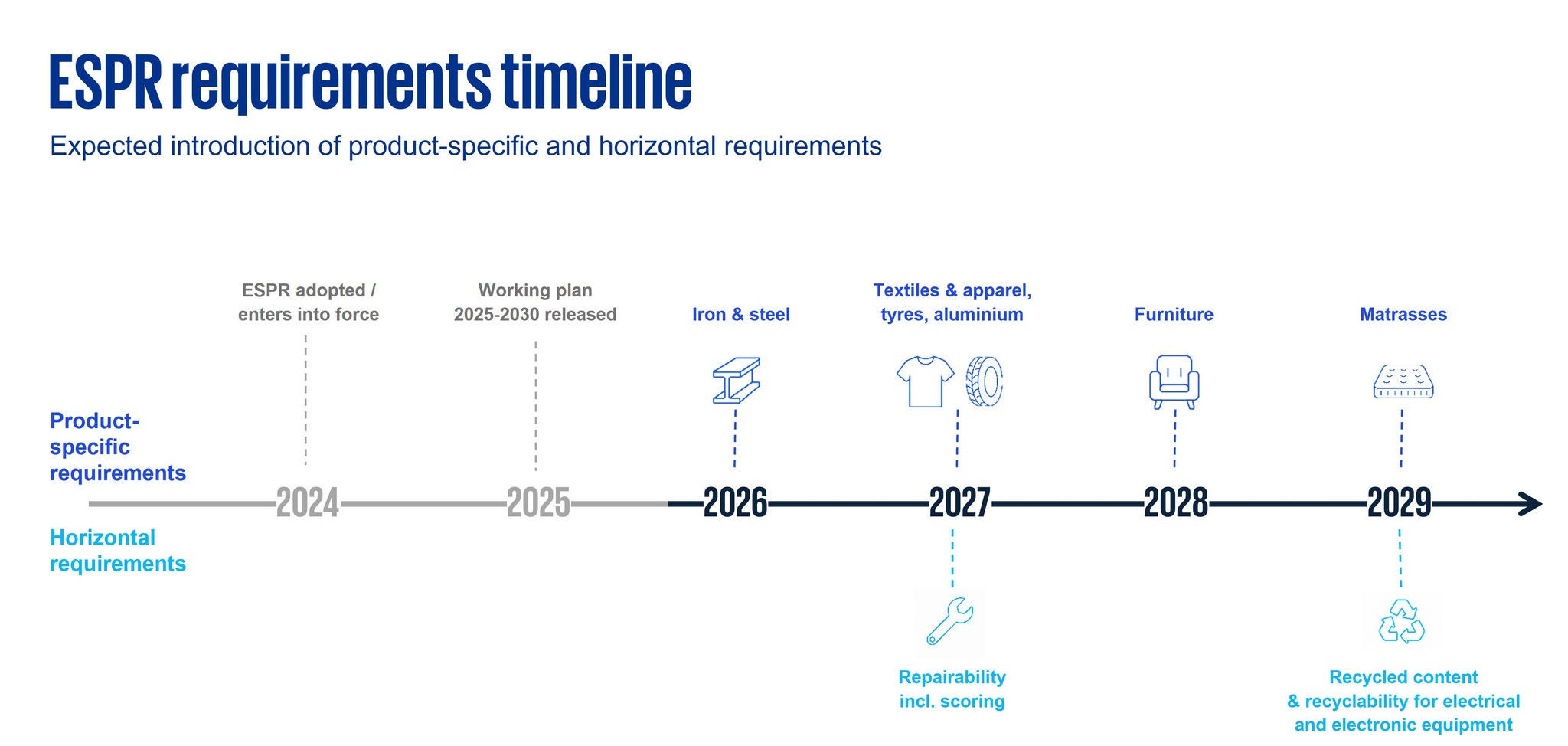
      The first product-specific requirements are currently expected for iron and steel (2026), followed by textiles, tires, and aluminum (2027), furniture (2028), and mattresses (2029).

      Horizontal requirements on repairability are expected in 2027. In 2029, horizontal requirements on recycled content and recyclability for electronics are expected to follow.

      Companies that export to the EU or maintain EU product portfolios should be preparing now.

      The timeline below reflects currently anticipated implementation milestones and may evolve as additional delegated acts are adopted under the ESPR.


      Three key Digital Product Passport readiness challenges

      Most organizations recognize the regulatory implications of the Digital Product Passport. The greater challenge is preparing the capabilities required to comply.
       

      1. Supplier data availability and quality 
        A significant share of DPP information originates from suppliers and may not be readily available in a consistent format.

      2. Data governance and accountability 
        Organizations need clear ownership for collecting, validating, and maintaining Digital Product Passport information across functions.

      3. Technology and process integration 
        Product, sustainability, compliance, and ERP systems often operate independently, making end-to-end data management challenging.

      Why this matters for decision-makers

      The ESPR is not a reporting obligation. It is an operational transformation that touches product design, data management, supply chain governance, and market access simultaneously.


      Strategic value beyond compliance


      The Digital Product Passport is more than a regulatory requirement. It can help organizations demonstrate circularity, product sustainability, and resource efficiency. The data collected for compliance can also support transparency, sustainability reporting, and customer trust.

      Accountability gap


      The economic operator placing a product on the EU market remains responsible for the accuracy of Digital Product Passport information, including supplier-provided data. This requires clear governance, controls, and accountability across the organization.


      Market access at stake


      Products that do not meet future ESPR requirements may no longer be eligible for the EU market. As Digital Product Passport requirements become enforceable, compliance will become increasingly transparent and verifiable.

      Data complexity


      Many required DPP data points originate from suppliers. Collecting, validating, and maintaining this information across the value chain can be a significant challenge and often requires new processes and systems.

      Regulatory convergence


      The ESPR connects to CSRD reporting (ESRS E1, E2, and E5), the EmpCo Directive on Sustainability Claims, the Packaging and Packaging Waste Regulation (PPWR), Waste Electrical and Electronic Equipment (WEEE), the Waste Framework Directive (WfD), the Classification, Labelling and Packaging Regulation (CLP), the Registration, Evaluation, Authorization and Restriction of Chemicals Regulation (REACH), and the Carbon Border Adjustment Mechanism (CBAM). Organizations that take an integrated approach can reduce duplicate compliance efforts and improve efficiency across regulatory programs.


      What should companies do now?

      Although product-specific requirements will be introduced gradually, organizations should begin preparing today.


      • Assess your exposure

        Identify which products and product categories may fall within the scope of future ESPR requirements.

      • Map product and supplier data

        Assess data availability and identify information gaps across the value chain.

      • Establish governance and responsibilities

        Define ownership for collecting, validating, and maintaining Digital Product Passport data.

      • Develop a readiness roadmap

        Prioritize actions, evaluate system requirements, and establish implementation milestones aligned with expected regulatory developments.


      How KPMG supports

      KPMG Switzerland helps organizations prepare for Digital Product Passport requirements. Our multidisciplinary team combines expertise in sustainability, supply chain transformation, data governance, technology, and regulatory compliance.

      Building the foundation for DPP compliance

      We support organizations with data strategy, supplier engagement, governance, technology selection, and implementation planning for Digital Product Passport compliance. This helps organizations establish the capabilities required to manage product information, support future compliance requirements, and improve transparency across the value chain.

      Digital Product Passport Readiness Assessment

      For organizations at the beginning of their journey, our DPP Readiness Diagnostic provides a structured assessment of regulatory exposure, data readiness, governance maturity, and implementation priorities.  The result is a practical roadmap with clear priorities, identified gaps, and recommended next steps.


      Frequently asked questions

      Digital Product Passport requirements are expected to be introduced gradually through product-specific and horizontal delegated acts under the ESPR. Timing differs by product category and may continue to evolve as additional legislation is adopted.

      No. A QR code is only one possible data carrier used to access Digital Product Passport information. Compliance depends on the availability, quality, accessibility, and maintenance of the required data. 

      Responsibility generally lies with the economic operator placing the product on the EU market. Depending on the product, implementation may involve multiple internal functions and external stakeholders across the value chain. 

      Data requirements will depend on future product-specific legislation. Depending on the product category, information may include material composition, sustainability performance, repairability, recyclability, product origin, substances of concern, and compliance-related information. 


      Learn more about our Circular Economy services

      Digital Product Passport requirements are closely linked to broader circular economy objectives, including circularity, resource efficiency, transparency, and sustainable value chains.

      Discover how KPMG supports organizations across the wider circular economy agenda, from strategy development and circular business models to implementation and transformation.

        Contact our Climate, Energy & Nature specialists

        Julian Meitanis

        Director, Corporate Sustainability Services

        KPMG Switzerland


        Related articles and more information

        The ESPR’s success will depend on ensuring a high level of transparency and an inclusive approach, in which the public and all relevant stakeholders are well-informed and have the chance to contribute.

        The Digital Product Passport (DPP) is a digital container for products, components, and materials, which will store relevant information to support products’ sustainability, promote their circularity and strengthen and facilitate legal compliance.

        Supporting Europe's transition to more transparent product information

        Ecodesign for Sustainable Products and Energy Labelling Working Plan 2025-2030.

        Under the new rules, businesses must prioritise keeping products in use by selling them or preparing them for reuse.

        The Delegated and Implementing Acts will support businesses in complying with new requirements.


          Impacting many brands and products placed on the EU market.

          How the Ecodesign for Sustainable Products Regulation is reshaping EU market access, and what boards need to decide now.