error
Subscriptions are not available for this site while you are logged into your current account.
close
Skip to main content

      The Base Erosion and Profit Shifting (BEPS) 2.0 initiative is a significant reform of the international tax system led by the Inclusive Framework and the Organisation for Economic Co-operation and Development (OECD).

      Pillar Two is a key component of this initiative. This pillar is intended to ensure that in-scope multinational groups are subject to a minimum effective tax rate of 15 per cent in each jurisdiction in which they operate.

      Canada has implemented key elements of the Pillar Two framework through its Global Minimum Tax Act, enacted in 2024. The Act, which applies to qualifying multinational groups for fiscal years beginning on or after December 31, 2023, implements the Income Inclusion Rule and a domestic minimum top-up tax. Additionally, Canada implemented an Under-taxed Profits Rule for fiscal years beginning on or after December 31, 2025. Canadian-headquartered groups and Canadian entities of foreign-parented groups may have tax, reporting, notification or payment obligations under these rules, even if they do not ultimately owe Canadian top-up tax.

      Complying with Pillar Two involves more than calculating potential top-up tax. Organizations may need to coordinate financial reporting, tax, data, technology and compliance across multiple entities and jurisdictions. Clear processes, roles and controls can help businesses manage their ongoing reporting and compliance obligations.

      As global minimum tax rules and administrative requirements continue to evolve, it’s critical for organizations to monitor developments in Canada and the other jurisdictions where they operate.
      Find out how KPMG's expertise can help you and your company

      Global minimum tax at a glance

      What is Pillar Two?

      Pillar Two is a global tax framework that applies a minimum effective tax rate of 15 per cent to in-scope multinational groups on a jurisdiction-by-jurisdiction basis.

      Who is affected?

      Multinational groups with consolidated annual revenue of at least €750 million in at least two of the four preceding fiscal years are affected, subject to specific exclusions.

      What applies in Canada?

      Canada’s Global Minimum Tax Act implements the Income Inclusion Rule, Under-taxed Profits Rules, and a domestic minimum top-up tax. The Act applies to qualifying multinational groups for fiscal years beginning on or after December 31, 2023.


      What needs to be filed?

      Depending on the group’s circumstances, filing obligations may include a GloBE Information Return (GIR) or notification, Canadian Global Minimum Tax return and related payments.

      When are filings due?

      Generally, filings are due 18 months after the first applicable fiscal year and 15 months after each subsequent fiscal year.

      What should businesses do now?

      Businesses should confirm scope, safe harbour eligibility, data readiness, filing responsibilities and requirements for the next compliance cycle.


      Who’s affected?

      Pillar Two generally applies to multinational enterprises (MNEs) with consolidated annual financial statement revenue of at least €750 million in at least two of the four fiscal years immediately preceding the fiscal year being tested. Certain entities and groups may be excluded.

      Canadian-headquartered groups, Canadian subsidiaries and Canadian permanent establishments of foreign-parented groups may all be affected. An organization may also have Canadian filing or notification obligations even if it does not expect to pay Canadian top-up tax.


      Three key implications for Canadian MNEs

      The Pillar Two rules are applied on a jurisdiction-by-jurisdiction basis, meaning that an MNE that is determined to be in-scope must calculate its ETR in every jurisdiction in which it operates, based on a detailed and complex set of rules. For example, higher taxes in one jurisdiction cannot offset lower taxes in another. If the jurisdictional ETR falls below 15 per cent (which can happen even for jurisdictions with high headline tax rates or accounting ETRs above 15 percent), the company is generally required to pay a “top-up tax”.

      Groups should assess how the rules interact with existing structures, cross-border arrangements, tax incentives and planned business changes. The analysis should consider potential top-up tax, available safe harbours, filing requirements and the documentation needed to support the group’s positions.

      The Income Inclusion Rule (IIR) acts as a primary taxing rule under Pillar Two. This rule may impose top-up tax at the level of a parent entity in respect of low-taxed income earned elsewhere in the group.

      Jurisdictions may also apply a Qualified Domestic Minimum Top-Up Tax (QDMTT), which takes priority over the IIR and allows the jurisdiction where the low-taxed income arises to collect the top-up tax. The Undertaxed Profits Rule is designed as a backstop where top-up tax has not been collected under a domestic minimum top-up tax or the IIR. The timing and application of the rule depend on the legislation adopted in each relevant jurisdiction.

      Pillar Two creates financial reporting and disclosure considerations related to potential top-up tax exposure.

      Groups should consider how financial reporting, local statutory accounts and country-by-country reporting information support their Pillar Two calculations. Differences among accounting, tax and reporting data may create additional reconciliation, review and documentation.

      The rules also include transitional and permanent safe harbours that may reduce the calculation burden or provide relief from top-up tax where the applicable conditions are met. Under the Transitional Country-by-Country Reporting Safe Harbour, an MNE group may qualify for relief in a jurisdiction by meeting one of three tests: the de minimis test, the simplified effective tax rate test or the routine profits test. If a jurisdiction qualifies, its top-up tax is treated as zero and the group is generally not required to complete the detailed Pillar Two calculations for that jurisdiction for the fiscal year.

      Eligibility should be assessed separately for each jurisdiction and fiscal year using qualifying information and appropriate supporting documentation. Organizations should also monitor changes to the availability, duration and conditions of relevant safe harbours.

      The calculations of the jurisdictional ETR under these rules, which can differ from the accounting computation of ETR, can be complex with potentially hundreds of data points required across multiple countries. MNEs should identify and resolve data gaps and establish clear processes for data collection, calculation, review, filing and documentation. Technology and automation may help organizations manage the volume of data and differences among jurisdictional requirements. KPMG’s BEPS 2.0 Automation Technology (KBAT) is one solution designed to support this process.

      Transition and ongoing compliance costs can be significant even if no top-up tax ultimately arises. Planning and budgets should factor in multi-stakeholder complexities and resourcing needs to manage potential system changes over a multi-year period.

      Coordination may be required where the GloBE Information Return (GIR) is filed centrally but local returns, notifications or tax payments remain due in individual jurisdictions. Groups should confirm which entity is responsible for each filing, where the GIR will be filed, whether the relevant exchange conditions are satisfied and which local obligations remain.


      How we can help

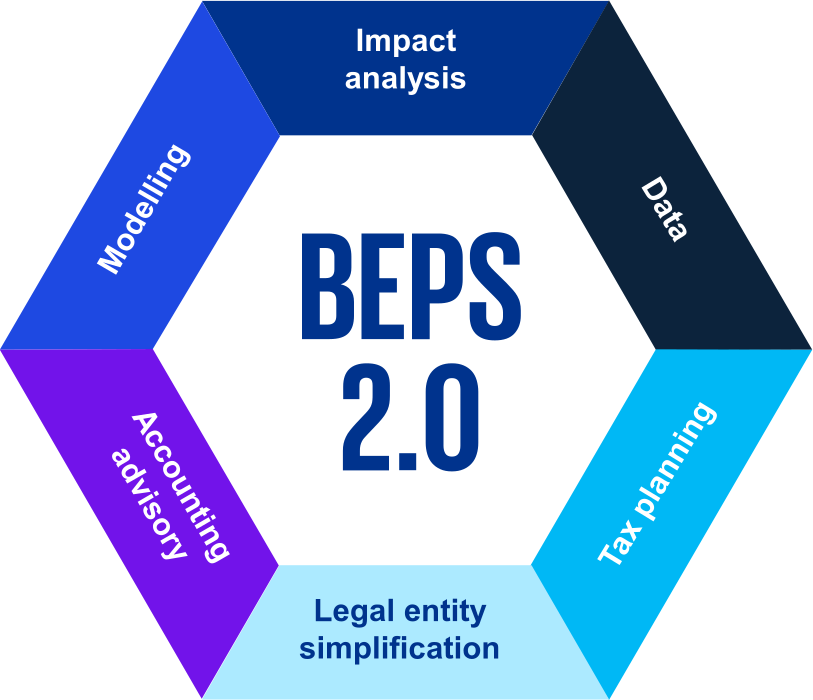
      KPMG’s multidisciplinary team can support organizations across the Pillar Two lifecycle, from scoping and impact assessment through data readiness, calculation, reporting and ongoing compliance.


      Pillar Two modelling
      High-level modelling to help estimate numerical outcomes based on financial data and map out the impact on the effective tax rate (ETR) and cash taxes under various scenarios.

      Accounting advisory services
      Coordinated approach to address systems and data related issues, including planning based on a choice of accounting treatments.

      Legal entity simplification​
      Assist with restructuring in cases where the group structure and value chain are no longer appropriate.

      Impact analysis
      Review the group structure to identify the scope of the group for Pillar Two purposes. Further identify required market disclosure statements.

      Data, systems and compliance
      Critical understanding of data sources, systems and maintenance to support implementation and production of tax sensitized information in standard and adaptable forms.

      Tax planning
      Identify planning opportunities to manage the impact of the Pillar Two rules and new measures adopted in relevant countries.


      paid

      KPMG’s modern tax services, data-driven solutions and professional experience can help you keep tax simple.
      public

      Helping businesses navigate complex international tax law and compliance requirements.
      query_stats

      Unify your tax data, workflows, and technology in one place.


      Connect with us

      KPMG. Make the Difference.

      We’re here to help your organization thrive.

      Office building

      Renee Milligan

      Partner, Tax Value Creation & International Corporate Tax

      Toronto

      KPMG Canada

      Rachael Ogilvie-Harris

      Partner, Tax Value Creation & International Corporate Tax

      Toronto

      KPMG Canada