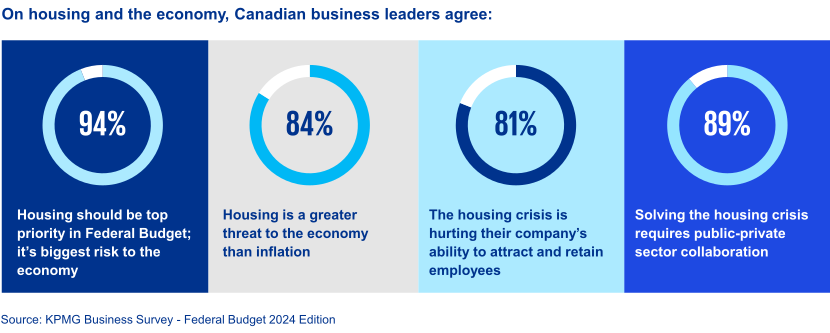
The overwhelming majority (94 per cent) of Canadian business leaders believe that housing should be the top priority in the upcoming federal budget, calling it the biggest risk to the economy, finds a recent survey by KPMG in Canada.
They expect the housing crisis will dampen economic growth this year, with nearly nine in 10 (87 per cent) saying the rising cost of living, driven largely by housing costs, is forcing their organization to pay more for labour and affecting their ability to attract and retain already-scarce talent.
“The ripple effects from the high cost of housing and lack of supply are being felt throughout the economy,” says Caroline Charest, an economist and Montreal-based partner at KPMG in Canada. “New and young Canadians are being shut out from purchasing and are finding rentals scarce and costly. Those who were able to enter the market a few years back due to record low interest rates now face the risk of default when their rates reset at upwards of three times what they pay now. All this is weighing heavily on business leaders struggling to attract and retain key personnel and talent, particularly in urban areas that have witnessed the highest increases in the cost of housing and in regions where housing is scarce.”
The survey finds that business leaders want to see more innovative public-private sector housing solutions, with nearly nine in 10 (89 per cent) saying public-private collaboration will be required.
However, the challenge for communities extends beyond housing to infrastructure and services that will be required to support population growth, says Chris Sainsbury, partner and National Leader for Smart Cities, KPMG in Canada, based in Vancouver.
“The central questions are, who are we building housing for, how will it be serviced, and how do we create cities and communities that we all want to live in?,” he says.
Beyond tax policy and funding, the federal government does not have many levers and provincial and local governments are relatively limited in influencing actual construction rates, adds Vivian Chan, a Vancouver-based KPMG partner in the Global Infrastructure Advisory Group.
“Just doing more and doing it faster is not good enough,” says Ms. Chan. “There needs to be a new model to deliver housing, one that brings all levels of government, not-for-profit associations, and the development community together. We have an opportunity to rethink and reshape how our cities and communities are built. But it requires governments to do something that’s fundamentally different.”
The primary concern from local governments is ensuring they have the resources today, and on an ongoing basis, to properly design and service a much-needed spike in new housing, she says.
“The reality is, most municipalities don’t have the bandwidth or technology to cut through the complex steps to access the much-needed federal grant programs,” Ms. Chan says. “It’s not only about the amount of money available to kickstart building but the reliability and sustainability of the source of funding around all of the infrastructure that will be needed to support housing development.”