The objective of the Internal Audit (IA) roundtable is to discuss new trends, developments, and leading practices for the financial services industry. During the event there is an opportunity for participants to network and share best practices.
Representatives of IA of financial institutions, insurance companies and market infrastructure gathered on the 7th of February 2025 for a discussion on risk culture and the intersection of internal audit and DORA.
Risk Culture
Risk culture is the blend of collective mindsets, shared norms, attitudes, and behaviors that guide how risks are identified, assessed, and managed across all tiers of a bank. Risk culture touches every aspect of decision-making by staff and leadership, steering the way risks are approached and handled daily. By assessing an organization’s risk culture, it becomes possible to gain deeper insight into how employees identify and address the risks they encounter in their roles.
The benefits of a risk culture
In today's dynamic and fast-paced environment, organizations are facing numerous ‘push factors’ that motivate a deep-dive into their risk culture. Examples of those push factors are the importance of ESG and its focus on governance and the intensification of public and regulatory scrutiny. At the same time, organizations face risks due to economic uncertainties. This increases the importance of creating a strong risk culture that allows corporations to promote ethical behavior, facilitate the reporting of internal incidents, reduce the risk for fraud and integrity incidents, make employees feel more engaged and create a setting that fosters innovation, which in turn allows institutions to improve their reputation with the general public, attract talent and enhance financial performance.
Room for improvement
Over the last few years, there has been a noticeable trend in which incidents receive widespread media coverage, provoking strong responses from the public, politicians, and regulatory bodies.
Common factors seem to be deficiencies in internal governance and risk culture that can be seen as early warning signs of difficulties ahead. Although the European Central Bank (ECB) has noted progress in this field for financial institutions, there is still room for improvement. That is why the ECB sets out key supervisory expectations on governance and risk culture, as recently published in the draft Guide on Governance and Risk Culture [i].
The ECB
The ECB has long striven to improve the quality of banks’ internal governance and risk management. Historically this has been the element of the Supervisory Review and Evaluation Process (SREP) where banks have scored worst, with little sign of improvement in recent years. This has led to growing frustration among supervisors – and increasingly intrusive investigations.
In its Supervisory Priorities for 2024 the ECB therefore promised further action to tackle persistent deficiencies in the quality of banks’ management. To that end, on 24 July 2024 the ECB published its new draft Guide on Governance and Risk Culture (for consultation until 16 October). The Guide, which draws on the results of a series of risk culture deep-dives conducted last year, as well as wider thinking by the ECB and national central banks, updates the ECB’s 2016 Supervisory Statement on Governance and Risk Appetite.
The Guide’s most significant innovation is its focus on behavioral aspects of risk culture: how employees act in practice when taking and managing risks. ECB Supervisory Board Vice-Chair Frank Elderson described informal behavioral norms as the ‘software’ of governance (complementing the ‘hardware’ of committee structures and formal policies) in a speech last September.
In the latest Guide, the ECB sets out an expectation for bank leadership to articulate and encourage a healthy risk culture at all levels of the organization. That should begin with bank leadership setting a clear ‘tone from the top’ on the importance of prudent risk management, as well as encouraging constructive challenge and welcoming diverse perspectives before decisions are taken.
This culture of prudence should be rooted in appropriate management structures. Boards and committees should be sufficiently large and diverse to accommodate a range of perspectives and expertise. In our view, banks should clearly allocate roles and responsibilities to allow for individual accountability. Risk management and other internal control functions must be independent of first-line business units and must be given sufficient resources and status within the organization to be effective. Finally risk management goals should be reflected in banks’ compensation and reward policies to create strong individual incentives for prudence. The Guide does not prescribe precisely how banks should meet these expectations, but it does list both good practices and ‘red flags’ for governance and risk culture that the ECB has observed in the course of its supervisory activities.
Source: Cultural evolution: The ECB launches a new Guide to Governance and Risk Culture
How KPMG can help
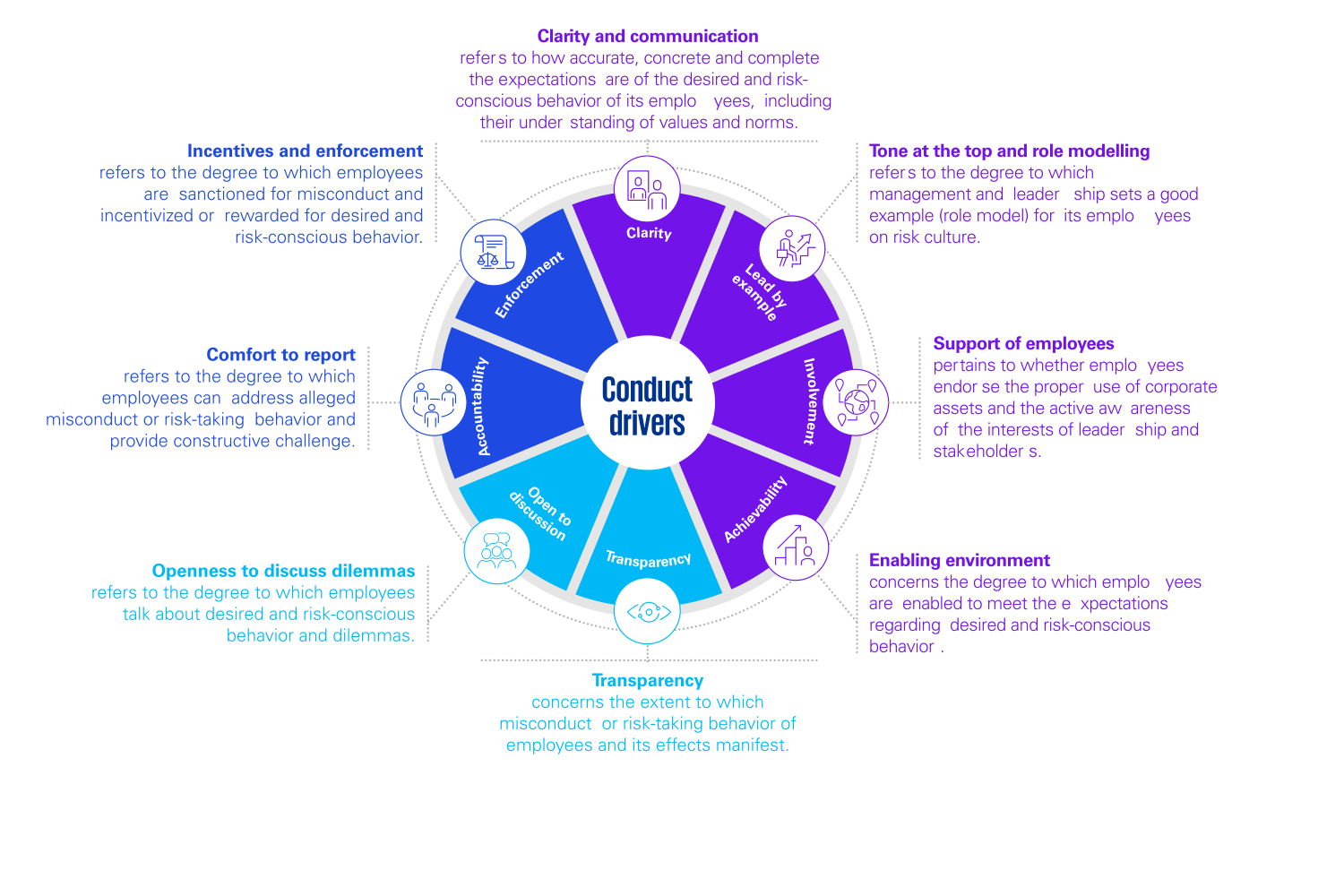
At KPMG, we leverage over 30 years of experience in assessing, measuring, and monitoring the risk culture of financial institutions and leading corporates. Simultaneously, we identify the root causes of incidents within these organizations. Our approach is comprehensive: we start by assessing the risk culture and governance to pinpoint the organization’s strengths and areas for improvement. Once identified, we provide clear and practical recommendations as well as hands-on support for strengthening and maturing the risk culture.
We have the capability and experience to measure, monitor and enhance an organization's risk culture — whether it encompasses the full spectrum or is focused on specific elements — through various established techniques, proven methods, and strategic interventions.
Central to our work is our robust and scientifically validated Risk Culture Model. Adaptors of this model include regulators such as the European and Dutch Central Bank, as well as many other (international) financial institutions and leading corporates in various sectors.