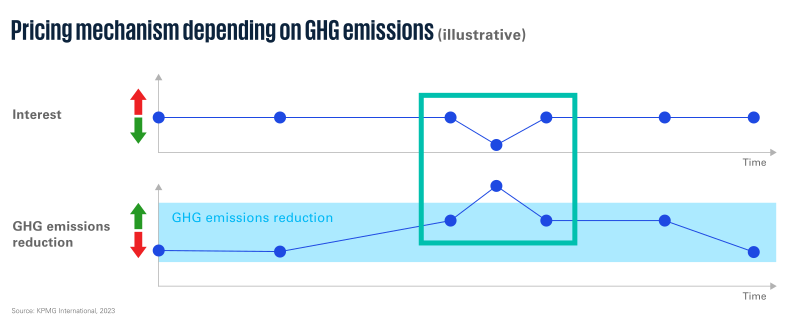
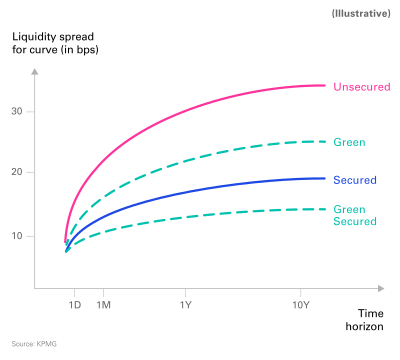
Note: Banks may introduce new green pricing curves, that, in terms of spread levels, may tend more towards existing unsecured or secured curves. Source: KPMG International, 2023
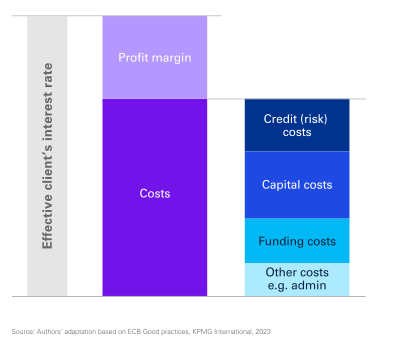
Credit and capital costs need to reflect a range of novel C&E risks. Banks use various performance metrics in loan pricing, such as return on equity (ROE), risk adjusted return on equity (RAROE) and risk adjusted return on risk adjusted capital (RARORAC). These metrics typically incorporate credit risk and capital-related elements, such as:
- IFRS 9 expected credit losses15 (ECL) and CRR expected losses (EL) in the context of credit risk costs; and
- Economic Capital (ECap) and risk-weighted assets (RWA)-based estimations in the context of capital costs16
The main challenges for integrating C&E risks in these elements via Probability of Default (PD) and Loss Given Default (LGD) are twofold. First, banks need to develop an approach to integrate C&E risk measurement into conventional risk differentiation, while considering different time horizons (e.g., rating horizon versus IFRS 9 lifetime horizon). Second, banks need to overcome the C&E data challenge. Ultimately, banks need to ensure that models and processes adequately reflect C&E risks in a way that avoids under or overpricing loans.
Next steps
Given the EU’s ambition for achieving its Fit-for-55 vision by 2030, we expect supervisors to continue their high intensity focus on climate-related risks over the next 2 to 3 years – gradually widening to include other environmental factors such as natural capital17.
Banks face a significant challenge to integrate C&E risks into their loan pricing frameworks in a robust and reliable manner that increases transparency of lending decisions. Many banks still have a lot of work to do to comply with the mounting pressure from supervisors and other stakeholders.
While considering the progress they have already made, banks should consider creating a roadmap for fully integrating C&E factors into loan pricing. This can be used internally, and in consultation with supervisors, to plan, monitor, and communicate their progress. In KPMG professionals’ view, a high-level roadmap should reflect the following key priorities for banks:
- Align pricing with strategy: Ensure that loan pricing is advancing the bank’s business and risk strategies, helping it to achieve its C&E targets.
- Pursue holistic integration: Integrate C&E factors into all cost elements of loan pricing (capital, credit, funding costs), not just the margin component. Moreover, C&E integration into loan pricing should also take place in conjunction with other bank-wide C&E initiatives, while addressing ECB expectations and relevant regulations. Considering the efforts this requires , some banks start the integration of C&E risks in loan pricing for selected portfolios only, with aim of expanding at a later stage to further C&E-material portfolios.
- Involve stakeholders (internal parties): Engage all relevant teams and functions in planning and implementation. One key group – including (credit) risk management and modelling, treasury, legal, finance and IT – needs to redefine the pricing framework and its controls, processes, and data. The second group – business units and relationship managers – needs to change their day-to-day loan pricing operations to incorporate C&E risks. A joined-up and holistic approach is vital to ensue that C&E risks are assessed appropriately while avoiding double counting.
Achieving the correct pricing of C&E risks can provides tremendous opportunities for early movers in the market, particularly in the current environment of evolving risk management standards and also benefiting from the highest interest rates in more than a decade. Moreover, by getting pricing C&E risks adequately, banks can establish themselves as a reliable partner and financial advisor for clients on their low-carbon transition journey. On the other hand, the late movers shall meanwhile take on comparable C&E-risky business at inappro: priate prices - due to adverse selection. It is therefore essential to clearly understand the potential broader implications for the bank when defining the timing of the roadmap to implement.
Author: Zsuzsanna Tajti, Sr. Manager, Financial Risk Management | Advisory KPMG in Belgium