In a world where buying, using, and throwing away used to be the norm, the circular economy offers a necessary alternative. That was the core message at the recent Power of ESG event, where ESG District, KPMG, and BNP Paribas Fortis explored whether circular business models also make financial sense.
The Power of ESG event in Brussels opened with a first-ever. Carine Vaeremans, CEO of Profacts, presented the results of the ESG District Survey 2025. The study examines how Belgian companies are adapting their ESG strategies to a rapidly changing economic, social, and geopolitical reality. “Business leaders acknowledge that ESG is important, but for many it’s not a top priority,” says Vaeremans. “Sixty percent sit somewhere in the middle: they consider ESG relevant, but their actions don’t yet reflect it.”
Those Belgian companies that do take action are currently focusing primarily on the “E” of ESG: the environment. Vaeremans explains: “Sixty-two percent actively invest in recycling, followed by energy-efficiency measures, optimal resource use, and reducing CO₂ emissions. When we zoom in on the circular economy specifically, 36 percent of companies are working on it today, and another 39 percent plan to launch circular initiatives in the coming year.”

Saving billions
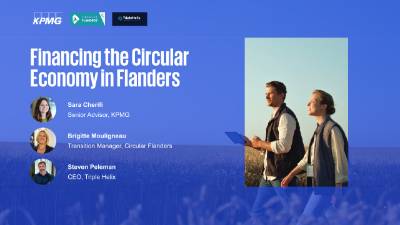
Sara Cherifi, Senior Sustainability Advisor at KPMG, presented a sobering timeline showing that many strategic natural resources could be depleted within a single generation. “The world today is only seven percent circular. Just a fraction of all materials is being recycled. Yet the circular economy offers major economic opportunities. By shifting to circular business models, we can save billions of euros and create millions of jobs,” Cherifi said.
Despite these advantages, the circular economy remains deeply underfunded. According to the Circularity Gap Report Finance by Circle Economy and KPMG, only two percent of global investments flow into circular projects—mostly traditional recycling. “Truly innovative solutions such as ecodesign receive barely any funding, even though they offer the greatest potential impact,” Cherifi noted.
Valley of death
This creates the same reality here as in the rest of the world: the so-called valley of death. Start-ups manage to secure funding for a proof of concept but stumble the moment they try to scale. Brigitte Mouligneau, Transition Manager at Circular Flanders, confirms this. “Today, the circular economy is mostly financed by other companies, business angels, or even family and friends. That’s unsustainable. We need the formal financial sector to scale up.”
To lower the barriers, Circular Flanders works with banks and investors in an expert group focused on circular financing. This group helps align risk models with circular business models, which often differ from classical approaches. “We need to give banks the right tools to accurately assess circular risks,” Mouligneau says.
Stalling or scaling
Still, there are companies today that prove circular business models can work, even if they too often need to re-prove their value to unlock financing. Steven Peleman, founder of Triple Helix, confirms this. His scale-up has developed a method to convert polyurethane into reusable products for the chemical industry.
Triple Helix began with support from friends and family, collecting around €8 million in seed capital and subsidies. Other funding sources are harder to access. “Private equity usually comes in later, venture capital in Belgium is limited, and international VC investors point to the small domestic market as a reason not to invest in Flanders. As a result, promising technologies risk stalling before they can scale,” Peleman says.
More resilience
“For us, the circular economy is a strategic pillar for the future,” says Emmanuelle Bru, Head of Circular Economy at BNP Paribas. “Circularity is essential to achieving climate and nature goals, it strengthens business resilience and it creates new economic opportunities.”
BNP Paribas has been working with a dedicated circular-economy approach since 2017, built around various circular business models. “A clear, consistent framework gives clients the certainty they need and allows us to finance different circular models through our ecosystem of business lines and partners,” Bru explains.
This can include investments in start-ups, loans for second-hand products, and even investment solutions such as a fund focused on the circular economy. Financing circular models also takes place through loans linked to sustainability targets.
Circular solutions
The Power of ESG event concluded with two case studies. With the opening of its new chemical recycling plant in Antwerp, Indaver Plastic2Chemicals has taken a major step toward a circular plastics value chain. “Our facility converts mixed plastic waste into high-quality raw materials. Chemistry isn’t the problem—it’s an essential part of the solution,” emphasizes Erik Moerman, Director Sales & Development. By 2040, Indaver Plastic2Chemicals aims to have the capacity to chemically recycle one million tons of plastic waste annually.
Finally, Claudia Verswyver, Sustainability Lead at A.S.Adventure and Sustainability Professional of the Year 2025, explained how A.S.Adventure is committed to making the textile chain circular. “We don’t just sell new products—we also promote renting, repairing, and reusing them. Our Care & Repair service extends the lifespan of outdoor gear, and since this autumn, customers can also buy second-hand clothing and equipment from us.”
Explore

Connect with us
- Find office locations kpmg.findOfficeLocations
- kpmg.emailUs
- Social media @ KPMG kpmg.socialMedia